CAT Prep / PYQ / CAT 1991

CAT 1991

125 questions with answers and explanations

Take this as a timed mock →

VARC50 questions

Question 77

Choose the statement that expresses the idea most correctly.

Answer & explanation

Correct answer: A

The verb is/are refers to the noun "best part". As the phrase "best part" is singular, 'is' must be used here. Hence, option A is correct.

Question 78

Choose the statement that expresses the idea most correctly.

Answer & explanation

Correct answer: A

The usage of the phrase "as well as" is preceded by a comma. In a sentence where "as well as" is used, the verb must agree with the noun before the "as well as" phrase. Here, the verb was/were refers to the noun 'professor'. As professor is singular, the correct verb to be used here is 'was'. Hence, option A is correct.

Question 79

Choose the statement that expresses the idea most correctly.

Answer & explanation

Correct answer: B

Option A is wrong because two independent clauses are not joined by a conjunction. In option C, the sentence after colon is an independent clause. But, the sentence after colon must be a dependent clause. So, option C is incorrect. The sentence in option D must have a comma after the completion of the dependent clause. Hence it is incorrect. Option B is the correct answer.

Question 80

Choose the statement that expresses the idea most correctly.

Answer & explanation

Correct answer: B

If "one" is used to refer a person in the dependent clause, the same word must also be used in the independent clause. Options A, C and D violate this rule. Option B is the correct answer.

Question 81

Choose the statement that expresses the idea most correctly.

Answer & explanation

Correct answer: B

"Either ... or" and "Neither .... nor" are followed by the verb that agrees with the noun nearest to it. In sentences A, C and D, the verbs do not agree with the nound nearest to it. Hence, option B is the correct answer.

Question 82

Choose the statement that expresses the idea most correctly.

Answer & explanation

Correct answer: A

There are three independent clauses in the sentence. Indepenent clauses can be joined by a conjunction or by using a semicolon. Only option A satisfies this rule.

Question 83

Choose the statement that expresses the idea most correctly.

Answer & explanation

Correct answer: D

In the first two sentences, "their" must replace "his" as there are 2 persons. "Either ... or" and "Neither .... nor" are followed by the verb that agrees with the noun nearest to it. "Ramesh" is the nearest noun to the verb and therefore, the correct verb is "has". Option D is the correct answer.

Question 84

Choose the statement that expresses the idea most correctly.

Answer & explanation

Correct answer: B

Option A contains two independent clauses without a semicolon or a conjunction. "The fact that ..." is the correct usage. Hence, option C is wrong. "Resulted in his having ...." is the correct usage. Option B is the correct answer.

Question 85

Choose the statement that expresses the idea most correctly.

Answer & explanation

Correct answer: C

A comma is not required after the phrase "The people of this company". Only option C satisfies this.

Question 86

Choose the statement that expresses the idea most correctly.

Answer & explanation

Correct answer: D

This sentence has only one clause. Therefore, a comma is not required. Option D is the correct answer.

Question 87

Choose the statement that expresses the idea most correctly.

Answer & explanation

Correct answer: A

The word who/whom refers to the "people". In this context, "who" is the correct usage. It is essential to understand the use of pronouns here. 'Who' and 'Whom' are relative pronouns. However, they are associated differently with personal and possessive pronouns. Whenever the subject is represented via personal pronouns (like he/she/it etc.), 'who' is utilized in the sentence. If the main subject can be replaced by a possessive pronoun (like him/her/his/their etc. ), we use 'whom' in the sentence. You can ask simple questions to understand this concept. For example: You can ask: "Who took my pencil?" You say: "He/She took it" (personal pronouns) You do not say: "Him/Her took it" (possessive pronouns) You can ask: "Whom did you meet yesterday?" You say: "I met him/her yesterday" (possessive pronouns) You do not say: "I met he/she yesterday" (personal pronouns) Hence, sentences wherein 'whom' is followed by/used alongside 'he' is incorrect. Luckily, all the options, except Option A, have this usage and can be easily discarded.

Question 88

Choose the option which contains a mistake.

Answer & explanation

Correct answer: C

The word "felicitate" in the third sentence is used as a verb. But, the word that describes a noun "contacts", must be an adjective. The word used must be "felicitated".

Question 89

Choose the option which contains a mistake.

Answer & explanation

Correct answer: C

"To the perceived problems" is the correct phrase to be used in the sentence since there are multiple problems. Option c) is the correct answer.

Question 90

Choose the option which contains a mistake.

Answer & explanation

Correct answer: C

"The Indian Government's choice" is a singular noun and should have the singular verb "stems". Hence, the sentence in option C is wrong.

Question 91

Choose the option which contains a mistake.

Answer & explanation

Correct answer: D

The quantifier "many" cannot modify a number. The correct quantifier to be used is "most".

Question 92

Choose the option which contains a mistake.

Answer & explanation

Correct answer: B

This is an unreal past condition. So, the verb used must be in the form of past participle. The correct phrase to be used is "you would have definitely".

Question 93

Choose the option which contains a mistake.

Answer & explanation

Correct answer: C

The usage of the word "requires" is wrong here. It must be replaced by "assumes".

Question 94

Choose the option which contains a mistake.

Answer & explanation

Correct answer: D

The verb "invite" does not agree with the singular noun "choice". Hence, the correct usage of the verb is "invites".

Question 95

Choose the option which contains a mistake.

Answer & explanation

Correct answer: C

The words "he then" are not required here. The correct sentence is "Gavaskar was a great batsman who having played more than 100 test matches, decided to call it a day".

Question 96

Choose the option which contains a mistake.

Answer & explanation

Correct answer: A

"Sold of" must be replaced by "sold off". The remaining sentences are correct. Option a) is the correct answer.

Question 97

Choose the option which contains a mistake.

Answer & explanation

Correct answer: C

'Minority' should take the verb 'has been'. On the other hand, the word 'minorities' take the verb 'have been'. Option c) is the correct answer.

Question 98

Choose the option which contains a mistake.

Answer & explanation

Correct answer: C

The use of the word "ambitious" is redundant since the word 'aspiring' has already been used. Only one of the two words has to be used in the third sentence. Option c) is the correct answer.

Question 99

Select the correct sequence of the four sentences given below. A. And that the pursuit of money by whatever design within the law is always benign. B. And it holds broadly that the greater the amount of money, the greater the intelligence. C. This is the institutional truth of Wall Street, this you will be required to believe. D. The institutional truth of the financial world holds that association with money implies intelligence.

Answer & explanation

Correct answer: C

D introduces the paragraph. B elaborates on the idea mentioned in D. So, B follows D. This is then followed by A, which continues the idea of D-B. C is the concluding sentence. The correct order of sentences is DBAC. Option c) is the correct answer.

Question 100

Select the correct sequence of the four sentences given below. A. Then think of by how much our advertising could increase the sales level. B. Advertising effectiveness can be best grasped intuitively on a per capita basis. C. Overall effectiveness is easily calculated by considering the number of buyers and the cost of advertising. D. Think of how much of our brand the average individual is buying now.

Answer & explanation

Correct answer: C

B is the best opening sentence - it introduces the topic of the paragraph, advertising. This is followed by C which talks about the overall effectiveness and then by D which talks about individual effectiveness. The last sentence is A. Option c) is the correct answer.

Question 101

Select the correct sequence of the four sentences given below. A. The age of pragmatism is here, whether we like it or not. B. The staple rhetoric that was for so long dished out also belongs to the bipolar world of yesterday. C. The old equations, based on the cold war and on non-alignment no longer holds good. D. But contrary to much of what is being said and written, it is a multipolar rather than unipolar world that appears to be emerging out of recent events.

Answer & explanation

Correct answer: C

A is the best opening sentence. It introduces the topic of the paragraph - the age of pragmatism. This is followed by D, which talks about an observation that is against expectations. This is further explained in B. So, B follows D. The concluding sentence is C. So, the order of sentences is ADBC. Option c) is the correct answer.

Question 102

Select the correct sequence of the four sentences given below. A. Past research has uncovered the fact that cognitive age is inversely related to life satisfaction among the elderly. B. A person may feel young or old irrespective of chronological age. C. That is, the younger an elderly person feels, the more likely she or he is to be satisfied with life in general. D. Cognitive age is a psychological construct that refers to one's subjective assessment of one's age.

Answer & explanation

Correct answer: B

The opening sentence is D. It introduces the topic of the paragraph - cognitive age. This is followed by B which continues the idea of cognitive age. Next is A, which talks about a past research finding. A is then followed by C, which explains the result in sentence A. The correct order of sentences is DBAC. Option b) is the correct answer.

Question 103

Select the correct sequence of the four sentences given below. A. It was a fascinating tempting green, like the hue of the great green grasshopper. B. Her teeth were very white and her voice had a cruel and at the same time a coaxing sound. C. While she was uncorking the bottle I noticed how green her eyeballs were. D. I saw, too, how small her hands were, which showed that she did not use them much.

Answer & explanation

Correct answer: C

The opening sentence of the paragraph is C - it introduces the person being talked about in the paragraph. This is followed by sentence A. It continues talking about the 'eyeballs' mentioned in C. From the options, we see that the only possibility is option c).

Question 104

Select the correct sequence of the four sentences given below. A. By intelligence we mean a style of life, a way of behaving in various situations, and particularly in new, strange and perplexing situations. B. When we talk about intelligence, we do not mean the ability to get a good score on a certain kind of test, or even the ability to do well at school. C. The true test of intelligence is not how to do, but how we behave when we don't know what to do. D. These are at best only indicators of something large, deeper and far more important.

Answer & explanation

Correct answer: A

The best opening sentence is B. It introduces the topic of the paragraph - intelligence. This is followed by D. The word 'these' in sentence D refers to the tests in sentence B. Next is sentence A, which talks about what intelligence actually means. The concluding sentence is C. The correct order of sentences is BDAC.

Question 105

Select the correct sequence of the four sentences given below. A. In formal speech, syllables are likely to be more deliberately sounded than in informal speech. B. Yet dictionary editors have no choice but to deal with each word as an individual entity. C. The pronunciation of words is influenced by the situation. D. Further, the pronunciation of a word is affected by its position in the sentence and by the meaning it carries.

Answer & explanation

Correct answer: D

C is the opening sentence of the paragraph. It introduces the topic of the paragraph - punctuation. This is followed by sentence A. It continues the idea mentioned in C and talks about how the punctuation is affected in formal speech. This is followed by D which talks about a different situation in which punctuation is affected. The concluding sentence is B. So, the correct order of sentences is CADB.

Passage for questions 106111

Each of these questions contains a sentence followed by four choices. Select from among these choices the one which most logically completes the idea contained in the given sentence.

Question 106

Particularly today, when so many difficult and complex problems face the human species, the development of broad

Answer & explanation

Correct answer: D

To solve such difficult and complex problems, broad and powerful thinking is needed. Moral values cannot guarantee solution to complex problems. Broad shoulders cannot tackle problem pertaining to human species. Option B is negative and is not suitable. Hence, option D is the correct answer.

Question 107

In the European Community countries there has been talk of an energy tax to raise funds

Answer & explanation

Correct answer: D

As the sentence in the question talks about energy tax to raise funds, it must be for some activity which will help them come out of the energy constraints. Thus, Option D is the best fit as the concluding part.

Question 108

"Look before you leap", reflects an attitude expressed in such a saying as

Answer & explanation

Correct answer: A

The idiom "look before you leap means "to consider the possible consequences before committing to an action". The idiom "forewarned is forearmed" means knowing possible difficulties and dangers earlier will give one a tactical advantage. Both these idioms have a common attitude that being prepared for a possible danger is to ones advantage. Thus, option A is the right choice.

Question 109

This is the ancient kingdom of Sumeria and you are its venerated ruler. The fate of Sumeria’s economy and of your royal subjects

Answer & explanation

Correct answer: C

From the context we can infer that the speaker is talking to the King of Sumeria. As the King the duty to protect his subjects and ensure the economic prosperity of the kingdom will be the duty of the King. Thus, option C which reflects the same is the best choice among the options.

Question 110

Furthermore, to be radical means to be ready and willing to break with the predominant cultural, political and social beliefs and values in order to

Answer & explanation

Correct answer: D

The sentence talks about breaking with the predominant cultural, political and social beliefs and values. In order to reconstruct something, the thing should first be broken. Thus, D logically follows the sentence. Sentence A is incorrect as it is vague. B is also incorrect as there is no talks of malaise in the society in the sentence. C can also be eliminated for the same reason as B.

Question 111

Entrepreneurs are never satisfied with the status quo, they are intent on shaping the future, rather than being shaped by it. As one Chief Executive once said

Answer & explanation

Correct answer: B

The given sentence talks about how entrepreneurs are never satisfied and they are always looking for something more innovative to shape the future. The quote used by the executive should be in line with this idea. C is completely unrelated to this while A distorts the meaning. Among B and D, the former one is a better choice because D talks about the business aspects which is nowhere implied in the given sentence. Hence B is the correct answer.

Question 112

Select the set in which the statements are logically related. A. No attendants are qualified. B. Some nurses are qualified. C. Some nurses are not qualified. D. All nurses are attendants. E. All attendants are qualified. F. Some attendants are qualified.

Answer & explanation

Correct answer: C

Sequence BDF is the most appropriate since if some nurses are qualified and if all nurses are attendants, then some attendants will also be qualified.This can be seen from the following figure:

Question 113

Select the set in which the statements are logically related. A. Mary is John's wife. B. Mary and John danced together. C. Mary wears John's ring. D. Husband and wives danced the last waltz. E. John loves Mary. F. John danced last with Mary.

Answer & explanation

Correct answer: A

AD will give the following figure which will have F as the conclusion.

Question 114

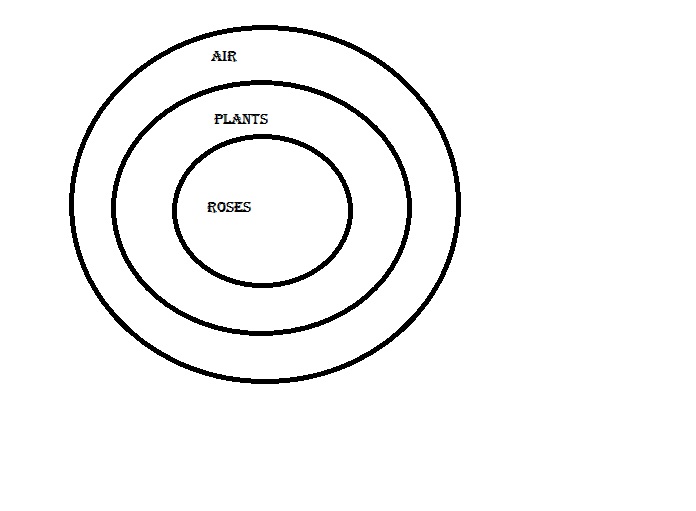
Select the set in which the statements are logically related. A. All roses are fragrant. B. All roses are majestic. C. All roses are plants. D. All plants need air. E. All roses need air. F. All plants need water.

Answer & explanation

Correct answer: C

Based on the Venn diagram shown below, option C is the correct option. ie

"All roses are plants" and "All plants need air" implies "All roses need air".

Question 115

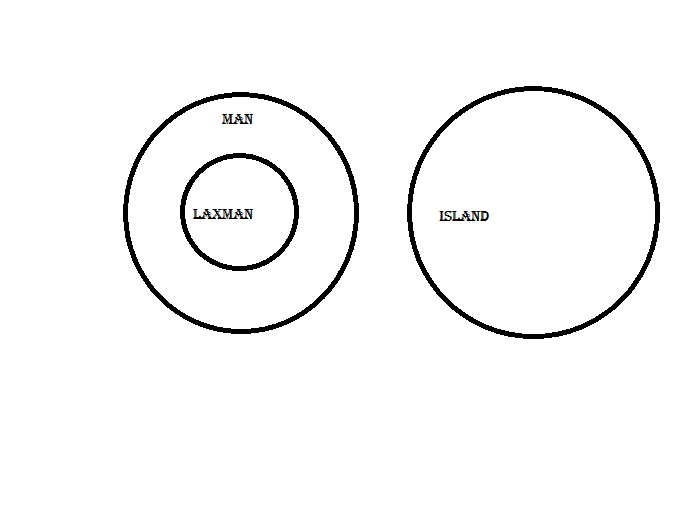
Select the set in which the statements are logically related. A. Laxman is a man. B. Meera is Laxman's wife. C. Some women are islands. D. No man is an island. E. Meera is not an island. F. Laxman is not a island.

Answer & explanation

Correct answer: C

Based on the Venn diagram below, Option C is the correct option. ie "Laxman is a man" and "No man is an island" imply that "Laxman is not an Island"

Question 116

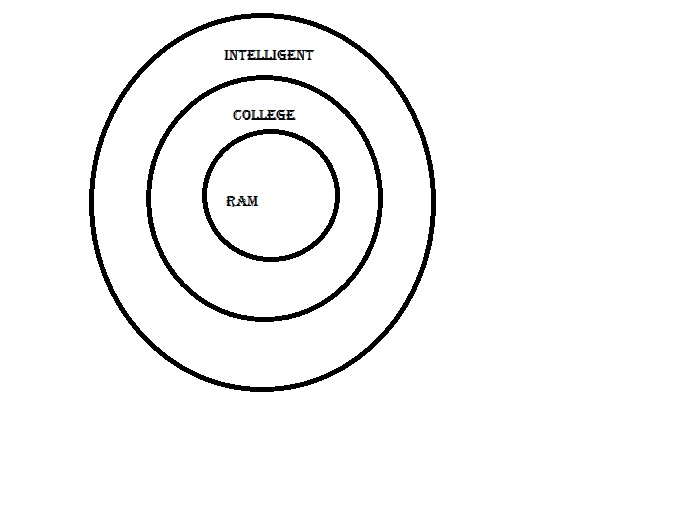
Select the set in which the statements are logically related. A. College students are intelligent. B. Intelligence is a collegian's attribute. C. Ram's sister is a college student. D. Ram goes to college. E. All intelligent persons go to college. F. Ram is an intelligent person.

Answer & explanation

Correct answer: A

Based on the Venn diagram below, option A is correct ie If "All college students are intelligent" and "Ram goes to college" are true then it holds that " Ram is an intelligent person".

Question 117

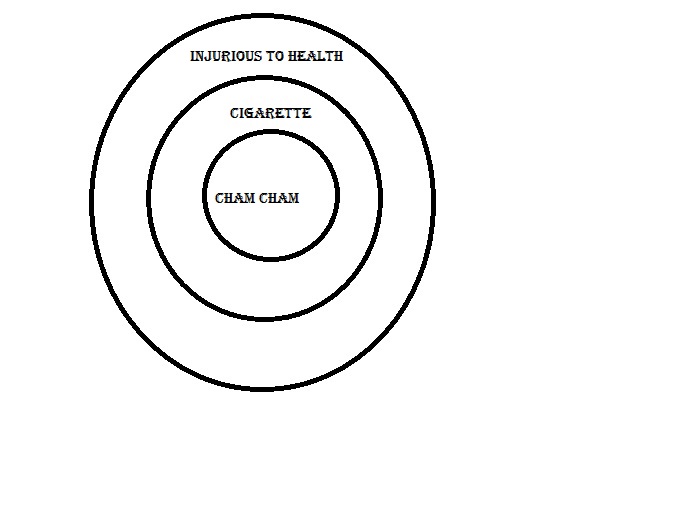
Select the set in which the statements are logically related. A. Smoking causes cancer. B. All cigarettes are hazardous to health. C. Smoking doesn't cause cancer sometimes. D. One brand of cigarettes is cham - cham. E. Brand X causes cancer. F. Cham-cham is bad for health.

Answer & explanation

Correct answer: B

Based on the Venn Diagram below, If all cigarettes are injurious to health and if Cham cham is a cigarette, then it implies that Cham cham is injurious to health.

Question 118

Select the set in which the statements are logically related. A. All good bridge players play good chess. B. Many good chess players are not bridge players. C. Goren is a good bridge player. D. Goren plays chess well. E. Spassky plays chess well. F. Spassky plays bridge badly.

Answer & explanation

Correct answer: D

AC will have the following figure which will have D as the conclusion.

Question 119

Select the set in which the statements are logically related. A. All snakes are reptiles. B. All reptiles are not snakes. C. All reptiles are cold blooded. D. All snakes lay eggs. E. All reptiles lay eggs. F. Snakes are cold blooded.

Answer & explanation

Correct answer: D

ACF will give the following Venn diagram which will give F as the correct conclusion for the premise AC.

Question 120

Select the set in which the statements are logically related. A. All leaves are green. B. All leaves have chlorophyll. C. Chlorophyll is green. D. All plants have leaves. E. All plants have chlorophyll. F. Only leaves have chlorophyll.

Answer & explanation

Correct answer: A

BDE will give the following Venn diagram which will give E as the conclusion for the premise BD.

From statements B and D we can infer E.

BEF is contradictory pair.

F is a false assumption in the pair BDF.

Question 121

Select the set in which the statements are logically related. A. Some men are bald. B. Bald people are intelligent. C. Raman is a man. D. Raman is bald. E. Raman is intelligent. F. All men are intelligent.

Answer & explanation

Correct answer: B

BD from the following Venn diagram has E as the conclusion.

Question 122

Select the set in which the statements are logically related. A. No barbarian is gentleman. B. Some gentlemen are barbarians. C. Some gentlemen are rude. D. No gentlemen are rude. E. Some barbarians are not rude. F. All barbarians are rude.

Answer & explanation

Correct answer: D

BD from the following figure gives E as the conclusion.

Question 123

Select the set in which the statements are logically related. A. Metal is good material for desks. B. Desks are made of metal. C. This object is not a desk. D. This object is a desk. E. This object is not made of metal. F. This is made of metal.

Answer & explanation

Correct answer: D

BDF has the below given Venn diagram from which we can see that F is the conclusion for the premise BD.

Question 124

Select the set in which the statements are logically related. A. Mathew and Paul are brothers. B. Siblings are known to quarrel often. C. Mathew and Paul don.t quarrel. D. All those who quarrel are siblings. E. Paul and Mathew quarrel often. F. Mathew and Paul cannot be siblings.

Answer & explanation

Correct answer: D

The premise AB gives E as the conclusion which can be seen from the following figure:

Question 125

Select the set in which the statements are logically related. A. Painting and music is art. B. Art is symptom of culture. C. Culture and art are complementary. D. Music is a form of art. E. Painting is a form of art. F. Music shows culture.

Answer & explanation

Correct answer: A

The premise BD gives F as the conclusion which can be seen from the following Venn diagram:

Question 126

Select the set in which the statements are logically related. A. Different hues are obtained from primary colours. B. A rainbow consists of several hues. C. Blue and red can give different hues. D. Red is a primary color. E. Blue can give different hues. F. Red can give different hues.

Answer & explanation

Correct answer: C

From the below given Venn diagram, we can see that F is the conclusion of ADF All the other options are not logically related. In ACE : CE are reiterated, A is unrelated to CE In AEF : All three statements are facts. In CDF: C and F are reiterated.

DILR25 questions

Passage for questions 5256

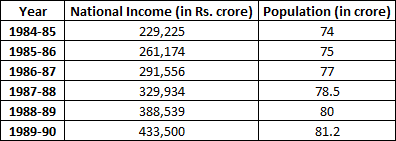
The following table gives the national income and the population of a country for the years 1984 – 85 to 1989 – 90. For each of the following questions choose the best alternative:

Question 52

The increase in the per capita income compared to the previous year is lowest for the year :

Answer & explanation

Correct answer: B

For increment in 1986-87, denominator is increased by 2 whereas in every other year it is either increased by 1 or 1.5 Since numerator has increased by 30, which is similar to that of other years, we can say lowest increment occur in the year 1986-1987.

Question 53

The per capita income is highest for the year :

Answer & explanation

Correct answer: D

The per capita of each of the following years is given below. 1984-85 is Rs. 3,098 1985-86 is Rs. 3,482 1986-87 is Rs. 3,786 1987-88 is Rs. 4,203 1988-89 is Rs. 4,857 1989-90 is Rs. 5,319 Hence, the percapita income is highest for the year 1989-90

Question 54

The difference between the percentage increase in per capita income and the percentage increase in the population compared to the previous year is highest for the year:

Answer & explanation

Correct answer: D

The per capita of each of the following years is given below. 1984-85 is Rs. 3,098 1985-86 is Rs. 3,482 (increased by 12.42%) 1986-87 is Rs. 3,786 (increased by 8.73%) 1987-88 is Rs. 4,203 (increased by 11.00%) 1988-89 is Rs. 4,857 (increased by 15.55%) 1989-90 is Rs. 5,339 (increased by 9.92%) The percentage increase in population over the years is fairly constant and varied between 1% and 2%. But the percentage increase in GDP per capita in the year 1988-89 is significantly higher. Hence, the correct answer is 1988-89

Question 55

The rate of increase in population was lowest in the year:

Answer & explanation

Correct answer: A

The population increase for the year 1985-86 from the year 1984-85 is just one crore. In every other year, the population increase was either 1.5 crore of 2 crores. Note that the denominators for each of the years (ie total population) is fairly same. Hence, the correct answer is 1985-86

Question 56

Increase in the per capita income compared to the previous year among the years given below was highest for the year:

Answer & explanation

Correct answer: D

The per capita of each of the following years is given below. 1984-85 is Rs. 3,098 1985-86 is Rs. 3,482 (increased by Rs. 384) 1986-87 is Rs. 3,786 (increased by Rs. 304) 1987-88 is Rs. 4,203 (increased by Rs. 416) 1988-89 is Rs. 4,857 (increased by Rs. 653) 1989-90 is Rs. 5,339 (increased by Rs. 481) Hence, the increase is highest for the year 1988-89

Passage for questions 5761

Read the following information and answer the questions that follows: Ghosh Babu deposited a certain sum of money in a bank in 1986. The bank calculated interest on the principal at 10 percent simple interest, and credited it to the account once a year. After the 1st year, Ghosh Babu withdrew the entire interest and 20% of the initial amount. After the 2nd year, he withdrew the interest and 50% of the remaining amount. After the 3rd year, he withdrew the interest and 50% of the remaining amount. Finally after the 4th year, Ghosh Babu closed the account and collected the entire balance of Rs. 11,000.

Question 57

The initial amount in rupees, deposited by Ghosh Babu was:

Answer & explanation

Correct answer: C

Let's say the principal amount is P, Rate is R. 1st withdrawal = $$PR+ \frac{P}{5}$$ Remaining money = $$\frac{4P}{5}$$ 2nd withdrawal = $$(\frac{4PR}{5} + \frac{2P}{5})$$ Remaining money = $$\frac{2P}{5}$$ 3rd withdrawal = $$\frac{2PR}{5} + \frac{P}{5}$$ Remaining money = $$\frac{P}{5}$$ 4th withdrawal = $$\frac{P}{5} + \frac{PR}{5}$$ = 11000 Or P = 50000 (Putting R = 10%)

Question 58

The year, at the end of which, Ghosh Babu withdrew the smallest amount was:

Answer & explanation

Correct answer: D

Let's say the principal amount is P, Rate is R (i.e. R = 10%) 1st withdrawal = $$PR+ \frac{P}{5} = \frac{15P}{50}$$ 2nd withdrawal = $$\frac{4PR}{5}+ \frac{2P}{5}$$ = $$\frac{24P}{50}$$ 3rd withdrawal = $$\frac{2PR}{5} + \frac{P}{5}$$ = $$\frac{12P}{50}$$ 4th withdrawal = $$\frac{PR}{5} + \frac{P}{5}$$ = $$\frac{11P}{50}$$ Lowest withdrawal was after the fourth year.

Question 59

The year, at the end of which, Ghosh Babu collected the maximum interest was:

Answer & explanation

Correct answer: A

Let's say the principal amount is P, Rate is R (i.e. R = 10%) 1st withdrawal = $$PR+ \frac{P}{5} = \frac{15P}{50}$$ 2nd withdrawal = $$\frac{4PR}{5}+ \frac{2P}{5}$$ = $$\frac{24P}{50}$$ 3rd withdrawal = $$\frac{2PR}{5} + \frac{P}{5}$$ = $$\frac{12P}{50}$$ 4th withdrawal = $$\frac{PR}{5} + \frac{P}{5}$$ = $$\frac{11P}{50}$$ Maximum Interest was after the first year (i.e. PR)

Question 60

The year, at the end of which, Ghosh Babu withdrew the maximum amount was:

Answer & explanation

Correct answer: B

Let's say the principal amount is P, Rate is R (i.e. R = 10%) 1st withdrawal = $$PR+ \frac{P}{5} = \frac{15P}{50}$$ 2nd withdrawal = $$\frac{4PR}{5}+ \frac{2P}{5}$$ = $$\frac{24P}{50}$$ 3rd withdrawal = $$\frac{2PR}{5} + \frac{P}{5}$$ = $$\frac{12P}{50}$$ 4th withdrawal = $$\frac{PR}{5} + \frac{P}{5}$$ = $$\frac{11P}{50}$$ Hence, Maximum withdrawal was after second year.

Question 61

The total interest, in rupees, collected by Ghosh Babu was:

Answer & explanation

Correct answer: A

Let's say the principal amount is P, Rate is R (i.e. R = 10%) 1st Interest = $$PR$$ 2nd Interest = $$\frac{4PR}{5}$$ 3rd Interest = $$\frac{2PR}{5}$$ 4th Interest = $$\frac{PR}{5}$$

Passage for questions 6266

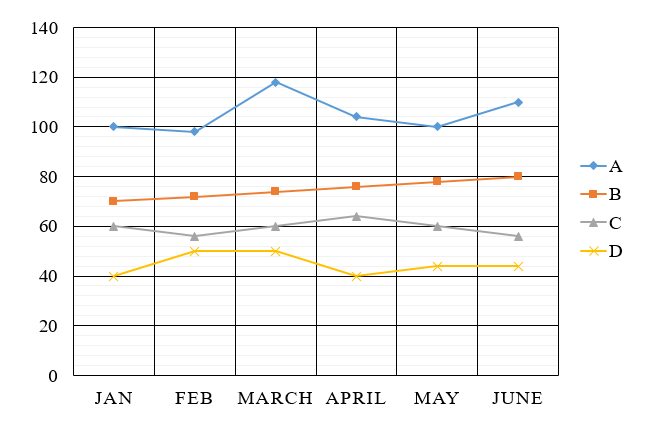
The graph below shows the end of the month market values of 4 shares for the period from January to June. Answer the following questions based on this graph.

Question 62

Which share showed the greatest percentage increase in market value in any month during the entire period?

Answer & explanation

Correct answer: A

For having the greatest percentage change, the slope of the line should be the highest. From the graph, we can see that slope is highest for A between Feb and March. So A is the correct answer.

Question 63

In which month was the greatest absolute change in market value for any share recorded?

Answer & explanation

Correct answer: A

To answer this question, let us calculate the highest increase in market value of each share. For share A, the highest increase in market value is from Feb to March and equals 110 - 90 = 20 For share B, the market value increases constantly over all the months and is equal to 75-70 = 5 For share C, the highest increase in market value is from Feb to March and equals 60 - 55 = 5 For share D, the highest increase in market value is from Jan to Feb and equals 50 - 40 = 10 Hence, the correct answer is March and the required share is share A

Question 64

In which month was the greatest percentage increase in market value for any share recorded?

Answer & explanation

Correct answer: A

To answer this question, let us calculate the highest percentage increase in market value of each share. For share A, the highest percentage increase in market value is from Feb to March and equals 110/90 -1 = 22.22% For share B, the highest percentage increase in market value is from Jan to Feb and equals 75/70 -1 = 7.14% For share C, the highest percentage increase in market value is from Feb to March and equals 60/55 -1 = 9.09% For share D, the highest percentage increase in market value is from Jan to Feb and equals 50/40 -1 = 25% Hence, the required answer is February and the required share is share D

Question 65

Ram gives Shyam a share of C and a share of D and takes a share of A in return. At which month-end would the Ram's loss from this transaction, be the most?

Answer & explanation

Correct answer: D

Loss from the transaction from Ram's standpoint is Sum of share prices of C and D - Share price of A. So, loss from the transaction at the end of January is (40+60) - 100 - = 0 So, loss from the transaction at the end of February is (50+55) - 90= 15 So, loss from the transaction at the end of March is (60+50)-110 = 0 So, loss from the transaction at the end of April is (65+40) - 105 = 0 So, loss from the transaction at the end of May is (60+45) -100 = 5 So, loss from the transaction at the end of June is (55+45) - 110 = 0 So, the correct answer is February.

Question 66

Ram gives Shyam a share of C and a share of D and takes a share of A in return. What is the maximum loss suffered by Ram from this transaction?

Answer & explanation

Correct answer: A

Loss from the transaction from Ram's standpoint is Sum of share prices of C and D - Share price of A. So, loss from the transaction at the end of January is (40+60) - 100 - = 0 So, loss from the transaction at the end of February is (50+55) - 90= 15 So, loss from the transaction at the end of March is (60+50)-110 = 0 So, loss from the transaction at the end of April is (65+40) - 105 = 0 So, loss from the transaction at the end of May is (60+45) -100 = 5 So, loss from the transaction at the end of June is (55+45) - 110 = 0 So, the correct answer is 15

Passage for questions 6771

Use the following information: Prakash has to decide whether or not to test a batch of 1000 widgets before sending them to the buyer. In case he decides to test, he has two options: a) Use test I ; b) Use test II. Test I cost Rs. 2 per widget. However, the test is not perfect. It sends 20% of the bad ones to the buyer as good. Test II costs Rs. 3 per widget. It brings out all the bad ones. A defective widget identified before sending can be corrected at a cost of Rs. 25 per widget. All defective widgets are identified at the buyer's end and penalty of Rs. 50 per defective widget has to be paid by Prakash.

Question 67

Prakash should not test if the number of bad widgets in the lot is:

Answer & explanation

Correct answer: A

We should consider three possible cases as 1. when he is using test 1 2. When he is using test 2 3. When he is using no test Now we will choose a method where the total expenditure will be least. So for option A, let's consider that number of defective pieces are 50. Hence, while using test 1: Cost of testing = $$1000 \times 2 = 2000$$ Correcting 80% of pieces = $$40 \times 25 = 1000$$ Penalty for 20% of pieces = $$10 \times 50 = 500$$ Total = 3500 For test 2: Cost of testing = $$1000 \times 3 = 3000$$ Correcting all 50 pieces = $$ 50 \times 25 = 1250 $$ Total= 4250 For no test: Penalty for all 50 pieces = $$ 50 \times 50 = 2500$$ Hence cost is least when he is using no test while number of defective pieces is less than 100.

Question 68

If there are 120 defective widgets in the lot, Prakash:

Answer & explanation

Correct answer: D

When there are 120 widgets defective: Using 1st test: Cost of testing = $$1000 \times 2 = 2000$$ Cost of correcting 80% pieces = $$96 \times 25 = 2400$$ Cost of penalty on 20% pieces = $$24 \times 50 = 1200$$ Total cost = 5600 Using 2nd test: Cost of testing = $$1000 \times 3 = 3000$$ Cost of correcting all 120 pieces = $$120 \times 25 = 3000$$ Total cost = 6000 Using no test: Total cost = 120 x 50 = 6000 Hence, he should use 1st test only.

Question 69

If the number of defective widgets in the lot is between 200 and 400, Prakash:

Answer & explanation

Correct answer: C

Let's say defective pieces are 300 Using test 1 Cost of testing= $$1000 \times 2 = 2000$$ Cost of correcting 80% pieces = $$240 \times 25 = 6000$$ Cost of penalty on 20% pieces = $$60 \times 50 = 3000$$ Total cost = 11000 Using test 2 Cost of testing = $$1000 \times 3 = 3000$$ Cost of correcting all 300 pieces = $$300 \times 25 = 7500$$ Total cost = 10500 Using no test: Cost of penalty on all pieces = $$300 \times 50 = 15000$$ Hence, he should use 2nd test.

Question 70

If Prakash is told that the lot has 160 defective widgets, he should:

Answer & explanation

Correct answer: A

For 160 defective pieces: Using 1st test: Cost of testing = $$1000 \times 2 = 2000$$ Cost correcting 80% pieces = $$128 \times 25 = 3200$$ Cost of penalty on 20% pieces = $$32 \times 50 = 1600$$ Total = 6800 Using 2nd test: Cost of testing = $$1000 \times 3 = 3000$$ Cost of correcting all pieces = $$160 \times 25 = 4000$$ Total = 7000 Using no test: Cost of penalty on all pieces = $$160 \times 50 = 8000$$ Hence, he should use first test only.

Question 71

If there are 200 defective widgets in the lot, Prakash:

Answer & explanation

Correct answer: A

When there are 200 defective pieces: Using test 1 Cost of testing= 2000 Cost of correcting 80% pieces = 4000 Cost of penalty on 20% pieces = 2000 Total = 8000 Using test 2 Cost of testing = 3000 Cost of correcting all pieces = 5000 Total = 8000 Using no test Cost of penalty on all pieces= 10000 Hence he can use either 1st test or second test.

Passage for questions 7276

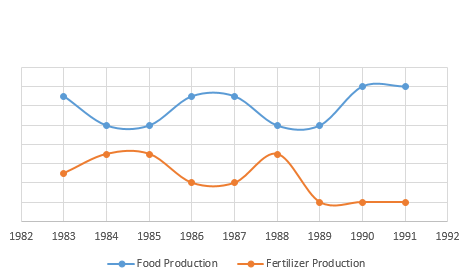
Study the following graph and answer questions that follow. The x-axis denotes the years from 1983 to 1991

Question 72

The sum of food and fertilizer production has shown a constant value for how many years?

Answer & explanation

Correct answer: D

In order to find the number of years for which the sum is same, we need to determine the change in production of food and fertilizer. If there is no effective change, then the sum of their productions is same. Change in 1984 => +1 - 1.5 = -0.5 Change in 1985 => 0 Change in 1986 => -1.5 + 1.5 = 0 Change in 1987 => 0 Change in 1988 => +1.5 - 1.5 = 0 Change in 1989 => -2.5 + 0 = -2.5 Change in 1990 => 0 + 1.5 = 1.5 Change in 1991 => 0 The change is 0 in 5 years. Hence, the answer is option D.

Question 73

If in 1988, the sum of the food and fertilizer production was 170 million tonnes, the value of food production must have been (approximately, in million tonnes) .

Answer & explanation

Correct answer: C

From the graph, in the year 1988, the ratio of food production to fertilizer production is 5:3.5 i.e 10:7 Let the food production be 10X and the fertilizer production be 7X Hence, the total is 10X+7X = 17X which equals 170 So, X = 10 and the total food production equals 10*10 = 100

Question 74

From its apparent behaviour, the food production in year 1992 can be expected to .

Answer & explanation

Correct answer: D

Just by looking at the graphs of the previous year's it is difficult to guess how the food production in the year 1992 will be. This is especially true as we don't have any information about the fertilizer production in the year 1992. Hence, the correct answer is option (d)

Question 75

Going according to previous trends, one can say that the Fertilizer Production has shown an anomalous behavior in which year?

Answer & explanation

Correct answer: D

The fertilizer and food production has been inversely proportional over the years. ie when food production increased, fertilizer production fell and vice versa. But as we can see in 1988-89, when food production remained constant, the fertilizer production fell steeply and in 89-90 when food production increased steeply, the fertilizer production stayed constant. So, 1989 is the year of the anamoly.

Question 76

A scholar observed that if the production of fertilizers in 1989 had been the same as that in 1988, then the total fertilizer production for all the given years would have been 450 million tonnes. Using this information, and knowing that the food production has been plotted on the same scale, one may say that the food production in 1983 was (approximately, in million tonnes) .

Answer & explanation

Correct answer: B

Let each unit in the scale be equal to X So, fertilizer production in 1983 is 2.5X So, fertilizer production in 1984 is 3.5X So, fertilizer production in 1985 is 3.5X So, fertilizer production in 1986 is 2X So, fertilizer production in 1987 is 2X So, fertilizer production in 1988 is 3.5X Assuming fertilizer production in 1989 is same as that of 1988 it equals 3.5X So, fertilizer production in 1990 is X So, fertilizer production in 1991 is X Hence, the total is 22.5X But this equals 450 million tonnes. Hence, X = 20 million tonnes Therefore, food production in 1983 = 6.5X equals 130 million tonnes

QA50 questions

Question 2

Is it more profitable for Company M to produce Q? I. Product R sells at a price four times that of Q II. One unit of Q requires 2 units of labour, while one unit of R requires 5 units of labour. There is a no other constraint on production.

Answer & explanation

Correct answer: C

Taking only 1st statement into consideration, nothing certain can be said about product Q Similarly with the only 2nd statement, we have only 1 information about product Q and R. But considering both statements together we can say with sufficient information that product R will be more beneficial than product Q

Question 3

A train started from Station A, developed engine trouble and reached Station B, 40 minutes late. What is the distance between Stations A and B? I. The engine trouble developed after travelling 40 km from Station A and the speed reduced to 1/4th of the original speed. II. The engine trouble developed after travelling 40 km from station A in two hours and the speed reduced to 1/4th of the original speed.

Answer & explanation

Correct answer: B

Using first statement alone, we won't be able to find distance as insufficient data is there. Now using second statement alone, we can find distance d as follows: velocity before engine failure = $$\frac{40}{2}$$ = 20 km/h and after engine failure = 5 km/hr And we know total time exceeds 45 min. Hence 2 + $$\frac{d}{5}$$ = $$\frac{40}{60}$$ + $$\frac{40+d}{20}$$ or $$d = \frac{40}{9}$$ km.

Question 4

What is the value of prime number x? I. $$x^2 + x$$ is a two-digit number greater than 50 II. $$x^3$$ is a three digit number.

Answer & explanation

Correct answer: A

Considering 1st statement alone, $$x^2 + x$$ is greater than 50, a two digit number and x is a prime number, then it has to be 7. On the other hand, we cannot uniquely determine the value of x using statement B alone. Option a) is the correct answer.

Question 5

The average of three unequal quotations for a particular share is Rs.110. If all are quoted in integral values of rupee, does the highest quotation exceed Rs. 129? I. The lowest quotation Rs. 100. II. One of the quotations is Rs. 115.

Answer & explanation

Correct answer: A

As Avg. of 3 quotations is 110, so the sum of them will be 330 Now considering 1st statement alone, if the lowest quotation is 100, then highest can not exceed 129 because then the sum of all three will exceed from 330. So we can get the answer by considering the first statement only.

Question 6

How many people ( from the group surveyed ) read both Indian Express and Times of India? I. Out of total of 200 readers, 100 read Indian Express, 120 read Times of India and 50 read Hindu. II. Out of a total of 200 readers, 100 read Indian Express, 120 reads Times of India and 50 read neither.

Answer & explanation

Correct answer: B

Considering first statement only, given information will not suffice to answer that how many people read both Indian express and Times of India as data regarding intersection of all and data regarding number of people reading other 2 newspapers is not given Now if we consider only second statement then we can answer about people reading both Indian express and Times of India as follows: Total readers = 200 = 100 (indian express) + 120 (Times of india) + 50 (Reading none) - Reading both. So Reading both newspapers = 270-200 = 70

Question 7

X says to Y, 'I am 3 times as old as you were 3 years ago'. How old is X? I. Y's age 17 years from now is same as X.s present age. II. X's age nine years from now is 3 times Y.s present age.

Answer & explanation

Correct answer: A

Given information X=3(Y-3) Now considering first statement alone, we will have following equation: Y+17 = X On solving two eq. we can find the value of X. Hence answer will be A.

Question 8

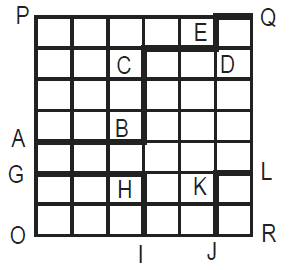
What is the area under the line GHI-JKL in the given quadrilateral OPQR, knowing that all the small spaces are squares of the same area? I. Length ABCDEQ is greater than or equal to 60. II. Area OPQR is less than or equal to 1512.

Answer & explanation

Correct answer: C

Let the side of the smallest square be x. According to statement 1,$$10x\geqslant 60$$ $$x\geqslant 6$$ According to statement 2, $$7x*6x\leq 1512$$ $$x\leq 6$$ From both the statements x = 6 and the answer can be determined.

Question 9

What is the radius of the circle? I. Ratio of its area to circumference is > 7. II. Diameter of the circle is <=32.

Answer & explanation

Correct answer: D

Considering the first statement only, we will get radius > 14. Hence, we can't find the value of radius with this information only. Now considering the second statement only, we will get radius <= 16.​Hence, we can't find the value of radius with this information only. Now considering both statements simultaneously, we can't find an absolute value of radius. Hence, answer will be D

Question 10

What is the time difference between New York and London? I. The departure time at New York is exactly 9.00 a.m local time and the arrival time at London is at 10.00 a.m. local time. II. The flight time is 5 hours.

Answer & explanation

Correct answer: C

Considering first and second statement alone, we can't say about time difference as information will not be sufficient. Now considering both statements together, we can say that if journey duration is of 5 hours and flight departure time is 9:00 a.m., arrival time according to new york will be 2:00 p.m. but it is given that in London, arrival time is 10:00 a.m. Hence, the time difference will be of 4 hours between NewYork and London.

Question 11

Mr. Murthy takes the morning train to his office from station A to station B, and his colleague Mr.Rahman joins him on the way. There are three stations C, D and E on the way not necessarily in that sequence. What is the sequence of stations? I. Mr. Rahman boards the train at D. II. Mr. Thomas, who travels between C & D has two segments of journey in common with Mr. Murthy but none with Mr. Rahman.

Answer & explanation

Correct answer: C

Considering first statement and second statement alone, information will not suffice to find the sequence of stations, But if we consider both statements together we can tell about the sequence of stations as between A and B, Mr. Thomas travels with Mr. Murthy but not with Mr. Rahman. That means Mr. Thomas must have departed from station C and arrived at station D. And it is also given that between C and D there are two segments. Hence, E lies between C and D, and Mr. Rahman departed from station D.

Question 12

A function can sometimes reflect on itself, i.e. if y = f(x), then x = f(y). Both of them retain the same structure and form. Which of the following functions has this property?

Answer & explanation

Correct answer: B

Putting y as x and x as y in given options, only options B satisfies the function property as follows. x = $$\frac{2y+3}{3y-2}$$ or 3xy - 2x = 2y+3 or y(3x-2) = 2x+3 or $$y = \frac{2x+3}{3x-2}$$

Question 13

What is the value of k for which the following system of equations has no solution: 2x-8y = 3 and kx +4y = 10

Answer & explanation

Correct answer: C

On solving both equations, we will get $$x = \frac{23}{2+2k}$$ now for having no solutions to system 2+2k should be 0. Hence k=-1

Question 14

How many 3 - digit even number can you form such that if one of the digits is 5, the following digit must be 7?

Answer & explanation

Correct answer: C

For a number to be even, its unit digit should be 0,2,4,6,8 Case 1: One of the digit is 5 Hence according to question, 5 can't come in middle and at unit's place, so numbers will be 570,572,574,576,578. Case 2: No digit is 5 Hence the hundreds place can be filled in 8 ways (except 0,5) and tens place can be filled in 9 ways (except 5). Number of ways = 8 * 9 * 5 = 360 Hence total number of ways = 360 + 5 = 365

Question 15

Alord got an order from a garment manufacturer for 480 Denim Shirts. He brought 12 sewing machines and appointed some expert tailors to do the job. However, many didn't report to duty. As a result, each of those who did, had to stitch 32 more shirts than originally planned by Alord, with equal distribution of work. How many tailors had been appointed earlier and how many had not reported for work?

Answer & explanation

Correct answer: C

Suppose he appointed x persons and y of them didn't come. Hence work done by each of them increases by 32. So $$\frac{480}{x-y} - \frac{480}{x} = 32$$ Now we can check options by putting in the above eq. x=10 and y=4 will be our answer

Question 16

Iqbal dealt some cards to Mushtaq and himself from a full pack of playing cards and laid the rest aside. Iqbal then said to Mushtaq. "If you give me a certain number of your cards, I will have four times as many cards as you will have. If I give you the same number of cards, I will have thrice as many cards as you will have". Of the given choices, which could represent the number of cards with Iqbal?

Answer & explanation

Correct answer: B

Let's say Iqbal has x cards initially and Mushtaq has y number of cards initially. So first Mushtaq gave t cards to Iqbal, hence (x+t) = 4(y-t) Now second time, Iqbal gave t cards to Mushtaq, hence x-t = 3(y+t) Solving above two equations we will get x=31t and y=9t And we know x+y<52 hence 40t<52 because t should be a whole number it will be 1 here and x=31 and y=9

Question 17

Fifty college teachers are surveyed as to their possession of colour TV, VCR and tape recorder. Of them, 22 own colour TV, 15 own VCR and 14 own tape recorders. Nine of these college teachers own exactly two items out of colour TV, VCR and tape recorder; and, one college teacher owns all three. How many of the 50 teachers own none of the three, colour TV, VCR or tape recorder?

Answer & explanation

Correct answer: C

Number of people owning exactly 2 articles = 9 Number of people owning exactly 3 articles = 1 Applying AUBUC formula, we get AUBUC = 22+15+14 - 9 -2*(1)=40 Number of people who do not own any article = 50-40 = 10

Question 18

Three times the first of three consecutive odd integers is 3 more than twice the third. What is the third integer?

Answer & explanation

Correct answer: A

Suppose consecutive odd integers are: (a-2), a, (a+2) Hence, 3a-6 = 2(a+2) + 3 => a=13 a+2 = 15

Question 19

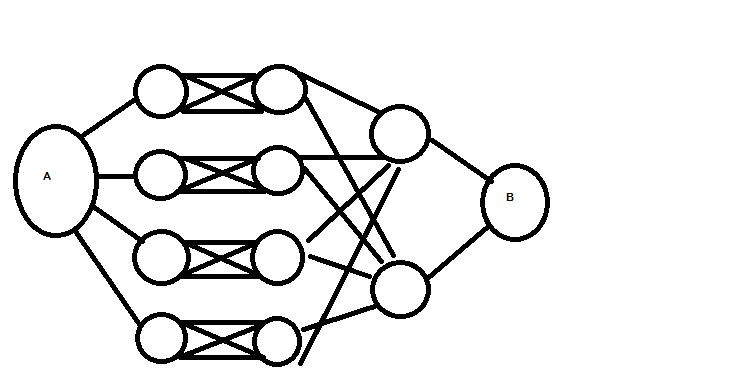
What is the total number of ways to reach A to B in the network given, such that no node is included twice and one can only move from left to right?

Answer & explanation

Correct answer: B

4 first level nodes are connected to A => 4 ways. Each of these first level nodes are connected to 1 second level node by four connections => 4 ways Each of these second level nodes are connected to 2 third level nodes => 2 ways. Each of these third level nodes are connected to B by 1 route => 1 way => 4 * 4 * 2 * 1 = 32 ways.

Question 20

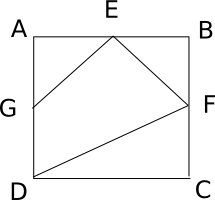
Let the consecutive vertices of a square S be A,B,C &D. Let E,F & G be the mid-points of the sides AB, BC & AD respectively of the square. Then the ratio of the area of the quadrilateral EFDG to that of the square S is nearest to

Answer & explanation

Correct answer: A

Let the side of the square be 1 cm

So, area of triangle AGE = 1/2 * 1/2 * 1/2 = 1/8

Similarly, area of triangle EBF = 1/8

Area of triangle DFC = 1/2 * 1 * 1/2 = 1/4

Area of the square = 1*1 = 1

So, area of the quadrilateral = 1 - (1/8 + 1/8 + 1/4) = 1 - 1/2 = 1/2

Option a) is the correct answer.

Question 21

$$2^{73}-2^{72}-2^{71}$$ is the same as

Answer & explanation

Correct answer: C

$$2^{71} (2^2 - 2^1 - 1)$$ $$2^{71} (4-2-1)$$ $$2^{71}$$

Question 22

The number of integers n satisfying -n+2 ≥ 0 and 2n ≥ 4 is

Answer & explanation

Correct answer: B

-n+2 >= 0 or n<=2 and 2n>=4 or n>=2 So we can take only one value of n i.e. 2

Question 23

The sum of two integers is 10 and the sum of their reciprocals is 5/12. Then the larger of these integers is

Answer & explanation

Correct answer: C

let's say integers are x and y so x+y = 10 => y = 10 - x and $$\frac{1}{x} + \frac{1}{y} = \frac{5}{12}$$ $$\frac{1}{x} + \frac{1}{10-x} = \frac{5}{12}$$ => (10 - x + x)*12 = 5*x(10-x) => $$120 = 50x - 5x^2$$ => $$24 = 10x - x^2$$ => x = 4, 6 => y = 6 or 4 The bigger of the two numbers is 6.

Question 24

A circle is inscribed in a given square and another circle is circumscribed about the square. What is the ratio of the area of the inscribed circle to that of the circumscribed circle?

Answer & explanation

Correct answer: D

As we know that area of the circle is directly proportional to the square of its radius. Hence $$\frac{A_{ic}}{A_{cc}} = \frac{\frac{x^2}{4}}{\frac{x^2}{2}}$$ Where $$x$$ is side of square (say), ic is inscribed circle with radius $$\frac{x}{2}$$, cc is circumscribed circle with radius $$\frac{x}{\sqrt{2}}$$ So ratio will be 1:2

Question 25

If $$y = f(x)$$ and $$f(x) = \frac{(1-x)}{(1 + x)}$$, which of the following is true?

Answer & explanation

Correct answer: D

Among all options only D satisfies the given equations as follows: $$f(y) = \frac{1-y}{1+y}$$ and for x: $$y + xy = 1-x$$ $$x(1+y) = 1-y$$ $$x= \frac{1-y}{1+y}$$ Hence $$x=f(y)$$

Passage for questions 2627

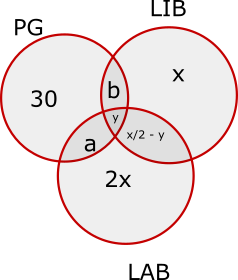
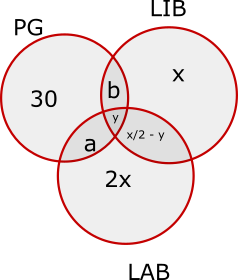
There were a hundred schools in a town. Of these, the number of schools having a play - ground was 30, and these schools had neither a library nor a laboratory. The number of schools having a laboratory alone was twice the number of those having a library only. The number of schools having a laboratory as well as a library was one-fourth the number of those having a laboratory alone. The number of schools having either a laboratory or a library or both was 35.

Question 26

How many schools had none of the three viz., laboratory, library or play - ground?

Answer & explanation

Correct answer: D

The diagram for this question has been shown:

Total number of schools having either or LAB or LIB or both = a+b+x/2 - y + y + 3x = 7x/2 + a + b = 35

Here a = b = y = 0

7x/2 = 35

x = 10

Total number of schools having at least one of PG, LIB or LAB = 30+2x+x+x/2 = 30+3x+x/2 = 30+30+5 = 65

Number of schools having neither of the three = 100-65 = 35

Question 27

What was the ratio of schools having laboratory those having library?

Answer & explanation

Correct answer: B

The diagram for this question has been shown:

Total number of schools having either or LAB or LIB or both = a+b+x/2 - y + y + 3x = 7x/2 + a + b = 35

It has been given that the schools having playground don't have a Library or Laboratory.

Hence a = b = y = 0

7x/2 = 35

x = 10

Required ratio = 25:15 = 5:3

Question 28

A player rolls a die and receives the same number of rupees as the number of dots on the face that turns up. What should the player pay for each roll if he wants to make a profit of one rupee per throw of the die in the long run?

Answer & explanation

Correct answer: A

The expected money got by the player = 1*1/6 + 2*1/6 + 3*1/6 + 4*1/6 + 5*1/6 + 6*1/6 = 21/6 = Rs 3.5 So, the player has to pay 3.5 - 1 = Rs 2.5 to get a profit of Re 1 in the long run.

Question 29

Three machines, A, B and C can be used to produce a product. Machine A will take 60 hours to produce a million units. Machine B is twice as fast as Machine A. Machine C will take the same amount of time to produce a million units as A and B running together. How much time will be required to produce a million units if all the three machines are used simultaneously?

Answer & explanation

Correct answer: B

As machine B's efficiency is twice as of A's, Hence, it will complete its work in 30 hours. And C's efficiency is putting A and B together i.e. = 20 hours $$( (\frac{1}{60} + \frac{1}{30})^{-1})$$ Now if all three work together, then it will be completed in x (say) days. $$\frac{1}{x} = \frac{1}{20} + \frac{1}{30} + \frac{1}{60}$$ or x = 10 hours

Question 30

Let Y = minimum of {(x+2), (3-x)}. What is the maximum value of Y for 0 <= x <=1?

Answer & explanation

Correct answer: D

For x<0 ; y=x+2 for 0<x<$$\frac{1}{2}$$ ; $$y=x+2$$ for $$x>\frac{1}{2}$$ ; $$y=3-x$$ Hence, $$y$$ attains its maxima at $$x=\frac{1}{2}$$ i.e. $$y$$ = 2.5

Question 31

There are 3 clubs A, B & C in a town with 40, 50 & 60 members respectively. While 10 people are members of all 3 clubs, 70 are members in only one club. How many belong to exactly two clubs?

Answer & explanation

Correct answer: B

We know that x + y + z = T and x + 2y + 3z = R, where x = number of members belonging to exactly 1 set = 70 y = number of members belonging to exactly 2 sets z = number of members belonging to exactly 3 sets = 10 T = Total number of members R = Repeated total of all the members = (40+50+60) = 150 Thus we have two equations and two unknowns. Solving this we get y = 25 So, 25 people belong to exactly 2 clubs.

Question 32

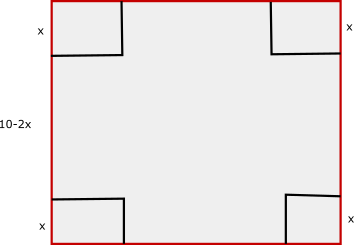
A square piece of cardboard of sides ten inches is taken and four equal squares pieces are removed at the corners, such that the side of this square piece is also an integer value. The sides are then turned up to form an open box. Then the maximum volume such a box can have is

Answer & explanation

Correct answer: A

Let the side of the square which is cut be x.

Volume of the cuboid so formed =$$(10-2x)^2*x$$

Put x = 1, 2, 3 and so on till 5

Maximum volume would be at x = 2

Volume of the cuboid so formed =$$(10-2*2)^2*2 = 72$$

Question 33

x, y and z are three positive integers such that x > y > z. Which of the following is closest to the product xyz?

Answer & explanation

Correct answer: A

The expressions in the four options can be expanded as xyz-yz; xyz-xz; xyz-xy and xyz+xz The closest value to xyz would be xyz-yz, as yz is the least value among yz, xz and xy. Option a) is the correct answer.

Question 34

What is the greatest power of 5 which can divide 80! exactly?

Answer & explanation

Correct answer: C

The highest power of 5 in 80! = [80/5] + [$$80/5^2$$] = 16 + 3 = 19 So, the highest power of 5 which divides 80! exactly = 19

Question 35

A third standard teacher gave a simple multiplication exercise to the kids. But one kid reversed the digits of both the numbers and carried out the multiplication and found that the product was exactly the same as the one expected by the teacher. Only one of the following pairs of numbers will fit in the description of the exercise. Which one is that?

Answer & explanation

Correct answer: B

13*62 = 806 31*26 = 806 Hence the answer is option b

Question 36

Find the minimum integral value of n such that the division $$\frac{55n}{124}$$ leaves no remainder.

Answer & explanation

Correct answer: A

As 55 and 124 don't have any common factor, and n has to be a minimum integer, Hence, it should be 124 only. So that given equation won't have a remainder.

Question 37

Let k be a positive integer such that k+4 is divisible by 7. Then the smallest positive integer n, greater than 2, such that k+2n is divisible by 7 equals

Answer & explanation

Correct answer: A

let's say k+4 = 7m k = 7m-4 Now for k+2n or 7m+(2n-4) is also multiple of 7. or 2n-4 should be a multiple of 7 So 2n-4 = 7p or 2n = 7p+4 For p=2; n=9 (p cannot be 1 as n is an integer )

Question 38

A calculator has two memory buttons, A and B. Value 1 is initially stored in both memory locations. The following sequence of steps is carried out five times: add 1 to B multiply A to B store the result in A What is the value stored in memory location A after this procedure?

Answer & explanation

Correct answer: C

A calculator has two memory buttons, A and B. Value 1 is initially stored in both memory locations. The following sequence of steps is carried out five times: add 1 to B multiply A to B store the result in A What is the value stored in memory location A after this procedure? The value in A and B before the start of the process is 1 and 1 respectively. In 1st iteration, After step I, A = 1 and B = 2 After steps II and III, A = 1 * 2 = 2, B = 2 In 2nd iteration, After step I, A = 2 and B = 3 After steps II and III, A = 2 * 3 = 6, B = 3 In 3rd iteration, After step I, A = 6 and B = 4 After steps II and III, A = 6 * 4 = 24, B = 4 In 4th iteration, After step I, A = 24 and B = 5 After steps II and III, A = 24 * 5 = 120, B = 5 In 5th iteration, After step I, A = 120 and B = 6 After steps II and III, A = 120 * 6 = 720, B = 6 Hence, option D is the correct answer.

Question 39

A one rupee coin is placed on a table. The maximum number of similar one rupee coins which can be placed on the table, around it, with each one of them touching it and only two others is

Answer & explanation

Correct answer: B

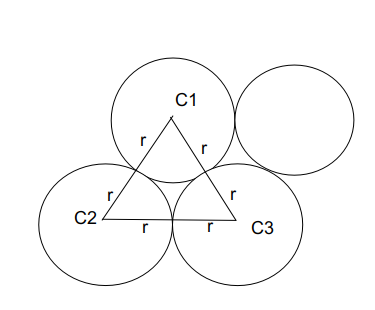
Considering the centre coin which is denoted by C1.

The surrounding coins are of equal radius as the centre coin. Since each coin is placed next to each other and considering the total number of coins = n.

The pairs formed by the coins which touch the consecutive coins is given by :

(1, 2) , (2, 3) ........... (n, 1)

The triangles formed by joining the centres of all the consecutive circles at the centre of C1 = 360 degrees.

If we join centres of 2 outer circles with the centre circle, it will make an equilateral triangle.

A single pair forms 60 degrees as it forms an equilateral triangle. Hence $$\frac{360}{n}=\ 60$$

n = 6

Question 40

Gopal went to a fruit market with certain amount of money. With this money he can buy either 50 oranges or 40 mangoes. He retains 10% of the money for taxi fare. If he buys 20 mangoes, then the maximum number of oranges he can buy is

Answer & explanation

Correct answer: B

Let's say the amount of money Gopal has is 100x rs. With this money he can buy either 50 oranges or 40 mangoes. Hence, the cost of 1 orange = $$\dfrac{100x}{50}$$ = Rs. 2x Similarly, the cost of 1 mango = $$\dfrac{100x}{40}$$ = Rs. 2.5x Taxi fare = 0.1*100x = 10x Remaining money with Gopal = 90x Cost incurred in buying 20 mangoes = 2.5*20 = 50x Hence, the amount of money left with Gopal = 100x - 10x - 50x = 40x Therefore, we can say that with this much money he can but a maximum of $$\dfrac{40x}{2x}$$ = 20 oranges.

Question 41

Every day Neera's husband meets her at the city railway station at 6.00 p.m. and drives her to their residence. One day she left early from the office and reached the railway station at 5.00 p.m. She started walking towards her home, met her husband coming from their residence on the way and they reached home 10 minutes earlier than the usual time. For how long did she walk?

Answer & explanation

Correct answer: D

Since we know that Neera's husband drives at a uniform speed to and from his residence. If he saved 10 mins overall travel time, he should have driven 5 mins less towards railway station and 5 mins less while driving towards residence. If he saved 5 minutes in his return journey, he should have started to return 5 minutes before his actual return time. When the husband met Neera, he should have met her 5 minutes before the actual meeting time i.e. at 5.55 PM. So, Neera must have walked for 55 minutes from 5PM.

Question 42

In Sivakasi, each boy's quota of match sticks to fill into boxes is not more than 200 per session. If he reduces the number of sticks per box by 25, he can fill 3 more boxes with the total number of sticks assigned to him. Which of the following is the possible number of sticks assigned to each boy?

Answer & explanation

Correct answer: B

Let the number of sticks assigned to each boy be N. Let the number of boxes be M. So, number of sticks per box = N/M Now, if he reduces the number of sticks in each box, the equation becomes N/(M+3) = N/M - 25 So, 25 = N/M - N/(M+3) From the options, if N = 150, then, we get 25 = 150 [ 1/M - 1/(M+3) ] => 1/6 = 1/M - 1/(M+3) => M = 3 So, the number of sticks assigned to each boy = 150

Question 43

A sum of money compounded annually becomes Rs.625 in two years and Rs.675 in three years. The rate of interest per annum is

Answer & explanation

Correct answer: B

As we know, formulae of compound interest for 2 years will be: $$P(1+\frac{r}{100})^{2}$$ = 625 (Where r is rate, P is principal amount) For 3 years: $$P(1+\frac{r}{100})^{3}$$ = 675 Dividing above two equations we will get r=8%

Question 44

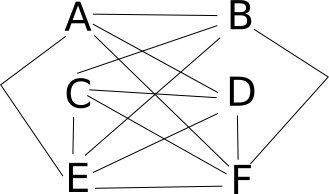
In a six-node network, two nodes are connected to all the other nodes. Of the remaining four, each is connected to four nodes. What is the total number of links in the network?

Answer & explanation

Correct answer: A

Consider the following diagram: In this, the nodes E and F are connected to all the other nodes whereas the other four nodes are connected to four nodes each.

The total number of connections is 13.

Question 45

If x is a positive integer such that 2x +12 is perfectly divisible by x, then the number of possible values of x is

Answer & explanation

Correct answer: C

If 2x+12 is perfectly divisible by x, then 12 must be divisible by x. Hence, there are six possible values of x : (1,2,3,4,6,12)

Question 46

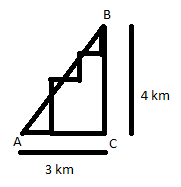
A man starting at a point walks one km east, then two km north, then one km east, then one km north, then one km east and then one km north to arrive at the destination. What is the shortest distance from the starting point to the destination?

Answer & explanation

Correct answer: D

In the diagram, A is starting point and B is ending point.

Accordingly, AB = $$\sqrt{(3^2 + 4^2)} = 5$$

Question 47

An outgoing batch of students wants to gift PA system worth Rs.4200 to their school. If the teachers offer to pay 50% more than the students, and an external benefactor gives three times teachers contribution. How much should the teachers donate?

Answer & explanation

Correct answer: C

Let's, say students contributed x rs. So teachers contributed = $$\frac{3x}{2}$$ And external benefactor contributed = $$\frac{9x}{2}$$ Summation of all contribution = 4200 = $$7x$$ or $$x=600$$ Hence, teachers contributed = 900

Question 48

A positive integer is said to be a prime number if it is not divisible by any positive integer other than itself and 1. Let $$p$$ be a prime number greater than 5. Then $$(p^2-1)$$ is

Answer & explanation

Correct answer: D

Let the Prime number be 6n+1. So $$(p^2 - 1)$$ = 6n(6n+2) = 12n(3n+1) For any value of n , n(3n+1) will have a factor of 2 Hence given equation will be always be divisible by 24

Question 49

To decide whether a number of n digits is divisible by 7, we can define a process by which its magnitude is reduced as follows: $$(i_{1}, i_{2}, i_{3}$$,..... are the digits of the number, starting from the most significant digit). $$i_{1} i_{2} ... i_{n} => i_{1}.3^{n-1} + i_{2}.3^{n-2} + ... + i_{n}.3^0$$. e.g. $$259 => 2.3^2 + 5.3^1 + 9.3^0 = 18 + 15 + 9 = 42$$ Ultimately the resulting number will be seven after repeating the above process a certain number of times. After how many such stages, does the number 203 reduce to 7?

Answer & explanation

Correct answer: A

For 203 : first step = $$2\times 3^2 + 0 \times 3^1 + 3 \times 3^0$$ = 21 second step = $$2 \times 3^1 + 1 \times 3^0$$ = 7 So two steps needed to reduce it to 7

Question 50

If 8 + 12 = 2, 7 + 14 = 3 then 10 + 18 = ?

Answer & explanation

Correct answer: A

8+12 =( 20 = 2+0) = 2 7+14 =( 21 = 2+1) = 3 10+18= (28= 2+8) = 10

Question 51

What is the distance between the points A(3, 8) and B(-2,-7)?

Answer & explanation

Correct answer: C

Distance between two points = $$\sqrt {(3-(-2))^2 + (8-(-7))^2}$$ = $$5\sqrt10$$