CAT Prep / PYQ / CAT 2007

CAT 2007

75 questions with answers and explanations

Take this as a timed mock →

VARC25 questions

Passage for questions 5153

The passage given below is followed by a set of three questions. Choose the most appropriate answer to each question. Human Biology does nothing to structure human society. Age may enfeeble us all, but cultures vary considerably in the prestige and power they accord to the elderly. Giving birth is a necessary condition for being a mother, but it is not sufficient. We expect mothers to behave in maternal ways and to display appropriately maternal sentiments. We prescribe a clutch of norms or rules that govern the role of a mother. That the social role is independent of the biological base can be demonstrated by going back three sentences. Giving birth is certainly not sufficient to be a mother but, as adoption and fostering show, it is not even necessary! The fine detail of what is expected of a mother or a father or a dutiful son differs from culture to culture, but everywhere behaviour is coordinated by the reciprocal nature of roles. Husbands and wives, parents and children, employers and employees, waiters and customers, teachers and pupils, warlords and followers; each makes sense only in its relation to the other. The term ‘role’ is an appropriate one, because the metaphor of an actor in a play neatly expresses the rule-governed nature or scripted nature of much of social life and the sense that society is a joint production. Social life occurs only because people play their parts (and that is as true for war and conflicts as for peace and love) and those parts make sense only in the context of the overall show. The drama metaphor also reminds us of the artistic licence available to the players. We can play a part straight or, as the following from J.P. Sartre conveys, we can ham it up. Let us consider this waiter in the cafe. His movement is quick and forward, a little too precise, a little too rapid. He comes towards the patrons with a step a little too quick. He bends forward a little too eagerly; his voice, his eyes express an interest a little too solicitous for the order of the customer. Finally there he returns, trying to imitate in his walk the inflexible stiffness of some kind of automaton while carrying his tray with the recklessness of a tightrope-walker....All his behaviour seems to us a game....But what is he playing? We need not watch long before we can explain it: he is playing at being a waiter in a cafe. The American sociologist Erving Goffman built an influential body of social analysis on elaborations of the metaphor of social life as drama. Perhaps his most telling point was that it is only through acting out a part that we express character. It is not enough to be evil or virtuous; we have to be seen to be evil or virtuous. There is distinction between the roles we play and some underlying self. Here we might note that some roles are more absorbing than others. We would not be surprised by the waitress who plays the part in such a way as to signal to us that she is much more than her occupation. We would be surprised and offended by the father who played his part ‘tongue in cheek’. Some roles are broader and more far-reaching than others. Describing someone as a clergyman or faith healer would say far more about that person than describing someone as a bus driver.

Question 51

What is the thematic highlight of this passage?

Answer & explanation

Correct answer: E

The passage does not talk about "absence of strong biological linkages". Hence, option A is wrong. The statement in option 2 does not agree with the passage.Hence, option B is wrong. Option 3 is contrary to the passage. The passage never stated that human behavior depends on biological linkages. Hence, option D is wrong. Option E correctly captures the theme of the passage.

Question 52

Which of the following would have been true if biological linkages structured human society?

Answer & explanation

Correct answer: B

We must look for an option that we do not consider as normal. Except option B, all the options are normal. For example, it is absolutely fine with us if a waiter serves more than that is expected from him. But we are offended when a father behaves in a tongue in cheek manner. If biological linkages structured human society, it should not matter to us how a father behaves. Hence, option B is the correct answer.

Question 53

It has been claimed in the passage that “some roles are more absorbing than others”. According to passage, which of the following seem(s) appropriate reason(s) for such a claim? A. Some roles carry great expectations from the society preventing manifestation of the true self. B. Society ascribes so much importance to some roles that the conception of self may get aligned with the roles being performed. C. Some roles require development of skill and expertise leaving little time for manifestation of self.

Answer & explanation

Correct answer: D

Statement A has been discussed in the passage while giving the example of clergymen and waiter. Hence, it is correct. By the example of the father, we can say that statement B is true. In the passage, the author has not mentioned that development of skill may result in denial of the self. So, statement C is incorrect. So, only statements A and B are correct. Option d) is the correct answer.

Passage for questions 5456

DIRECTIONS for the following three questions: In each question, there are five sentences or parts of sentences that form a paragraph. Identify the sentence(s) or part(s) of sentence(s) that is/are correct in terms of grammar and usage. Then, choose the most appropriate option.

Question 54

In each question, there are five sentences or parts of sentences that form a paragraph. Identify the sentence(s) or part(s) of sentence(s) that is/are correct in terms of grammar and usage. Then, choose the most appropriate option. A. When I returned to home, I began to read B. everything I could get my hand on about Israel. C. That same year Israel’s Jewish Agency sent D. a Shaliach a sort of recruiter to Minneapolis. E. I became one of his most active devotees. [CAT 2007]

Answer & explanation

Correct answer: A

Statements C and E are correct. There is no need of the word 'to' between 'returned' and 'home' in sentence A. In statement B, the correct use of the phrase is 'hands on' and not 'hand on'. In statement D, there should be a hyphen or comma after the word Shaliach ( a Shaliach - a sort of recruiter to Minneapolis.).

Question 55

In each question, there are five sentences or parts of sentences that form a paragraph. Identify the sentence(s) or part(s) of sentence(s) that is/are correct in terms of grammar and usage. Then, choose the most appropriate option. A. So once an economy is actually in recession, B. The authorities can, in principle, move the economy C. Out of slump - assuming hypothetically D. That they know how to - by a temporary stimuli. E. In the longer term, however, such policies have no affect on the overall behaviour of the economy.

Answer & explanation

Correct answer: E

The usage of the word "so" is inappropriate; additionally, the phrase should be " into recession" => A is wrong "Assuming hypothetically" is redundant; additionally, the phrase should be "out of a slump" => Only one of the words can be used here.=> C is wrong. "a temporary stimulus" is the correct phrase => D is wrong. The term "effect" should be used instead of "affect" => E is wrong. Hence, only B is correct

Question 56

In each question, there are five sentences or parts of sentences that form a paragraph. Identify the sentence(s) or part(s) of sentence(s) that is/are correct in terms of grammar and usage. Then, choose the most appropriate option. A. It is sometimes told that democratic B. government originated in the city-states C. of ancient Greece. Democratic ideals have been handed to us from that time. D. In truth, however, this is an unhelpful assertion. E. The Greeks gave us the word, hence did not provide us with a model.

Answer & explanation

Correct answer: C

In sentence A, the word "said" must be used instead of "told". Sentence B is correct. In sentence C, 'handed to us' should be replaced with 'handed down to us'. Sentence D is correct. In sentence E, 'hence' should be replaced with 'but' or some other conjunction that is similar in meaning to 'but'. So, only B and D are correct.

Passage for questions 5759

The passage given below is followed by a set of three questions. Choose the most appropriate answer to each question. Every civilized society lives and thrives on a silent but profound agreement as to what is to be accepted as the valid mould of experience. Civilization is a complex system of dams, dykes, and canals warding off, directing, and articulating the influx of the surrounding fluid element; a fertile fenland, elaborately drained and protected from the high tides of chaotic, unexercised, and inarticulate experience. In such a culture, stable and sure of itself within the frontiers of 'naturalized' experience, the arts wield their creative power not so much in width as in depth. They do not create new experience, but deepen and purify the old. Their works do not differ from one another like a new horizon from a new horizon, but like a madonna from a madonna. The periods of art which are most vigorous in creative passion seem to occur when the established pattern of experience loosens its rigidity without as yet losing its force. Such a period was the Renaissance, and Shakespeare its poetic consummation. Then it was as though the discipline of the old order gave depth to the excitement of the breaking away, the depth of job and tragedy, of incomparable conquests and irredeemable losses. Adventurers of experience set out as though in lifeboats to rescue and bring back to the shore treasures of knowing and feeling which the old order had left floating on the high seas. The works of the early Renaissance and the poetry of Shakespeare vibrate with the compassion for live experience in danger of dying from exposure and neglect. In this compassion was the creative genius of the age. Yet, it was a genius of courage, not of desperate audacity. For, however elusively, it still knew of harbours and anchors, of homes to which to return, and of barns in which to store the harvest. The exploring spirit of art was in the depths of its consciousness still aware of a scheme of things into which to fit its exploits and creations. But the more this scheme of things loses its stability, the more boundless and uncharted appears the ocean of potential exploration. In the blank confusion of infinite potentialities flotsam of significance gets attached to jetsam of experience; for everything is sea, everything is at sea - .... The sea is all about us; The sea is the land's edge also, the granite Into which it reaches, the beaches where it tosses Its hints of earlier and other creation ... - and Rilke tells a story in which, as in T.S. Eliot's poem, it is again the sea and the distance of 'other creation' that becomes the image of the poet's reality. A rowing boat sets out on a difficult passage. The oarsmen labour in exact rhythm. There is no sign yet of the destination. Suddenly a man, seemingly idle, breaks out into song. And if the labour of the oarsmen meaninglessly defeats the real resistance of the real waves, it is the idle single who magically conquers the despair of apparent aimlessness. While the people next to him try to come to grips with the element that is next to them, his voice seems to bind the boat to the farthest distance so that the farthest distance draws it towards itself. 'I don't know why and how,' is Rilke's conclusion, 'but suddenly I understood the situation of the poet, his place and function in this age. It does not matter if one denies him every place - except this one. There one must tolerate him.'

Question 57

In the passage, the expression “like a madonna from a madonna” alludes to

Answer & explanation

Correct answer: B

The sentence "the arts wield their creative power not so much ............ a new horizon from a new horizon" says that the art words do not differ in their "width" and "breadth" as well as "life" and "interpretation of life". => Options C and D are wrong. Option A is irrelavent as it is not discussed in the passage. The comparison between Madonna and modern day singer is not correct => option E wrong. Option B is the answer.

Question 58

The sea and ‘other creation’ leads Rilke to

Answer & explanation

Correct answer: A

After giving the example of "sea" and "the other creation", Rilke says "I suddenly understood the situation of the poet, his place and his function in this age". Option a) captures this idea succinctly. None of the other options are applicable. Option A is the correct answer.

Question 59

According to the passage, the term “adventurers of experience” refers to

Answer & explanation

Correct answer: C

Refer to the following lines of the paragraph: "Adventurers of experience set out as though in lifeboats to rescue and bring back to the shore treasures of knowing and feeling which the old order had left floating on the high seas. The works of the early Renaissance and the poetry of Shakespeare vibrate with the compassion for live experience in danger of dying from exposure and neglect." Here the author refers to the poets of renaissance as adventurers of experience. Option c) is the correct answer.

Passage for questions 6062

Each of the following questions has a paragraph from which the last sentence has been deleted. From the given options, choose the sentence that completes the paragraph in the most appropriate way.

Question 60

Characters are also part of deep structure. Characters tie events in a story together and provide a thread of continuity and meaning. Stories can be about individuals, groups, projects or whole organizations, so from an organizational studies perspective, the focal actor(s) determine the level and unit of analysis used in a study. Stories of mergers and acquisitions, for example, are common place. In these stories whole organizations are personified as actors. But these macro-level stories usually are not told from the perspective of the macro-level participants, because whole organizations cannot narrate their experiences in the first person.

Answer & explanation

Correct answer: E

The paragraph describes the role of the chracters in the whole story.Then the paragraph moves to the macro-level stories where the organisation does not tell the whole narrative.Option 5 extends the idea about the purpose of personification of whole organisation.Option 1 and 4 are incorrect because of the deviation from the topic.Option 2 is incorrect as it talks abstracting away from the actors rather than explaining the reason behind it.Option 3 is incorrect as there is no point of invoking the importance of personification of organisation.

Question 61

Nevertheless, photographs still retain some of the magical allure that the earliest daguerreotypes inspired. As objects, our photographs have changed; they have become physically flimsier as they have become more technologically sophisticated. Daguerre produced pictures on copper plates; today many of our photographs never become tangible thins, but instead remain filed away on computers and cameras, part of the digital ether that envelops the modern world. At the same time, our patience for the creation of images has also eroded. Children today are used to being tracked from birth by digital cameras and video recorders and they expect to see the results of their poses and performances instantly. The space between life as it is being lived and life as it is being displayed shrinks to a mere second.

Answer & explanation

Correct answer: A

The paragarph starts by talking about the retaining of the allure of the photographs.It describes the new digital age where the photos have become digital. Option A perfectly ends the paragraph by talking about the positives of the photographs. 2,3,4 are deviations from the main idea. 5th is close but it introduces a new idea rather than closing the paragraph.

Question 62

Mma Ramotswe had a detective agency in Africa, at the foot of Kgale Hill. These were its assets; a tiny white van, two desks, two chairs, a telephone, and an old typewriter. Then there was a teapot, in which Mma Ramotswe - the only private lady detective in Botswana - brewed red bush tea. And three mugs - one for herself, one for her secretary and one for the client. What else does a detective agency really need? Detective agencies rely on human intuition and intelligence, both of which Mma Ramotswe had in abundance.

Answer & explanation

Correct answer: B

No inventory would ever include those, ofcourse’. The para starts with listing out ‘the inventory’. The option which says ‘what she lacked………..natural shrewdness’ is beyond the scope of the argument. All the options can be easily eliminated. ‘Those’ in the option ‘No inventory would ever include those, ofcourse’, refers to human intuition and intelligence of Mma Ramotswe.

Passage for questions 6365

The passage given below is followed by a set of three questions. Choose the most appropriate answer to each question. To discover the relation between rules, paradigms, and normal science, consider first how the historian isolates the particular loci of commitment that have been described as accepted rules. Close historical investigation of a given specialty at a given time discloses a set of recurrent and quasi-standard illustrations of various theories in their conceptual, observational, and instrumental applications. These are the community's paradigms, revealed in its textbooks, lectures, and laboratory exercises. By studying them and by practicing with them, the members of the corresponding community learn their trade. The historian, of course, will discover in addition a penumbral area occupied by achievements whose status is still in doubt, but the core of solved problems and techniques will usually be clear. Despite occasional ambiguities, the paradigms of a mature scientific community can be determined with relative ease. That demands a second step and one of a somewhat different kind. When undertaking it, the historian must compare the community's paradigms with each other and with its current research reports. In doing so, his object is to discover what isolable elements, explicit or implicit, the members of that community may have abstracted from their more global paradigms and deploy it as rules in their research. Anyone who has attempted to describe or analyze the evolution of a particular scientific tradition will necessarily have sought accepted principles and rules of this sort. Almost certainly, he will have met with at least partial success. But, if his1 9 experience has been at all like my own, he will have found the search for rules both more difficult and less satisfying than the search for paradigms. Some of the generalizations he employs to describe the community's shared beliefs will present more problems. Others, however, will seem a shade too strong. Phrased in just that way, or in any other way he can imagine, they would almost certainly have been rejected by some members of the group he studies. Nevertheless, if the coherence of the research tradition is to be understood in terms of rules, some specification of common ground in the corresponding area is needed. As a result, the search for a body of rules competent to constitute a given normal research tradition becomes a source of continual and deep frustration. Recognizing that frustration, however, makes it possible to diagnose its source. Scientists can agree that a Newton, Lavoisier, Maxwell, or Einstein has produced an apparently permanent solution to a group of outstanding problems and still disagree, sometimes without being aware of it, about the particular abstract characteristics that make those solutions permanent. They can, that is, agree in their identification of a paradigm without agreeing on, or even attempting to produce, a full interpretation or rationalization of it. Lack of a standard interpretation or of an agreed reduction to rules will not prevent a paradigm from guiding research. Normal science can be determined in part by the direct inspection of paradigms, a process that is often aided by but does not depend upon the formulation of rules and assumption. Indeed, the existence of a paradigm need not even imply that any full set of rules exists.

Question 63

What is the author attempting to illustrate through this passage?

Answer & explanation

Correct answer: D

The main point of the first paragraph is to define what are accepted rules and how to identify them. In the second paragraph, the author talks about comparing different sets of accepted rules or community paradigms and analysing them. In the last paragraph, the author talks about how paradigm, even if they cannot be distilled into rules, can yet guide research and be widely accepted. Thus, the main point of the passage is how to understand scientific paradigms. Option a) is an answer to how the author is attempting to illustrate his point through the passage. It does not answer the 'what' part. Options b), c) and e) give only partial answers to what the author is trying to illustrate through the passage. Hence, Option d) is the correct answer.

Question 64

The term ‘loci of commitment’ as used in the passage would most likely correspond with which of the following?

Answer & explanation

Correct answer: C

In the first line of the passage, the author describes loci of commitment as accepted rules. The passage talks about the historian trying to isolate the particular loci of commitment, which he later concludes as the community's paradigms. Option c) succinctly captures this idea. None of the other options are applicable.

Question 65

The author of this passage is likely to agree with which of the following?

Answer & explanation

Correct answer: E

Throughout the passage, the author highlights that "the paradigms" are "the general rules of science". Rules are difficult to be defined. On the other hand, paradigms can follow without any rules. Option e) accurately represents the idea.

Passage for questions 6668

There are four sentences. Each sentence has pairs of words/phrases that are italicized and highlighted. From the italicized and highlighted word(s)/phrase(s), select the most appropriate word(s)/phrase(s) to form correct sentences. Then, from the options given, choose the best one.

Question 66

The cricket council that was [A] / were [B] elected last March i s [A] / are [B] at sixes and sevens over new rules. The critics censored [A] / censured [B] the new movie because of its social inaccessibility. Amit’s explanation for missing the meeting was credulous [A] / credible [B]. She coughed discreetly [A] / discretely [B] to announce her presence.

Answer & explanation

Correct answer: D

Cricket Council is a collective noun so it takes a singular verb. The reference is made to a group as a whole and not to an individual. So correct option for 1st sentence is AA. Censure implies harsh criticism.Censor means to put a ban on something objectionable.So Censure should be the correct answer here. Credible means capable of being believed.Credulous means tending to believe without evidence.So credible should be used for 3rd sentence. Discretely means distinct whereas discreetly means to carefully avoid social embarrassment or distress; tactful. So use of ' discreetly' is correct here. Hence option D.

Question 67

The further [A] / farther [B] he pushed himself, the more disillusioned he grew. For the crowds it was more of a historical [A] / historic [B] event; for their leader, it was just another day. The old man has a healthy distrust [A] / mistrust [B] for all new technology. This film is based on a real [A] / true [B] story. One suspects that the compliment [A] / complement [B] was backhanded

Answer & explanation

Correct answer: E

Use “farther” for physical distance and “further” for metaphorical, or figurative, distance. So further should be used here. Correct usage for 2nd sentence is 'historic event', which means 'an event of great importance'. In sentence 3, the word 'distrust', which means 'the feeling that someone or something cannot be relied upon' should be used. The correct usage is sentence 4 is 'true' story. A backhanded compliment, also known as a left-handed compliment or asteism, is an insult that is disguised as a compliment. Option e) is the correct answer.

Question 68

Regrettably [A] / Regretfully [B] I have to decline your invitation. I am drawn to the poetic, sensual [A] / sensuous [B] quality of her paintings. He was besides [A] / beside [B] himself with rage when I told him what I had done. After brushing against a stationary [A] / stationery [B] truck my car turned turtle. As the water began to rise over[A]/above[B] the danger mark, the signs of an imminent flood were clear.

Answer & explanation

Correct answer: E

'Decline regretfully' is the correct usage. It means being sorry to decline. Sensuous means taking delight in beauty. Hence is perfect for 2nd sentence. Beside means next to. Besides means apart from or and another thing. So 'beside' should be used in given context. Stationary means 'stand still'. Hence is the correct for usage in 4th sentence. 5th statement can be correctly written as, ' As the water began to rise above the danger mark, the signs of an imminent flood were clear.' Option e) is the correct answer.

Passage for questions 6971

The passage given below is followed by a set of three questions. Choose the most appropriate answer to each question. The difficulties historians face in establishing cause-and-effect relations in the history of human societies are broadly similar to the difficulties facing astronomers, climatologists, ecologists, evolutionary biologists, geologists, and palaeontologists. To varying degrees each of these fields is plagued by the impossibility of performing replicated, controlled experimental interventions, the complexity arising from enormous numbers of variables, the resulting uniqueness of each system, the consequent impossibility of formulating universal laws, and the difficulties of predicting emergent properties and future behaviour. Prediction in history, as in other historical sciences, is most feasible on large spatial scales and over long times, when the unique features of millions of small-scale brief events become averaged out. Just as I could predict the sex ratio of the next 1,000 newborns but not the sexes of my own two children, the historian can recognize factors that made2 1 inevitable the broad outcome of the collision between American and Eurasian societies after 13,000 years of separate developments, but not the outcome of the 1960 U.S. presidential election. The details of which candidate said what during a single televised debate in October 1960 Could have given the electoral victory to Nixon instead of to Kennedy, but no details of who said what could have blocked the European conquest of Native Americans. How can students of human history profit from the experience of scientists in other historical sciences? A methodology that has proved useful involves the comparative method and so-called natural experiments. While neither astronomers studying galaxy formation nor human historians can manipulate their systems in controlled laboratory experiments, they both can take advantage of natural experiments, by comparing systems differing in the presence or absence (or in the strong or weak effect) of some putative causative factor. For example, epidemiologists, forbidden to feed large amounts of salt to people experimentally, have still been able to identify effects of high salt intake by comparing groups of humans who already differ greatly in their salt intake; and cultural anthropologists, unable to provide human groups experimentally with varying resource abundances for many centuries, still study long-term effects of resource abundance on human societies by comparing recent Polynesian populations living on islands differing naturally in resource abundance. The student of human history can draw on many more natural experiments than just comparisons among the five inhabited continents. Comparisons can also utilize large islands that have developed complex societies in a considerable degree of isolation (such as Japan, Madagascar, Native American Hispaniola, New Guinea, Hawaii, and many others), as well as societies on hundreds of smaller islands and regional societies within each of the continents. Natural experiments in any field, whether in ecology or human history, are inherently open to potential methodological criticisms. Those include confounding effects of natural variation in additional variables besides the one of interest, as well as problems in inferring chains of causation from observed correlations between variables. Such methodological problems have been discussed in great detail for some of the historical sciences. In particular, epidemiology, the science of drawing inferences about human diseases by comparing groups of people (often by retrospective historical studies), has for a long time successfully employed formalized procedures for dealing with problems similar to those facing historians of human societies. In short, I acknowledge that it is much more difficult to understand human history than to understand problems in fields of science where history is unimportant and where fewer individual variables operate. Nevertheless, successful methodologies for analyzing historical problems have been worked out in several fields. As a result, the histories of dinosaurs, nebulae, and glaciers are generally acknowledged to belong to fields of science rather than to the humanities.
Question 69

Why do islands with considerable degree of isolation provide valuable insights into human history?

Answer & explanation

Correct answer: C

Consider the following lines from the passage: "Those include confounding effects of natural variation in additional variables besides the one of interest, as well as problems in inferring chains of causation from observed correlations between variables." This explains the reason why islands with considerable degree of isolation provide valuable insights into human history. Option c) is the correct answer.

Question 70

According to the author, why is prediction difficult in history?

Answer & explanation

Correct answer: E

Refer to the following lines "Prediction in history, as in other historical sciences, is most feasible on large spatial scales and over long times, when the unique features of millions of small-scale brief events become averaged out. Just as I could predict the sex ratio of the next 1,000 newborns but not the sexes of my own two children. the historian can recognize factors that made inevitable the broad outcome of the collision between American and Eurasian societies after 13,000 years of separate developments, but not the outcome of the 1960 U.S. presidential election" From this we can understand the reason why the author says prediction in history is difficult is because historical sciences suffer from the inability to conduct controlled experiments. Option e) is the correct answer.

Question 71

According to the author, which of the following statements would be true?

Answer & explanation

Correct answer: C

Refer to the lines "The student of human history can draw on many more natural experiments than just comparisons among the five inhabited continents. Comparisons can also utilize large islands that have developed complex societies in a considerable degree of isolation (such as Japan, Madagascar. Native American Hispaniola, New Guinea, Hawaii, and many others), as well as societies on hundreds of smaller islands and regional societies within each of the continents." From this, we can understand that the students of history are missing opportunities by not studying a sufficient variety of natural experiments. Option c) is the correct answer.

Passage for questions 7275

In each question, there are five sentences/paragraphs. The sentence/ paragraph labelled A is in its correct place. The four that follow are labelled B, C, D and E, and need to be arranged in the logical order to form a coherent paragraph/passage. From the given options, choose the most appropriate option.

Question 72

A. In America, highly educated women, who are in stronger position in the labour market than less qualified ones, have higher rates of marriage than other groups. B. Some works supports the Becker thesis, and some appears to contradict it. C. And, as with crime, it is equally inconclusive. D. But regardless of the conclusion of any particular piece of work, it is hard to establish convincing connections between family changes and economic factors using conventional approaches. E. Indeed, just as with crime, an enormous academic literature exists on the validity of the pure economic approach to the evolution of family structures.

Answer & explanation

Correct answer: D

E follows A because it creates an anology and explains the situation. Then, C follows E because, it continues that anology. Also statements BD is a pair as B talks about some support and contradiction of work and D talks about conclusion of work and difficulty in connections. Hence ECBD is the answer.

Question 73

A. Personal experience of mothering and motherhood are largely framed in relation to two discernible or “official” discourses; the “medical discourse and natural childbirth discourse”. Both of these tend to focus on the “optimistic stories” of birth and mothering and underpin stereotypes of the “godmother”. B. At the same time, the need for medical expert guidance is also a feature for contemporary reproduction and motherhood. But constructions of good mothering have not always been so conceived and in different contexts may exist in parallel to other equally dominant discourses. C. Similarly, historical work has shown how what are now taken for granted aspects of reproduction and mothering practices result from contemporary “pseudoscientific directives” and “managed constructs”. These changes have led to a reframing of modern discourses that pattern pregnancy and motherhood leading to an acceptance of the need for greater expert management. D. The contrasting, overlapping and ambiguous strands with in these frameworks focus to varying degrees on a woman’s biological tie to her child and predisposition to instinctively know and be able to care for her child. E. In addition, a third, “unofficial popular discourse” comprising “old wives” tales and based on maternal experiences of childbirth has also been noted. These discourses have also been acknowledged in work exploring the experiences of those who apparently do not “conform” to conventional stereotypes of the “good mother”?

Answer & explanation

Correct answer: A

Sentence A introduces two official discourses about childbirth. Sentence E introduces a third discourse and the remaining sentences discuss the features of the mentioned discourses. Hence, A-E form a pair. Sentences D and B focus on the two main features of these discourses - firstly the mother's innate ability to care for the child and secondly, the need for expert medical guidance. As B starts with "At the same time", it should be the second feature. Hence, D-B form a pair. The second sentence in B talks about how the idea of what it means to be a good mother has not always been as indicated in D-B and C backs this assertion up by showing how some beliefs about mothering were challenged as pseudo-scientific and how this has led to a reframing of the discourse. Thus, the order should be A-E-D-B-C.

Question 74

A. Indonesia has experienced dramatic shifts in its formal governance arrangements since the fall of President Soeharto and the close of his centralized, authoritarian "New Order" regime in 1997. B. The political system has taken its place in the nearly 10 years since Reformasi began. It has featured the active contest for political office among a proliferation of parties at central, provincial and district levels; direct elections for the presidency (since 2004); and radical changes in centre-local government relations towards administrative, fiscal, and political decentralization. C. The mass media, once tidily under Soeharto's thumb, has experienced significant liberalization, as has the legal basis for non-governmental organizations, including many dedicated to such controversial issues as corruption control and human rights. D. Such developments are seen optimistically by a number of donors and some external analysts, who interpret them as signs of Indonesia's political normalization. E. A different group of analysts paint a picture in which the institutional forms have changed, but power relations have not. Vedi Hadiz argues that Indonesia's "democratic transition" has been anything but linear.

Answer & explanation

Correct answer: E

The argument given by Vedi Hadiz in statement E is not discussed in any other sentence => sentence E is last. Out of B and C , B is appropriate statement which should follow A because the first sentence talks about formal governance shifts and B correctly follows by talking abou the general political system in Indonesia. After discussing about changes in political system, discussing about changes in mass media would be apt => C follows B => B - C - D - E is the answer

Question 75

A. I had six thousand acres of land, arid had thus got much spare land besides the coffee plantation. Part of the farm was native forest, and about one thousand acres were squatters' land, what [the Kikuyu] called their shambas. B. The squatters' land was more intensely alive than the rest of the farm, and was changing with the seasons the year round. The maize grew up higher than your head as you walked on the narrow hard-trampled footpaths in between the tall green rustling regiments. C. The squatters are Natives, who with their families hold a few acres on a white man's farm, and in return have to work for him a certain number of days in the year. -My squatters, I think, saw the relationship in a different light, for many of them were born on the farm, and their fathers before them, and they very likely regarded me as a sort of superior squatter on their estates. D. The Kikuyu also grew the sweet potatoes that have a vine like leaf and spread over the ground like a dense entangled mat, and many varieties of big yellow and green speckled pumpkins. E. The beans ripened in the fields, were gathered and thrashed by the women, and the maize stalks and coffee pods were collected and burned, so that in certain seasons thin blue columns of smoke rose here and there all over the farm.

Answer & explanation

Correct answer: C

"Squatters" mentioned in sentence A is discussed in sentence C => C follows A. After description of who squatters are, description of squatters' land would be apt => B follows C. The sentence "The maize grew up ...... " in sentence B needs sentence E to follow it to make sense. => C - B - E - D is the answer.

DILR25 questions

Passage for questions 2629

Directions for the following four questions:

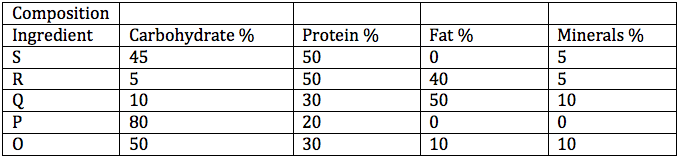
A health-drink company’s R&D department is trying to make various diet formulations, which can be used for certain specific purposes. It is considering a choice of 5 alternative ingredients (O, P, Q, R, and S), which can be used in different proportions in the formulations.

The table below gives the composition of these ingredients. The cost per unit of each of these ingredients is O: 150, P: 50, Q: 200, R: 500, S: 100.

Question 26

For a recuperating patient, the doctor recommended a diet containing 10% minerals and at least 30% protein. In how many different ways can we prepare this diet by mixing at least two ingredients?

Answer & explanation

Correct answer: A

We want a diet with 10% minerals and at least 30% protien. The mixture of O and Q is suitable because both contain 10% minerals.In required proportion we can get 10% minerals and at least 30% proteins. Solution P and R contains minerals which are less than 10% and maximum mineral %age in any component is 10. So if we include P or R in any mixture,we can't get 10% mineral %age. So only 1 solution of O and Q is possible.

Question 27

Which among the following is the formulation having the lowest cost per unit for a diet having 10% fat and at least 30% protein? The diet has to be formed by mixing two ingredients.

Answer & explanation

Correct answer: D

Option A: P and Q in 4:1 ratio gives fat 10% but the protein is 22% Option B: P and S do not contain fat. Hence we wont analyse the option. Option C: P and R in 3:1 ratio gives fat 10% but the protein is 27.5% Option D: Q and S in 1:4 gives fat and protein as 10% and 46 %. Cost of the mixture= [(1*200)+(4*100)]/5=120 Option E: R and S in 1:3 gives 10% fat and 50%protein. Cost of the mixture= [(1*500)+(3*100)]/4=200

Question 28

In what proportion P, Q and S should be mixed to make a diet having at least 60% carbohydrate at the lowest per unit cost?

Answer & explanation

Correct answer: E

P,Q,S contain 80%,10% and 45% carbohydrates respectively. Option A,C and D does not contain 60% carbohydrates. Option E: Carbohydrate %=[(4*80)+(1*10)+(1*45)]/6= 62.5% Cost per unit=[(4*50)+(200)+100]/6=83.3 Option B: Carbohydrate %=[(4*80)+(1*20)+(2*45)]/7= 61.4% Cost per unit=[(4*50)+(200)+(2*100)]/7=600/7=85.7

Question 29

The company is planning to launch a balanced diet required for growth needs of adolescent children. This diet must contain at least 30% each of carbohydrate and protein, no more than 25% fat and at least 5% minerals. Which one of the following combinations of equally mixed ingredients is feasible?

Answer & explanation

Correct answer: E

Two ingredients are mixed in equal proportion. So, the minimum amount of protein and carbohydrate should be 60 each, the minimum amount of minerals is 10 and the maximum amount of fat is 50. The combination of O and S satisfies this requirement.

Passage for questions 3033

Directions for the following four questions: Each question is followed by two statements, A and B. Answer each question using the following instructions:

Question 30

In a particular school, sixty students were athletes. Ten among them were also among the top academic performers. How many top academic performers were in the school? A. Sixty per cent of the top academic performers were not athletes. B. All the top academic performers were not necessarily athletes.

Answer & explanation

Correct answer: A

No. of athletes which are top academic performers: 10 According to statement a) Sixty per cent of the top academic performers were not athletes so 40% of top academic performers are athletes which we know is 10. So total no. of top academic performers are 25. Hence statement a is alone to answer the question. while we cant deduce anything from statement b .

Question 31

Five students Atul, Bala, Chetan, Dev and Ernesto were the only ones who participated in a quiz contest. They were ranked based on their scores in the contest. Dev got a higher rank as compared to Ernesto, while Bala got a higher rank as compared to Chetan. Chetan’s rank was lower than the median. Who among the five got the highest rank? A. Atul was the last rank holder. B. Bala was not among the top two rank holders.

Answer & explanation

Correct answer: D

From the information given in the question, D has a better rank than E and B has a better rank than C. Also, C = 4 or 5. From statement A, A = 5 => C = 4. But we do not know if D or B is number 1. From statement B, B = 3 or 4. Again, we cannot determine the number 1 rank precisely. By using both the statements together, we know C = 4, A = 5, B = 3 and D has a better rank than E. So, D = 1 and E = 2. Therefore, the question can be answered by using both the statements together. Hence, option D.

Question 32

Thirty per cent of the employees of a call centre are males. Ten per cent of the female employees have an engineering background. What is the percentage of male employees with engineering background? A. Twenty five per cent of the employees have engineering background. B. Number of male employees having an engineering background is 20% more than the number of female employees having an engineering background

Answer & explanation

Correct answer: C

Let the total number of employees be 100k. Number of males = 30k. Number of females = 70k. Number of female engineers = 7k. From statement A, number of male engineers = 25k - 7k = 18k. From statement B, number of male engineers = (6/5)*7k. Therefore, percentage of male engineers can be calculated. So, the question can be answered by either statement alone.

Question 33

In a football match, at the half-time, Mahindra and Mahindra Club was trailing by three goals. Did it win the match? A. In the second-half Mahindra and Mahindra Club scored four goals. B. The opponent scored four goals in the match.

Answer & explanation

Correct answer: E

From statement A, we know that the club scored four goals in the second half but we do not know the number of goals scored by the opposition. So, we cannot answer the question. From statement B, we know that the opposition scored 4 goals in the match but we do not know the number of goals scored by Mahindra and Mahindra club. So, we cannot answer the question. Using both the statements, we know that the opposition scored 4 goals in the match and Mahindra and Mahindra scored 4 goals in the second half. But, we do not know if the score was 3-0 or 4-1 at the end of first half. If it was 4-1, then Mahindra and Mahindra would win the match after the second half. But if the score was 3-0 at the end of first half, the match would end in a draw after the second half. Therefore, the question cannot be answered even by using both the statements together.

Passage for questions 3437

Directions for the following four questions:

Answer the following questions based on the information given below.

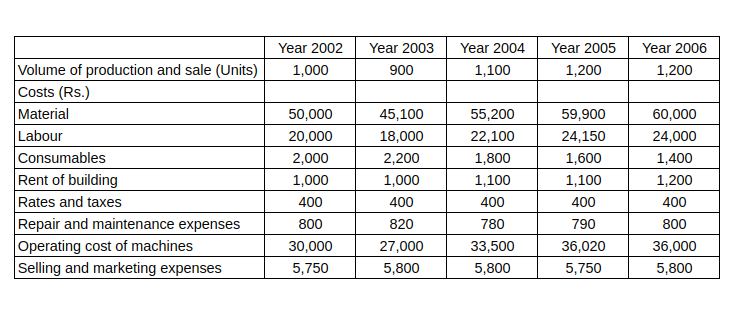
The following table shows the break-up of actual costs incurred by a company in last five years (year 2002 to year 2006) to produce a particular product.

The production capacity of the company is 2000 units. The selling price for the year 2006 was Rs. 125 per unit. Some costs change almost in direct proportion to the change in volume of production, while others do not follow any obvious pattern of change with respect to the volume of production and hence are considered fixed. Using the information provided for the year 2006 as the basis for projecting the figures for the year 2007, answer the following questions:

Question 34

What is the approximate cost per unit in rupees, if the company produces and sells 1400 units in the year 2007?

Answer & explanation

Correct answer: B

Fixed costs in 2006 are consumables, rent of building, rates and taxes, repair and maintenance expenses and selling and marketing expenses. We can see this from the trend followed in the years 2002-2006. Fixed costs in 2006 = 1400 + 1200 + 400 + 800 + 5800 = 9600 We can see that that material , labour and operation costs depend on no. of units. If we take units = x . Total cost of these 3 materials is 50x +20x+30x = 100x and remaining fixed cost taking same as in 2006 we get , 9600+100x , but here x = 1400. We have total cost per unir (9600+100*1400)/1400 = 107(approx). Hence option B.

Question 35

What is the minimum number of units that the company needs to produce and sell to avoid any loss?

Answer & explanation

Correct answer: C

Fixed costs in 2006 are consumables, rent of building, rates and taxes, repair and maintenance expenses and selling and marketing expenses. We can see this from the trend followed in the years 2002-2006. Fixed costs in 2006 = 1400 + 1200 + 400 + 800 + 5800 = 9600 => fixed costs in 2007 are same. We can see that that material , labour and operation costs depend on no. of units. If we take units = x . Total cost of these 3 materials is 50x +20x+30x = 100x and remaining fixed cost taking same as in 2006 we get , 9600+100x. As the selling price is 125, we have 100x + 9600 < 125*x. Solving this we get x = 384. Hence option C.

Question 36

If the company reduces the price by 5%, it can produce and sell as many units as it desires. How many units the company should produce to maximize its profit?

Answer & explanation

Correct answer: E

Fixed costs in 2006 are consumables, rent of building, rates and taxes, repair and maintenance expenses and selling and marketing expenses. We can see this from the trend followed in the years 2002-2006. Fixed costs in 2006 = 1400 + 1200 + 400 + 800 + 5800 = 9600 => fixed costs in 2007 are same. We can see that that material , labour and operation costs depend on no. of units. If we take units = x . Total cost of these 3 materials is 50x +20x+30x = 100x and remaining fixed cost taking same as in 2006 we get , 9600+100x. Selling price is reduced by 5% => SP = 125 * 0.95 = Rs 118.75 Profit = 118.75x - 100x - 9600 = 18.75x - 9600 Profit will be maximum when x is maximum => 2000 units.

Question 37

Given that the company cannot sell more than 1700 units, and it will have to reduce the price by Rs.5 for all units if it wants to sell more than 1400 units. What is the maximum profit that can be realized provided that the company sells more than 1400 units?

Answer & explanation

Correct answer: B

Fixed costs in 2006 are consumables, rent of building, rates and taxes, repair and maintenance expenses and selling and marketing expenses. We can see this from the trend followed in the years 2002-2006. Fixed costs in 2006 = 1400 + 1200 + 400 + 800 + 5800 = 9600 => fixed costs in 2007 are same. We can see that that material , labour and operation costs depend on no. of units. If we take units = x . Total cost of these 3 materials is 50x +20x+30x = 100x and remaining fixed cost taking same as in 2006 we get , 9600+100x. Selling price = 125 - 5 = Rs 120. Profit = 120x - 100x - 9600 = 20x - 9600 When x = 1700 => Profit = 20*1700 - 9600 = 34000 - 9600 = Rs 24400.

Passage for questions 3841

DIRECTIONS for the following four questions:

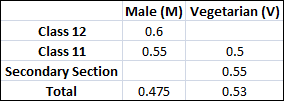
The proportion of male students and the proportion of vegetarian students in a school are given below. The school has a total of 800 students, 80% of whom are in the Secondary Section and rest equally divided between Class 11 and 12.

Question 38

What is the percentage of male students in the secondary section?

Answer & explanation

Correct answer: B

According to given condition No of male students in 11,12 and in total are 44 , 48 and 380. So No of males in secondary are 380-44-48=288. 288 students => 45% of total secondary students.

Question 39

In Class 12, twenty five per cent of the vegetarians are male. What is the difference between the number of female vegetarians and male non-vegetarians?

Answer & explanation

Correct answer: E

There are 640 secondary section students, 80 11th class students and 80 12th class students. If the fraction of vegetarians in 12th class is x, then 80x + 80*0.5 + 640*0.55 = 0.53*800 => x + 0.5 + 4.4 = 5.3 => x = 0.4 => There are 32 vegetarian students in class 12. 25% of class 12 i.e 8 are males. So there are 24 vegetarian female students. No. of non-veg males = 40 and veg females=24. Required answer 40 - 24 = 16.

Question 40

What is the percentage of vegetarian students in Class 12?

Answer & explanation

Correct answer: A

There are 640 secondary section students, 80 11th class students and 80 12th class students. If the fraction of vegetarians in 12th class is x, then 80x + 80*0.5 + 640*0.55 = 0.53*800 => x + 0.5 + 4.4 = 5.3 => x = 0.4 => 40% are vegetarians in class 12.

Question 41

In the Secondary Section, 50% of the males are vegetarian. Which of the following statements is correct?

Answer & explanation

Correct answer: C

x is the fraction of male members in the secondary section. 0.6*80 + 0.55*80 + 640x = 800*0.475 => 0.6 + 0.55 + 8x = 4.75 => 8x = 3.6 => x = 0.45 => 45% are males and 55% are females => 288 males and 352 females => There are 144 vegetarian males and 208 vegetarian females . Also there are 144 non-vegetarian males and 144 non-vegetarian females. So leaving vegetarian females all others are same in nos.

Passage for questions 4245

DIRECTIONS for the following four questions:

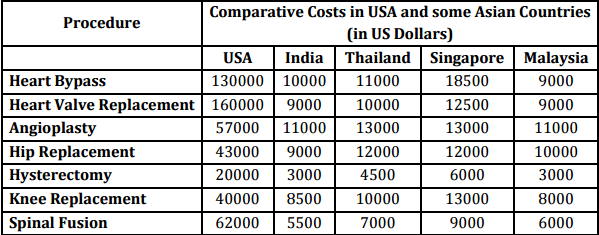
The Table I shows the comparative costs, in US Dollars, of major surgeries in USA and a select few Asian countries.

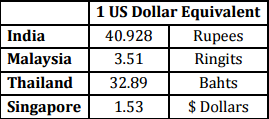
The equivalent of US Dollar in the local currencies is given in Table II.

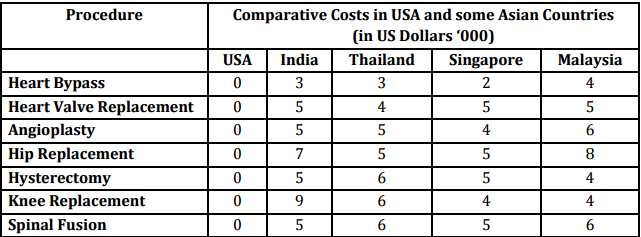
A consulting firm found that the quality of the health services were not the same in all the countries above. A poor quality of a surgery may have significant repercussions in future, resulting in more cost in correcting mistakes. The cost of poor quality of surgery is given in Table III

Question 42

A US citizen is hurt in an accident and requires an angioplasty, hip replacement and a knee replacement. Cost of foreign travel and stay is not a consideration since the government will take care of it. Which country will result in the cheapest package, taking cost of poor quality into account?

Answer & explanation

Correct answer: C

Total cost incurred by the american citizen in various countries after taking cost of poor quality into account is ( in '000 USD) America - 57 + 43 + 40 = 140 India - 11 + 9 + 8.5 + 5 + 7 + 9 = 49.5 Thailand - 13 + 12 + 10 + 5 + 5 + 6 = 51 Singapore - 13 + 12 + 13 + 4 + 5 + 4 = 51 Malaysia - 11 + 10 + 8 + 6 + 8 + 4 = 47 Hence the cheapest country is Malaysia.

Question 43

Taking the cost of poor quality into account, which country/countries will be the most expensive for knee replacement?

Answer & explanation

Correct answer: A

Knee replacement cost in the countries given in the options are : India - 17.5 Thailand - 16 Malaysia - 17 Singapore - 12. Hence the costliest treatment is in India.

Question 44

Approximately, what difference in amount in Bahts will it make to a Thai citizen if she were to get a hysterectomy done in India instead of in her native country, taking into account the cost of poor quality? It costs 7500 Bahts for oneway travel between Thailand and India.

Answer & explanation

Correct answer: D

Cost of treatment in India in USD ('000) 8 and in Thailand 10.5. So she pays 2.5 more in Thailand. Converting in Bahts we get 82500. Subtracting the total travelling cost of 15000 Baht from the above. So difference is 67500 Bahts.

Question 45

The rupee value increases to Rs.35 for a US Dollar, and all other things including quality, remain the same. What is the approximate difference in cost, in US Dollars, between Singapore and India for a Spinal Fusion, taking this change into account?

Answer & explanation

Correct answer: B

Cost for operation in India is around = 5500*41. After Rupee value increases, increased cost in USD = 5500*41/35 which is arount 6500 USD. Thus the requires difference in price is 9000(for singapore) - 6500 = 2500 USD.

Passage for questions 4650

DIRECTIONS for the following four questions:

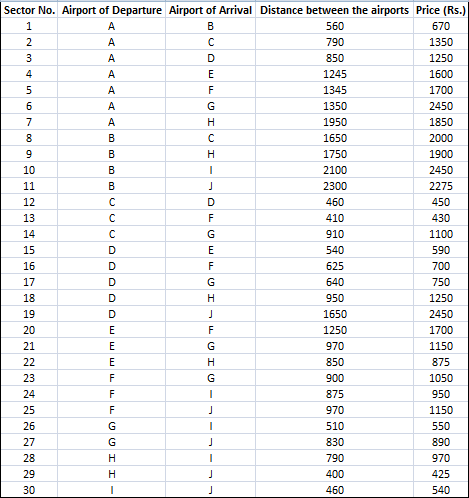
A low-cost airline company connects ten India cities, A to J. The table below gives the distance between a pair of airports and the corresponding price charged by the company. Travel is permitted only from a departure airport to an arrival airport. The customers do not travel by a route where they have to stop at more than two intermediate airports.

Question 46

What is the lowest possible fare, in rupees, from A to J?

Answer & explanation

Correct answer: A

From the table we can see that, the lowest price would be from A to H and H to J. The cost of travel from A to H = Rs 1850 The cost of travel from H to J = Rs 425 Total cost = 1850 + 425 = Rs 2275.

Question 47

The company plans to introduce a direct flight between A and J. The market research results indicate that all its existing passengers travelling between A and J will use this direct flight if it is priced 5% below the minimum price that they pay at present. What should the company charge approximately, in rupees, for this direct flight?

Answer & explanation

Correct answer: B

From the table we can see that, the lowest price would be from A to H and H to J. The cost of travel from A to H = Rs 1850 The cost of travel from H to J = Rs 425 Total cost = 1850 + 425 = Rs 2275 Lowest price = Rs 2275 95% of 2275 = Rs 2161

Question 48

If the airports C, D and H are closed down owing to security reasons, what would be the minimum price, in rupees, to be paid by a passenger travelling from A to J?

Answer & explanation

Correct answer: C

If the airports C, D and H are closed down the minimum price to be paid by a passenger travelling from A to J would be by first travelling to F and then from F to J. The cost of travel from A to F = Rs 1700 The cost of travel from F to J = Rs 1150 Total cost = 1700 + 1150 = Rs 2850

Question 49

If the prices include a margin of 10% over the total cost that the company incurs, what is the minimum cost per kilometer that the company incurs in flying from A to J?

Answer & explanation

Correct answer: B

The minimum cost from A to J we know is 2275. Let the CP to company be C Since 10% over actual CP is the total price i.e. $$\text{CP}\times1.1 = 2275 \rightarrow CP = \frac{2275}{1.1}$$ The total distance is 1950+1400=2350 Km. Cost per Km = $$\dfrac{\frac{2275}{1.1}}{2350}$$ = Rs 0.88/Km

Question 50

If the prices include a margin of 15% over the total cost that the company incurs, which among the following is the distance to be covered in flying from A to J that minimizes the total cost of travel for the company?

Answer & explanation

Correct answer: D

Even if If the prices include a margin of 15% over the total cost that the company incurs, the total cost company incurs would be minimum for route AHJ i.e 2350 km. Hence option D.

QA25 questions

Passage for questions 14

Directions for the following four questions: Each question is followed by two statements A and B. Indicate your responses based on data sufficiency

Question 1

The average weight of a class of 100 students is 45 kg. The class consists of two sections, I and II, each with 50 students. The average weight, $$W_I$$ , of Section I is smaller than the average weight, $$W_{II}$$ , of Section II. If the heaviest student, say Deepak, of Section II is moved to Section I, and the lightest student, say Poonam, of Section I is moved to Section II, then the average weights of the two sections are switched, i.e., the average weight of Section I becomes $$W_{II}$$ and that of Section II becomes $$W_I$$ . What is the weight of Poonam? A: $$W_{II} - W_I = 1.0 $$ B: Moving Deepak from Section II to I (without any move from I to II) makes the average weights of the two sections equal.

Answer & explanation

Correct answer: C

Let w1 and w2 be average of both the groups respectively. Since average of whole class is 45. $$\frac{50*w1+50*w2}{100} = 45 $$ => w1 + w2 = 90 And if we consider case A we have w2-w1 = 1. From the two equations average weight can be found out. Further using the equations deduced from given condition which are : $$\frac{50*w1-l+h}{50} = w2$$ and $$\frac{50*w2+l-h}{50} = w1$$ where l and h is weight of poonam and deepak respectively. However, both of the above equations are effectively the same. Hence we have two equations and 3 unknowns, thus we cannot find the weights by using statement I alone. If we consider statement B, then we can get another equation. So we will have 3 equations and then we can solve them for the 3 variables. So both the equations are required to answer the question.

Question 2

ABC Corporation is required to maintain at least 400 Kilolitres of water at all times in its factory, in order to meet safety and regulatory requirements. ABC is considering the suitability of a spherical tank with uniform wall thickness for the purpose. The outer diameter of the tank is 10 meters. Is the tank capacity adequate to meet ABC’s requirements? A: The inner diameter of the tank is at least 8 meters. B: The tank weighs 30,000 kg when empty, and is made of a material with density of 3 gm/cc.

Answer & explanation

Correct answer: B

Using statement A alone, we can determine the inner volume of the tank to be at least 4/3 $$\pi$$ (125-64) = 256 $$m^3$$. But we do not know if it is more than 400 $$m^3$$. So, using statement A alone, we cannot determine the answer. Using statement B alone, volume of tank = 30000 kg / 3gm/cc = $$10^7 * 10^{-6}$$ = 10 $$m^3$$ So, inner volume = 4/3 $$\pi$$ 125 - 10 > 400 $$m^3$$ So, using statement B alone, we can answer the question

Question 3

Consider integers x, y and z. What is the minimum possible value of $$x^2 + y^2 + z^2$$? A: x + y + z = 89 B: Among x, y, z two are equal.

Answer & explanation

Correct answer: A

We know that the $$x^2 + y^2 + z^2$$ will be minimum when x = y = z = 89/3 Since that is not an integer, we can consider integer values that are closest to 89/3 Let x = y = 30 and z = 29 => $$x^2 + y^2 + z^2$$ = 2641 If x = y = 29 and z = 31,$$x^2 + y^2 + z^2$$ = 2643 So, the minimum is 2641 So, the question can be answered using statment 1 alone Using statement 2 alone, we cannot answer the question. Option a)

Question 4

Rahim plans to draw a square JKLM with a point O on the side JK but is not successful. Why is Rahim unable to draw the square? A: The length of OM is twice that of OL. B: The length of OM is 4 cm

Answer & explanation

Correct answer: A

If the side of the square is x cm, then the maximum length of OM is $$\sqrt2x$$ The minimum length of OL is x. So, OM can never be 2 times OL So, using statement A alone, we can conclude that Rahim is unable to draw the square. Using statement B alone, we cannot answer the question. So, option a) is the correct answer.

Passage for questions 56

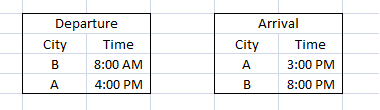
Directions for the following two questions: Cities A and B are in different time zones. A is located 3000 km east of B. The table below describes the schedule of an airline operating non-stop flights between A and B. All the times indicated are local and on the same day.

Assume that planes cruise at the same speed in both directions. However, the effective speed is influenced by a steady wind blowing from east to west. It reduces or increases the speed of plane by 50 km per hour depending on direction of flight.

Question 5

What is the time difference between A and B?

Answer & explanation

Correct answer: D

Let the speed of the plane be p Kmph. So the speed of plane from A to B will be 'p+50' and the speed from B to A will be 'p-50'. We notice that the plane goes from B to A stays there for 1 hr and again come back to B with total time duration 12 hrs. So we have $$\frac{3000}{p-50} + 1 + \frac{3000}{p+50} = 12$$. We can clearly see that speed of the plane is 550 which satisfies the above equation. So for the journey of B to A, the plane takes $$\frac{3000}{550-50} = 6$$ hrs. So time at B when plane reaches at A is 2 pm . Hence the time difference between A and B is 1 hr. Alternatively, Let speed of flight be s, Since A is to the east of B, A is ahead of be in time Let A be ahead of B in time by a hours Departure from A = 4PM, Arrival at B = 8PM Travel time = 8 - 4 +a = 4 + a Since City B is behind city A by 'a' hours, the actual travel time is 'a' hours more than the difference of local times. Similarly when one travels from B to A, since B is ahead of A by 'a' hrs, actual travel time is 'a' hours less than total i.e. B->A Travel time = (3PM - 8AM) - a = 7 -a Total distance travelled = Speed $$\times$$ Time taken ....(1) From A to B, the wind is favourable / in same direction as flight Hence from (1), we have A->B >>> $$3000 = (s+50)(4+a) => 3000(7-a) = (s+50)(4+a)(7-a)$$ ...(2) B->A >>> $$3000 = (s-50)(7-a) => 3000(4+a) = (s-50)(7-a)(4+a)$$ ...(3) (2) - (3) => $$3000(3-2a) = 100(7-a)(4+a) => a^2-63a+62=0 => a=1/62$$ Hence the time difference between A and B is 1 hr.

Question 6

What is the plane’s cruising speed in km per hour?

Answer & explanation

Correct answer: B

Let the speed of the plane be p Kmph. So the speed of plane from A to B will be 'p+50' and the speed from B to A will be 'p-50'. We notice that the plane goes from B to A stays there for 1 hr and again come back to B with total time duration 12 hrs. So we have $$\frac{3000}{p-50} + 1 + \frac{3000}{p+50} = 12$$. On substituting the options, we can clearly see that speed of the plane is 550 which satisfies the above equation.

Passage for questions 78

Directions for the following two questions: Shabnam is considering three alternatives to invest her surplus cash for a week. She wishes to guarantee maximum returns on her investment. She has three options, each of which can be utilized fully or partially in conjunction with others. Option A: Invest in a public sector bank. It promises a return of +0.10%. Option B: Invest in mutual funds of ABC Ltd. A rise in the stock market will result in a return of +5%, while a fall will entail a return of – 3%. Option C: Invest in mutual funds of CBA Ltd. A rise in the stock market will result in a return of – 2.5%, while a fall will entail a return of + 2%.

Question 7

The maximum guaranteed return to Shabnam is

Answer & explanation

Correct answer: C

Let a, b and c be the percentages of amount invested in options A, B and C respectively => a + b + c = 100 Return attained if there is a rise in the stock market => 0.001a + 0.05b - 0.025c Return attained if there is a fall in the stock market => 0.001a - 0.03b + 0.02c Maximum guaranteed return is attained when both are equal because it is indifferent to rise and fall in the market. 0.001a + 0.05b - 0.025c = 0.001a - 0.03b + 0.02c => 0.08b = 0.045c => 16b = 9c Let's put the values for a, b and c that satisfy the above equation. b = 9, c = 16, a = 75 => return = 0.125 b = 18, c = 32, a = 50 => return = 0.15 b = 27, c = 48, a = 25 => return = 0.175 b = 36, c = 64, a = 0 => return = 0.2 Hence, the maximum guaranteed return is 0.2%

Question 8

What strategy will maximize the guaranteed return to Shabnam?

Answer & explanation

Correct answer: B

Let a, b and c be the percentages of amount invested in options A, B and C respectively => a + b + c = 100 Return attained if there is a rise in the stock market => 0.001a + 0.05b - 0.025c Return attained if there is a fall in the stock market => 0.001a - 0.03b + 0.02c Maximum guaranteed return is attained when both are equal because it is indifferent to rise and fall in the market. 0.001a + 0.05b - 0.025c = 0.001a - 0.03b + 0.02c => 0.08b = 0.045c => 16b = 9c Let's put the values for a, b and c that satisfy the above equation. b = 9, c = 16, a = 75 => return = 0.125 b = 18, c = 32, a = 50 => return = 0.15 b = 27, c = 48, a = 25 => return = 0.175 b = 36, c = 64, a = 0 => return = 0.2 Hence, the maximum guaranteed return is 0.2% and it is attained when 36% is invested in option B and 64% is invested in option C.

Passage for questions 910

Directions for the following two questions: Let S be the set of all pairs (i, j) where 1 <= i < j <= n , and n >= 4 (i and j are natural numbers). Any two distinct members of S are called “friends” if they have one constituent of the pairs in common and “enemies” otherwise. For example, if n = 4, then S = {(1, 2), (1, 3), (1, 4), (2, 3), (2, 4), (3, 4)}. Here, (1, 2) and (1, 3) are friends, (1,2) and (2, 3) are also friends, but (1,4) and (2, 3) are enemies.

Question 9

For general n, how many enemies will each member of S have?

Answer & explanation

Correct answer: D

Any ordered pair has 2 elements => There are n-2 elements that are not present in the ordered pair. The number of enemies of any ordered pair is all the ordered pairs in the set formed using the numbers other than these two elements = $$^{n-2}C_2$$ = $$1/2 * (n^2 - 5n + 6)$$.

Question 10

For general n, consider any two members of S that are friends. How many other members of S will be common friends of both these members?

Answer & explanation

Correct answer: D

For n, the number of elements in set S is $$^nC_2$$. Lets say the 2 friends are (x,a) and (y,a) These two friends have 3 numbers in total and 1 common element(say a) (as both elements cannot be exactly same) They have 2 non common elements(x, y) The number of common friends is formed by the non-common elements of the friends (x,y) + the number of elements in the set which have the common element other than the two friends (a,c), (a,d) and so on = 1 + (n-1 - 2) = n-2. For the example in question, if the friends are (1,2) and (1,3), then common friends are (2,3) and all other elements with 1 All elements with 1 = n-1= 3 which are (1,2) (1,3) (1,4) excluding the friends (1,2) and (1,3) only 1 other friend is common. Hence it is 1+(n-1)-2=n-2

Passage for questions 1112

Directions for the following two questions: Mr. David manufactures and sells a single product at a fixed price in a niche market. The selling price of each unit is Rs. 30. On the other hand, the cost, in rupees, of producing x units is $$240 + bx + cx^2$$ , where b and c are some constants. Mr. David noticed that doubling the daily production from 20 to 40 units increases the daily production cost by 66.67%. However, an increase in daily production from 40 to 60 units results in an increase of only 50% in the daily production cost. Assume that demand is unlimited and that Mr. David can sell as much as he can produce. His objective is to maximize the profit.

Question 11

How many units should Mr. David produce daily?

Answer & explanation

Correct answer: B

Cost of 20 units = 240+20b+400c Cost of 40 units = 240+40b+1600c = 5/3 * (240+20b+400c) => 720+120b+4800c = 1200+100b+2000c => 480 = 20b + 2800c => 120 = 5b + 700c Cost of 60 units = 240+60b+3600c = 3/2 (240+40b+1600c) => 480 + 120b + 7200c = 720 + 120b + 4800c => 240 = 2400c => c = 1/10 and b = 10 Let the number of items needed for max profit be k CP = $$240+10k+k^2/10$$ SP = 30k Profit = SP - CP = $$30k - 240 - 10k - k^2/10$$ = $$20k - 240 - k^2/10$$ or Profit = $$\frac{1}{10} (-k^2 + 200k - 2400)$$ or, Profit = $$\frac{1}{10} (-(k^2 - 200k + 2400))$$ or, Profit = $$\frac{1}{10} (-(k^2 - 200k + 2400 + 7600 - 7600))$$ or, Profit = $$\frac{1}{10} (-(k^2 - 200k + 10000) + 7600)$$ or, Profit = $$\frac{1}{10} (-(k - 100)^2 + 7600)$$ To maximise the value of Profit, $$-(k - 100)^2$$ must be 0. So, $$k$$ must be equal to 100. Hence, option B is the correct answer.

Question 12

What is the maximum daily profit, in rupees, that Mr. David can realize from his business?

Answer & explanation

Correct answer: D

Cost of 20 units = 240+20b+400c Cost of 40 units = 240+40b+1600c = 5/3 * (240+20b+400c) => 720+120b+4800c = 1200+100b+2000c => 480 = 20b + 2800c => 120 = 5b + 700c Cost of 60 units = 240+60b+3600c = 3/2 (240+40b+1600c) => 480 + 120b + 7200c = 720 + 120b + 4800c => 240 = 2400c => c = 1/10 and b = 10 Let the number of items needed for max profit be k CP = $$240+10k+k^2/10$$ SP = 30k Profit = SP - CP = $$30k - 240 - 10k - k^2/10$$ = $$20k - 240 - k^2/10$$ Maximum when 20 - k/5 = 0 or k = 100 Profit = 2000 - 240 - 1000 = 760

Passage for questions 1314

Directions for the following two questions: Let $$a_1= p$$ and $$b_1 = q$$, where p and q are positive quantities. Define $$a_n = pb_{n-1} , b_n = qb_{n-1}$$ , for even n > 1. and $$a_n = pa_{n-1} , b_n = qa_{n-1}$$ , for odd n > 1.

Question 13

Which of the following best describes $$a_n + b_n$$ for even n?

Answer & explanation

Correct answer: B

$$a_n + b_n$$ for even n = $$p*b_{n-1} + q*b_{n-1}$$ = $$(p+q)*b_{n-1}$$ $$b_{n-1} = q*a_{n-2} = qp*b_{n-3}$$ = $$q^2*p*a_{n-4} = q^2p^2*b_{n-5}$$ . . = $$(qp)^{n/2-1}*b_1 = (qp)^{n/2-1}*q$$ So, $$a_n + b_n$$ = $$q(pq)^{(n/2) -1}(p+q)$$

Question 14

If p = 1/3 and q = 2/3 , then what is the smallest odd n such that $$a_n+b_n < 0.01$$?

Answer & explanation

Correct answer: D

$$a_{n} + b_{n}$$ (n is odd) = $$p^{\frac{n+1}{2}}*q^{\frac{n-1}{2}} + p^{\frac{n -1}{2}}*q^{\frac{n+1}{2}}$$ = $$(p + q)pq^{\frac{n-1}{2}}$$ Substituting the values of p and q we get $$a_{n} + b_{n}$$ = $$(\frac{2}{9})^{\frac{n-1}{2}}$$ Now substitute the values of n and check. We can see that the lowest value of n for which $$a_{n} + b_{n}$$ < .01 is 9

Question 15

Consider the set S = {2, 3, 4, ...., 2n+1}, where n is a positive integer larger than 2007. Define X as the average of the odd integers in S and Y as the average of the even integers in S. What is the value of X - Y ?

Answer & explanation

Correct answer: B

The odd numbers in the set are 3, 5, 7, ...2n+1 Sum of the odd numbers = 3+5+7+...+(2n+1) = $$n^2 + 2n$$ Average of odd numbers = $$n^2 + 2n$$/n = n+2 Sum of even numbers = 2 + 4 + 6 + ... + 2n = 2(1+2+3+...+n) = 2*n*(n+1)/2 = n(n+1) Average of even numbers = n(n+1)/n = n+1 So, difference between the averages of even and odd numbers = 1

Question 16

Ten years ago, the ages of the members of a joint family of eight people added up to 231 years. Three years later, one member died at the age of 60 years and a child was born during the same year. After another three years, one more member died, again at 60, and a child was born during the same year. The current average age of this eight-member joint family is nearest to

Answer & explanation

Correct answer: E

Ten years ago, the total age of the family is 231 years. Seven years ago, (Just before the death of the first person), the total age of the family would have been 231+8*3 = 231+24 = 255. This is because, in 3 years, every person in the family would have aged by 3 years, Total change in age = 231+24 = 255 After the death of one member, the total age is 255-60 = 195 years. Since a child takes birth in the same year, the number of members remain the same i.e. (7+1) = 8 Four years ago, (i.e. 6 years after start date) one of the member of age 60 dies, therefore, total age of the family is 195+24-60 = 159 years. Since a child takes birth in the same year, the number of members remain the same i.e. (7+1) = 8 After 4 more years, the current total age of the family is = 8x4 + 159 = 191 years The average age is 191/8 = 23.875 years = 24 years (approx) Alternatively, Since the number of members is always the same throughout The 2 older members dropped their age by 60 So, after 10yrs, total age = 231 + 8*10 - 2*60 = 191 Average age = 191/8 = 23.875 $$\simeq$$ 24

Question 17

A function $$f (x)$$ satisfies $$f(1) = 3600$$, and $$f (1) + f(2) + ... + f(n) =n^2f(n)$$, for all positive integers $$n > 1$$. What is the value of $$f (9)$$ ?

Answer & explanation

Correct answer: A

According to given conditions we get f(2)=f(1)/3 , then f(3)=f(1)/6, then f(4)=f(1)/10 , then f(5)=f(1)/15 . We can see the pattern here that the denominator goes on increasing from 3,3+3,6+4,10+5,15+6,.. so for the f(9) the denominator will be same as 15+6+7+8+9=45 . So f(9)=3600/45 = 80

Question 18

Suppose you have a currency, named Miso, in three denominations: 1 Miso, 10 Misos and 50 Misos. In how many ways can you pay a bill of 107 Misos?

Answer & explanation

Correct answer: C

If two 50 Misos are used, the 107 can be paid in only 1 way. If one 50 Miso is used, the number of ways of paying 107 is 6 - zero 10 Miso, one 10 Miso and so on till five 10 Misos. If no 50 Miso is used, the number of ways of paying 107 is 11 - zero 10 Miso, one 10 Miso and so on till ten 10 Misos. So, the total number of ways is 18

Question 19

A confused bank teller transposed the rupees and paise when he cashed a cheque for Shailaja, giving her rupees instead of paise and paise instead of rupees. After buying a toffee for 50 paise, Shailaja noticed that she was left with exactly three times as much as the amount on the cheque. Which of the following is a valid statement about the cheque amount?

Answer & explanation

Correct answer: D

Let the value of cheque be x Rs and y ps and the amount she received is y Rs and x ps. After 50 ps is deducted she has the amount which is 3 times the amount on cheque, So 100y+x-50=3(100x+y) (After converting the amount in paise) y= (299x+50)/97 = 3x+ (8x+50)/97 Since x is an integer, 3x will definitely be an integer. Now, (8x+50)/97 has to be an integer for y to be an integer. So, 8x+50 has to be a multiple of 97. 8x+50= 97 $$\Rightarrow$$ x = 47/8, this value of x is not an integer. 8x+50= 97*2 = 194 8x = 144 $$\Rightarrow$$ x = 144/8 = 18. Here, we got an integer. So, the amount has to be 18 rupees and some paise. Hence, option D is correct.

Question 20

How many pairs of positive integers m, n satisfy 1/m + 4/n = 1/12 , where n is an odd integer less than 60?

Answer & explanation

Correct answer: E

1/m + 4/n = 1/12 So, 1/m = 1/12 - 4/n So, m = 12n/(n-48) Since m is positive, n should be greater than 48 Also, since n is an odd number, it can take only 49, 51, 53, 55, 57 and 59 If n = 49, 51, 57 then m is an integer, else it is not an integer So, there are 3 pairs of values for which the equation is satisfied

Question 21

In a tournament, there are n teams $$T_1 , T_2 ....., T_n$$ with $$n > 5$$. Each team consists of k players, $$k > 3$$. The following pairs of teams have one player in common: $$T_1$$ & $$T_2$$ , $$T_2$$ & $$T_3$$ ,......, $$T_{n-1}$$ & $$T_n$$ , and $$T_n$$ & $$T_1$$ . No other pair of teams has any player in common. How many players are participating in the tournament, considering all the n teams together?

Answer & explanation

Correct answer: A

The number of players in all the teams put together = k * n The number of players that are common is 1*n = n So, the number of players in the tournament = kn - n = n(k-1)

Question 22

Consider four digit numbers for which the first two digits are equal and the last two digits are also equal. How many such numbers are perfect squares?

Answer & explanation

Correct answer: E

Let the number be xxyy xxyy = 1000x + 100x + 10y +y = 1100x+11y = 11(100x+y) Since xxyy is a perfect square, and 11 is one of the factors, it should be a multiple of 121 So, xxyy = 121k, where k is also a perfect square. For k = 4, xxyy is a 3 digit number and for k > 82, xxyy is a five digit number Between 4 and 82, only for k = 64, the number is of the form xxyy 121*64 = 7744 So, there is only 1 number 7744 which is of the form xxyy and a perfect square. Alternatively: The number should be definitely more than 32 and less than 100 as the square is a two digit number. A number of such form can be written as $$(50 \pm a)$$ and $$100 - a$$ where $$0 \leq a \leq 100$$ So, the square would be of form $$(50 \pm a)^2 = 2500 + a^2 \pm 100a$$ or $$ (100 - a)^2$$ i.e. $$10000 + a^2 + 200 a$$ In both cases, only $$a^2$$ contributes to the tens and ones digit. Among squares from 0 to 25, only 12 square i.e. 144 has repeating tens and ones digit. So, the number can be 38, 62, or 88. Checking these squares only 88 square is in the form of xxyy i.e. 7744.

Question 23

The price of Darjeeling tea (in rupees per kilogram) is 100 + 0.10n, on the nth day of 2007 (n=1, 2, ..., 100), and then remains constant. On the other hand, the price of Ooty tea (in rupees per kilogram) is 89 + 0.15n, on the nth day of 2007 (n = 1, 2, ..., 365). On which date in 2007 will the prices of these two varieties of tea be equal?

Answer & explanation

Correct answer: C

Price of Darjeeling tea on 100th day= 100+(0.1*100)=110 Price of Ooty tea on nth day= 89+0.15n Let us assume that the price of both varieties of tea would become equal on nth day where n<=100 So 89+0.15n=100+0.1n n=220 which does not satisfy the condition of n<=100 So the price of two varieties would become equal after 100th day. 89+0.15n=110 n=140 140th day of 2007 is May 20 (Jan=31,Feb=28,March=31,April=30,May=20)

Question 24

Two circles with centres P and Q cut each other at two distinct points A and B. The circles have the same radii and neither P nor Q falls within the intersection of the circles. What is the smallest range that includes all possible values of the angle AQP in degrees?

Answer & explanation

Correct answer: C

To know the range, we have to take the limiting case.

The limiting case in this case is when the circles pass through each other's centers.

In this case, PQ = AP = AQ => They form an equilateral triangle => angle AQP = 60 degrees.

So, the maximum possible angle is 60 degrees.

Another limiting case is when the circles touch each other externally.

In this case, angle AQP = 0 degrees.

Hence, the range is 0 to 60.

Question 25

A quadratic function f(x) attains a maximum of 3 at x = 1. The value of the function at x = 0 is 1. What is the value of f (x) at x = 10?

Answer & explanation

Correct answer: B

Let the function be $$ax^2 + bx + c$$. We know that x=0 value is 1 so c=1. So equation is $$ax^2 + bx + 1$$. Now max value is 3 at x = 1. So after substituting we get a + b = 2. If f(x) attains a maximum at 'a' then the differential of f(x) at x=a, that is, f'(a)=0. So in this question f'(1)=0 => 2*(1)*a+b = 0 => 2a+b = 0. Solving the equations we get a=-2 and b=4. $$ -2x^2 + 4x + 1$$ is the equation and on substituting x=10, we get -159.