CAT Prep / PYQ / CAT 2024 — Slot 2

CAT 2024 — Slot 2

68 questions with answers and explanations

Take this as a timed mock →

VARC24 questions

Question 1

There is a sentence that is missing in the paragraph below. Look at the paragraph and decide where (option 1, 2, 3, or 4) the following sentence would best fit. Sentence : Science has officially crowned us superior to our early-rising brethren. Paragraph : My fellow night owls, grab a strong cup of coffee and gather around: I have great news. ___(1)___. For a long time, our kind has been unfairly maligned. Stereotyped as lazy and undisciplined. Told we ought to be morning larks. Advised to go to bed early so we can wake before 5am and run a marathon before breakfast like all high-flyers seem to do. Now, however, we are having the last laugh. ___(2)___. It may be a tad more complicated than that. A study published last week, which you may have already seen while scrolling at 1am, suggests that staying up late could be good for brain power. ___(3)___. Is this study a thinly veiled PR exercise conducted by a caffeine-pill company? Nope, it’s legit. ___(4)___. Research led by academics at Imperial College London studied data on more than 26,000 people and found that “self-declared ‘night owls’ generally tend to have higher cognitive scores”.

Answer & explanation

Correct answer: D

D) Option 2 is the correct answer. The sentence before option 2 states "Now, however, we are having the last laugh". The reason they are having the last laugh is given in the sentence, "Science has officially crowned us superior to our early-rising brethren." Therefore, it fits here perfectly forming a coherent paragraph. A) Option 4 : Placing the sentence here would seem a bit disconnected. The sentence before and after Blank 4 flows continuously and placing the sentence here would break this flow B) Option 3 : This placement would disrupt the flow of the sentence before and after Blank 3. The study mentioned before, blank 3, is the moment where the night owl's position is validated, so introducing the idea of "superiority" will be out of place and feel redundant. C) Option 1 : It may seem plausible initially, but it would not be right to talk about the claim without first mentioning the negative stereotypes, making this placement less effective.
Question 2

Five jumbled up sentences (labelled 1, 2, 3, 4 and 5), related to a topic, are given below. Four of them can be put together to form a coherent paragraph. Identify the odd sentence and key in the number of that sentence as your answer. 1. No known real researcher of human behaviour would say that gender is all nature or all nurture. 2. The evidence for a biological basis for gender certainly doesn’t mean we should be complacent in the face of sexism. 3. Many people are uncomfortable with the idea that gender is not purely a social construct. 4. Despite this empirical truth, researchers who study the biological basis of gender often face political pushback. 5. There’s a political preference for gender to be only a reflection of social factors and so entirely malleable.

Up to 2 decimal places. No negative marking for TITA.

Answer & explanation

Correct answer: 2

Sentence 2 is the odd one out. Sequence 1435 forms a coherent paragraph: Sentence 1 introduces the debate about gender being influenced by both biological and social factors. It sets the tone for the paragraph, addressing the complexity of gender. Sentence 4 follows logically from Sentence 1. After introducing the complexity of gender, it suggests that, even with the acknowledgment of both nature and nurture, researchers studying gender's biological basis still face political challenges. Sentence 3 builds on Sentence 4, highlighting why researchers studying the biological aspects of gender face resistance. The public discomfort with viewing gender as more than just a social construct is explained. Sentence 5 connects to Sentence 3 by elaborating on the political preference for viewing gender purely as a social construct, reinforcing the challenges faced by researchers advocating for a more nuanced view of gender. Sentence 2 doesn't fit in the context of the paragraph . The rest of the sentences are focused on the complexities of gender as a mix of nature and nurture and the political and societal challenges researchers face. Sentence 2 shifts the focus to the issue of sexism, which, while related to gender, does not directly tie into the previous sentences discussing the nature vs. nurture debate and the political resistance to biological explanations.

Question 3

There is a sentence that is missing in the paragraph below. Look at the paragraph and decide where (option 1, 2, 3, or 4) the following sentence would best fit. Sentence : [T]he Europeans did not invent globalization. Paragraph : The first phase of globalization occurred long before the introduction of either steam or electric power…Chinese consumers at all social levels consumed vast quantities of spices, fragrant woods and unusual plants. The peoples of Southeast Asia who lived in forests gave up their traditional livelihoods and completely reoriented their economies to supply Chinese consumers….___(1)___. These exchanges of the year 1000 opened some of the routes through which goods and peoples continued to travel after Columbus traversed the mid- Atlantic. ___(2)___. Yet the world of 1000 differed from that of 1492 in important ways….the travellers who encountered one another in the year 1000 were much closer technologically. ___(3)___. They changed and augmented what was already there since 1000. ___(4)___. If globalization hadn’t yet begun, Europeans wouldn’t have been able to penetrate the markets in so many places as quickly as they did after 1492.

Answer & explanation

Correct answer: D

We can attempt to place the given sentence by breaking the passage down into three segments - The discussion till Blank (2) can be considered the first segment: it introduces the idea that globalization was already underway well before the industrial era. It highlights the economic interconnectedness between Chinese consumers and Southeast Asian suppliers, emphasizing that trade networks and economic reorientations were already shaping societies. The missing sentence does not fit here in Blanks (1) or (2) because the focus is on early economic exchange rather than the role of Europeans in globalization. The discussion between Blanks (2) and (3) can be labelled as the second segment: it explores how trade routes developed in the year 1000, predating Columbus’s journey. It sets up a comparison between different historical periods - 1000 and 1492 - but the idea this comparison is leading to is still unclear. This is where the final segment [the discussion after Blank (3)] fits in. It delivers the passage’s key argument: European involvement in global trade was not a beginning but a continuation of pre-existing systems. It reinforces the idea that the economic structures and trade routes established before 1492 were instrumental in enabling European expansion. The given sentence would best fit Blank (3) because we make a declaration ["The Europeans did not invent globalization"] and then follow up with information that reinforces this idea [“They changed and augmented what was already there since 1000”]. Hence, Option D is the correct choice.

Question 4

The passage given below is followed by four alternate summaries. Choose the option that best captures the essence of the passage. Different from individuals, states conduct warfare operations using the DIME model— “diplomacy, information, military, and economics.” Most states do everything they can to inflict pain and confusion on their enemies before deploying the military. In fact, attacks on vectors of information are a well-worn tactic of war and usually are the first target when the charge begins. It’s common for telecom data and communications networks to be routinely monitored by governments, which is why the open data policies of the web are so concerning to many advocates of privacy and human rights. With the worldwide adoption of social media, more governments are getting involved in low-grade information warfare through the use of cyber troops. According to a study by the Oxford Internet Institute in 2020, cyber troops are “government or political party actors tasked with manipulating public opinion online.” The Oxford research group was able to identify 81 countries with active cyber troop operations, utilizing many different strategies to spread false information, including spending millions on online advertising.

Answer & explanation

Correct answer: D

The passage starts by explaining how states use the DIME model in warfare, often targeting information systems first to destabilize enemies. Governments monitor communication networks, raising privacy concerns. With social media's rise, many countries employ "cyber troops" to manipulate public opinion online, spreading disinformation through tactics like paid ads. Option D best captures all these points. Option A : This option incorrectly focuses on open data policies being used to deploy cyber troops, which the passage does not emphasize. Option B : This option fails to address the key part of the passage, which is monitoring telecom data and networks. Option C : The passage does not indicate that governments conduct warfare simultaneously with military forces; rather, they act before involving the military. We can infer this from the statement, "Most states do everything they can to inflict pain and confusion on their enemies before deploying the military."

Question 5

The passage given below is followed by four alternate summaries. Choose the option that best captures the essence of the passage. John Cleese told Fox News Digital that comedians do not have the freedom to be funny in 2022. “There’s always been limitations on what they’re allowed to say,” Cleese said. “I think it’s particularly worrying at the moment because you can only create in an atmosphere of freedom, where you’re not checking everything you say critically before you move on. What you have to be able to do is to build without knowing where you’re going because you’ve never been there before. That’s what creativity is — you have to be allowed to build. And a lot of comedians now are sitting there and when they think of something, they say something like, ‘Can I get away with it? I don’t think so. So and so got into trouble, and he said that, oh, she said that.’ You see what I mean? And that’s the death of creativity.”

Answer & explanation

Correct answer: D

Option D best captures the essence of the passage. John Cleese argues that comedians need freedom to be creative and that fear of offending people or worrying about the consequences of what they say hinders their ability to be original. He highlights how modern comedians often second-guess themselves, which stifles their creativity. Option D reflects this idea, which stresses the importance of freedom and creativity in comedy, while warning against the fear that stifles innovation. Option A : While Cleese advocates for freedom in comedy, he doesn't say that comedians "must go where no one has gone before, " which is more of an extreme interpretation than the essence of the passage. Option B : This option focuses too much on the relationship between creativity and critical thinking. The passage is more about how fear of offending hinders creativity, not about creativity being incompatible with critical thinking. Option C : This focuses on the "death of the art form," but Cleese's main point is about how fear of repercussions impacts creativity, not about the art form dying as such.

Question 6

There is a sentence that is missing in the paragraph below. Look at the paragraph and decide where (option 1, 2, 3, or 4) the following sentence would best fit. Sentence : Yet each day the flock produced eggs with calcareous shells though they apparently had not ingested any calcium from land which was entirely lacking in limestone. Paragraph : Early in this century a young Breton schoolboy who preparing himself for a scientific career began to notice a strange fact about hens in his father's poultry yard. ___(1) ___. As they scratched the soil they constantly seemed to be pecking at specks of mica, a siliceous material dotting the ground. ___(2)___. No one could explain to Louis Kervran why the chickens selected the mica, or why each time a bird was killed for the family cooking pot no trace of the mica could be found in its gizzard. ___(3) ___. It took Kervran many years to establish that the chickens were transmuting one element into another. ___(4)___.

Answer & explanation

Correct answer: B

Evaluation of the options: Option 1: The sentence starting with "Yet each day..." would not fit here. This part is introducing Kervran’s initial observations about the hens. Inserting this sentence would feel disjointed because the paragraph hasn't yet explained the significance of the eggs. Option 2: The sentence wouldn't fit here either. The focus here is on what the hens are doing (pecking mica), and the sentence about eggs feels disconnected from this point in the narrative. Option 3: The sentence about the eggs fits perfectly here because it explains a key element of the puzzle: the hens are producing eggs with calcareous shells despite not having an obvious source of calcium. This provides a crucial piece of information that explains why Kervran was puzzled in the first place. It ties directly to the anomaly he is investigating. Option 4: It won't fit here as the paragraph has already shifted to Kervran's conclusion about the chickens transmuting one element to into another. Inserting the sentence about the eggs here would introduce new information too late, disrupting the focus on Kervran's final findings. Therefore, The sentence fits best in Option 3. It helps to explain Kervran's puzzling observations and contributes to the mystery that he's trying to solve, all while maintaining a smooth narrative flow. The other options either disrupt the flow or introduce new information too soon or too late.

Passage for questions 710

The passage below is accompanied by four questions. Based on the passage, choose the best answer for each question. The history of any major technological or industrial advance is inevitably shadowed by a less predictable history of unintended consequences and secondary effects — what economists sometimes call “externalities.” Sometimes those consequences are innocuous ones, or even beneficial. Gutenberg invents the printing press, and literacy rates rise, which causes a significant part of the reading public to require spectacles for the first time, which creates a surge of investment in lens-making across Europe, which leads to the invention of the telescope and the microscope. Oftentimes the secondary effects seem to belong to an entirely different sphere of society. When Willis Carrier hit upon the idea of air-conditioning, the technology was primarily intended for industrial use: ensuring cool, dry air for factories that required low-humidity environments. But…it touched off one of the largest migrations in the history of the United States, enabling the rise of metropolitan areas like Phoenix and Las Vegas that barely existed when Carrier first started tinkering with the idea in the early 1900s. Sometimes the unintended consequence comes about when consumers use an invention in a surprising way. Edison famously thought his phonograph, which he sometimes called “the talking machine,” would primarily be used to take dictation….But then later innovators… discovered a much larger audience willing to pay for musical recordings made on descendants of Edison’s original invention. In other cases, the original innovation comes into the world disguised as a plaything…the way the animatronic dolls of the mid-1700s inspired Jacquard to invent the first “programmable” loom and Charles Babbage to invent the first machine that fit the modern definition of a computer, setting the stage for the revolution in programmable technology that would transform the 21st century in countless ways. We live under the gathering storm of modern history’s most momentous unintended consequence….carbon-based climate change. Imagine the vast sweep of inventors whose ideas started the Industrial Revolution, all the entrepreneurs and scientists and hobbyists who had a hand in bringing it about. Line up a thousand of them and ask them all what they had been hoping to do with their work. Not one would say that their intent had been to deposit enough carbon in the atmosphere to create a greenhouse effect that trapped heat at the surface of the planet. And yet here we are. Ethyl (leaded fuel) and Freon belonged to the same general class of secondary effect: innovations whose unintended consequences stem from some kind of waste by-product that they emit. But the potential health threats of Ethyl (unleaded fuel) were visible in the 1920s, unlike, say, the long-term effects of atmospheric carbon build up in the early days of the Industrial Revolution…. Indeed, it is reasonable to see CFCs (chlorofluorocarbons) as a forerunner of the kind of threat we will most likely face in the coming decades, as it becomes increasingly possible for individuals or small groups to create new scientific advances — through chemistry or biotechnology or materials science — setting off unintended consequences that reverberate on a global scale.

Question 7

The author lists all of the following examples as “externalities” of major technical advances EXCEPT:

Answer & explanation

Correct answer: B

Option B is the correct answer. This is not an externality because it was the original intended use of air-conditioning. The passage mentions that Carrier invented air-conditioning to ensure cool, dry air for factories with low-humidity requirements. The other options are externalities: Option A: This is an unintended consequence. CFCs were initially used in refrigeration and air-conditioning, but their long-term environmental impact (ozone depletion) was not anticipated. Option C: The Jacquard loom was originally a mechanical device for weaving patterns in fabric, but it led to the development of programmable machines, which had far-reaching effects on modern computing, which was also an unintended consequence of the loom's invention. Option D: The passage states that the phonograph was initially designed for dictation but was adapted for music recording, which was an unintended consequence.

Question 8

Which of the following best conveys the main point of the first paragraph?

Answer & explanation

Correct answer: B

Option B is the correct answer. The first paragraph discusses how technological or industrial advances are often accompanied by unintended consequences or secondary effects, which may not be fully understood or predictable at the time of the invention. It gives the example of the printing press, which led to unexpected developments such as the creation of spectacles, and later, the telescope and microscope. This is well captured in Option B. Option A: While some secondary effects may be beneficial, the focus of the paragraph is more on the unpredictability and far-reaching nature of these effects, rather than their inherent benefit. Option C: The paragraph doesn't advocate judging inventions by their secondary effects. Instead, it mentions that these effects are unpredictable and sometimes surprising. The main point is their unpredictability, not how to judge an invention. Option D: The paragraph does not suggest that the impact of a technological advance should be evaluated by the boost its secondary effects give to generating further technological advances.

Question 9

Carrier, Babbage, and Edison are mentioned in the passage to illustrate the author’s point that

Answer & explanation

Correct answer: B

Option B is the correct answer. The author mentions Carrier, Babbage, and Edison to emphasize that the inventors' original intentions were not related to the unexpected societal impacts their inventions had: Option A: The secondary effects are shown as surprising or leading to unforeseen societal changes, rather than leading to more inventions. Option C: The passage doesn't claim that the unintended consequences were largely beneficial. While some consequences may have been beneficial (like the telescope and microscope from the printing press), others (like climate change ) have been harmful. Option D: This is close, but it's not the main point. The intended purpose of the inventions may have been different from their actual use, but the author’s primary argument is about how the inventors could not have predicted the full societal impacts of their inventions, rather than focusing on how inventions end up being used for different purposes.

Question 10

We can assume that the author would support all of the following views EXCEPT:

Answer & explanation

Correct answer: A

Option A is the correct answer. The author does not imply that recent advances are more threatening than past ones. Instead, he suggests that the nature of technological progress (with more individuals and smaller groups able to innovate) has changed, leading to new risks. The focus is not on comparing "past vs. recent" as more threatening but on the unexpected global impacts of all technological advances. Thus, option A misrepresents the author's view. Option B: The author would agree with this because the passage explains that Ethyl (leaded fuel) and Freon are examples of innovations whose unintended consequences stem from by-products they emitted (such as lead from fuel and chemicals from Freon), which had secondary effects on health and the environment. Option C: The author would support this as he mentions how individuals or small groups can now create innovations that have global impacts, particularly in fields like biotechnology and chemistry, which was less true in the past. Option D: The author suggests that the health threats of leaded fuel were visible earlier (in the 1920s), implying that they should have been addressed sooner. Hence, the author would support this

Question 11

The passage given below is followed by four alternate summaries. Choose the option that best captures the essence of the passage. Recent important scientific findings have emerged from crossing the boundaries of scientific fields. They stem from physicists collaborating with biologists, sociologists and others, to answer questions about our world. But physicists and their potential collaborators often find their cultures out of sync. For one, physicists often discard a lot of information while extracting broad patterns; for other scientists, information is not readily disposed. Further, many non-physicists are uncomfortable with mathematical models. Still, the desire to work on something new and different is real, and there are clear benefits from the collision of views.

Answer & explanation

Correct answer: A

Option A is the correct answer. Option A captures the core idea that their collaborations have led to valuable scientific discoveries despite differences in research methods between physicists and other scientists. The passage emphasizes how these contrasting approaches still lead to productive outcomes, demonstrating the benefits of cross-disciplinary work. Option B: While large data sets and mathematical models are mentioned, this option incorrectly focuses on "large data sets and mathematical models" as the main contributor, which is not the main point of the passage. Option C: This is partially true, but the passage does not emphasize the "desire to diversify" research or focus on social scientists. It is about the collaboration of different scientific fields, not specifically social science. Option D: This is inaccurate because the passage does not state that physicists have "buried" their differences; rather, it says that their differences exist, but the collaboration is still valuable. This is an extreme interpretation.

Question 12

Five jumbled up sentences (labelled 1, 2, 3, 4 and 5), related to a topic, are given below. Four of them can be put together to form a coherent paragraph. Identify the odd sentence and key in the number of that sentence as your answer. 1. The UK is a world leader in developing cultivated meat and the approval of a cultivated pet food is an important milestone. 2. If we’re to realise the full potential benefits of cultivated meat the government must invest in research and infrastructure. 3. The first UK applications for cultivated meat produced for humans remain under assessment with the Food Standards Agency. 4. The previous UK government had been looking at fast-tracking the approval of cultivated meat for human consumption. 5. It underscores the potential for new innovation to help reduce the negative impacts of intensive animal agriculture.

Up to 2 decimal places. No negative marking for TITA.

Answer & explanation

Correct answer: 4

Sentence 4 is the odd one out. Sentences 1, 2, 3, and 5 all focus on the current status and future prospects of cultivated meat in the UK, such as the leadership in developing cultivated meat, regulatory assessments, and the importance of government investment in research. Sentence 4, however, refers to the previous UK government's efforts to fast-track approval of cultivated meat which is disconnected from the other sentences, as the focus shifts to a past action rather than the current developments or future needs in the industry.

Passage for questions 1316

The passage below is accompanied by four questions. Based on the passage, choose the best answer for each question. The job of a peer reviewer is thankless. Collectively, academics spend around 70 million hours every year evaluating each other’s manuscripts on the behalf of scholarly journals — and they usually receive no monetary compensation and little if any recognition for their effort. Some do it as a way to keep abreast with developments in their field; some simply see it as a duty to the discipline. Either way, academic publishing would likely crumble without them. In recent years, some scientists have begun posting their reviews online, mainly to claim credit for their work. Sites like Publons allow researchers to either share entire referee reports or simply list the journals for whom they’ve carried out a review…. The rise of Publons suggests that academics are increasingly placing value on the work of peer review and asking others, such as grant funders, to do the same. While that’s vital in the publish-or-perish culture of academia, there’s also immense value in the data underlying peer review. Sharing peer review data could help journals stamp out fraud, inefficiency, and systemic bias in academic publishing.…. Peer review data could also help root out bias. Last year, a study based on peer review data for nearly 24,000 submissions to the biomedical journal eLife found that women and non- Westerners were vastly underrepresented among peer reviewers. Only around one in every five reviewers was female, and less than two percent of reviewers were based in developing countries…. Openly publishing peer review data could perhaps also help journals address another problem in academic publishing: fraudulent peer reviews. For instance, a minority of authors have been known to use phony email addresses to pose as an outside expert and review their own manuscripts.… Opponents of open peer review commonly argue that confidentiality is vital to the integrity of the review process; referees may be less critical of manuscripts if their reports are published, especially if they are revealing their identities by signing them. Some also hold concerns that open reviewing may deter referees from agreeing to judge manuscripts in the first place, or that they’ll take longer to do so out of fear of scrutiny…. Even when the content of reviews and the identity of reviewers can’t be shared publicly, perhaps journals could share the data with outside researchers for study. Or they could release other figures that wouldn’t compromise the anonymity of reviews but that might answer important questions about how long the reviewing process takes, how many researchers editors have to reach out to on average to find one who will carry out the work, and the geographic distribution of peer reviewers. Of course, opening up data underlying the reviewing process will not fix peer review entirely, and there may be instances in which there are valid reasons to keep the content of peer reviews hidden and the identity of the referees confidential. But the norm should shift from opacity in all cases to opacity only when necessary.

Question 13

According to the passage, which of the following is the only reason NOT given in favour of making peer review data public?

Answer & explanation

Correct answer: D

Option D is the correct answer. The passage provides several arguments in favour of making peer review data public, but it does not mention that making this data public would help in selecting appropriately qualified reviewers for academic writing. Option A: The passage mentions that openly publishing peer review data could help journals address fraudulent peer reviews, such as authors using fake email addresses to review their own manuscripts. Therefore, this is a reason given in favour of making the data public. Option B: The passage discusses a study showing that women and non-Westerners are underrepresented among peer reviewers. Publishing peer review data could help highlight these gender and race biases, which is one of the reasons for making the data public. Option C: The passage suggests that sharing peer-review data could help journals tackle issues like fraud, inefficiency, and systemic bias in the publishing process, which is another reason given in favour of making the data public.

Question 14

All of the following are listed as reasons why academics choose to review other scholars’ work EXCEPT:

Answer & explanation

Correct answer: D

Option D is the correct answer. This is not mentioned as a reason in the passage. The focus is on staying informed, contributing to the field, and publicizing their own work, not on expanding influence. Therefore, option D is the correct answer as it is the only reason not mentioned in the passage. Option A : The passage mentions that some academics review work to "keep abreast with developments in their field," which aligns with the idea that reviewing helps them stay updated with cutting-edge ideas. This is a valid reason. Option B : The passage also mentions that some scientists post their reviews online "mainly to claim credit for their work, " which indicates that some view reviewing as an opportunity to publicize their contributions. This is a valid reason Option C : The passage states that some view reviewing as "a duty to the discipline," which is a form of service to the academic community. Therefore, option C is also a valid reason.

Question 15

Based on the passage we can infer that the author would most probably support

Answer & explanation

Correct answer: D

Option D is the correct answer. The passage discusses the value of making peer-reviewed data public to help address various issues in academic publishing, such as bias, inefficiency, and fraud. The author advocates for a shift "from opacity in all cases to opacity only when necessary," implying support for greater transparency in peer review. Option A : The passage mentions concerns about reviewer selection, such as gender and geographic imbalances, but it does not suggest that careful screening of content-familiar reviewers is a priority. Option B : The passage mentioned about maintaining confidentiality, but it does not strongly argue in favour of preserving anonymity. Option C : The author does not fully endorse the publication of actual reviews or reviewer identities in every situation. While the author advocates for sharing peer review data, they also acknowledge that, in some cases, the content of reviews and reviewers' identities may need to remain confidential.

Question 16

According to the passage, some are opposed to making peer reviews public for all the following reasons EXCEPT that it

Answer & explanation

Correct answer: B

Let's evaluate the options: Option A : The passage mentions this concern: "referees may be less critical of manuscripts if their reports are published, especially if they are revealing their identities by signing them." Option B : The passage does not mention that one of the reasons to oppose open peer review is to protect reviewers from unwarranted and unjustified criticism. Instead, the passage discusses the concern that reviewers may avoid giving critical feedback if their identities and reports are made public, not because they want to avoid unjust criticism. The key concern is the fear of justified criticism rather than avoiding unjust or unwarranted criticism. Option C : The passage mentions that reviewers may be less critical in their reports if they fear their reviews will be published. This might prevent reviewers from being honest and offering critical assessments, which are crucial for the integrity of the publishing process. Option D : Another concern raised in the passage is that reviewers might take longer to submit their reviews if they know they will be publicly scrutinized. This delay in the review process is seen as a disadvantage of open peer review. Therefore, option B is the correct answer because the passage does not mention concerns about leaving reviewers unexposed to unwarranted criticism.

Passage for questions 1720

The passage below is accompanied by four questions. Based on the passage, choose the best answer for each question. [S]pices were a global commodity centuries before European voyages. There was a complex chain of relations, yet consumers had little knowledge of producers and vice versa. Desire for spices helped fuel European colonial empires to create political, military and commercial networks under a single power. Historians know a fair amount about the supply of spices in Europe during the medieval period - the origins, methods of transportation, the prices - but less about demand. Why go to such extraordinary efforts to procure expensive products from exotic lands? Still, demand was great enough to inspire the voyages of Christopher Columbus and Vasco Da Gama, launching the first fateful wave of European colonialism. . . . So, why were spices so highly prized in Europe in the centuries from about 1000 to 1500? One widely disseminated explanation for medieval demand for spices was that they covered the taste of spoiled meat. . . . Medieval purchasers consumed meat much fresher than what the average city-dweller in the developed world of today has at hand. However, refrigeration was not available, and some hot spices have been shown to serve as an anti-bacterial agent. Salting, smoking or drying meat were other means of preservation. Most spices used in cooking began as medical ingredients, and throughout the Middle Ages spices were used as both medicines and condiments. Above all, medieval recipes involve the combination of medical and culinary lore in order to balance food's humeral properties and prevent disease. Most spices were hot and dry and so appropriate in sauces to counteract the moist and wet properties supposedly possessed by most meat and fish. . . . Where spices came from was known in a vague sense centuries before the voyages of Columbus. Just how vague may be judged by looking at medieval world maps . . . To the medieval European imagination, the East was exotic and alluring. Medieval maps often placed India close to the so-called Earthly Paradise, the Garden of Eden described in the Bible. Geographical knowledge has a lot to do with the perceptions of spices’ relative scarcity and the reasons for their high prices. An example of the varying notions of scarcity is the conflicting information about how pepper is harvested. As far back as the 7th century Europeans thought that pepper in India grew on trees "guarded" by serpents that would bite and poison anyone who attempted to gather the fruit. The only way to harvest pepper was to burn the trees, which would drive the snakes underground. Of course, this bit of lore would explain the shriveled black peppercorns, but not white, pink or other colors. Spices never had the enduring allure or power of gold and silver or the commercial potential of new products such as tobacco, indigo or sugar. But the taste for spices did continue for a while beyond the Middle Ages. As late as the 17th century, the English and the Dutch were struggling for control of the Spice Islands: Dutch New Amsterdam, or New York, was exchanged by the British for one of the Moluccan Islands where nutmeg was grown.

Question 17

It can be inferred that all of the following contributed to a decline in the allure of spices, EXCEPT:

Answer & explanation

Correct answer: B

Option B is the correct answer. The demand for spices was not necessarily tied to their availability. The passage states that medieval Europeans had limited geographical knowledge of where spices came from and were highly prized despite their relative scarcity. Spices were used for culinary and medicinal purposes, and the demand was driven by cultural and medical factors rather than availability. Option A: The passage states that spices were used partly due to the unavailability of refrigeration, and some spices served as antibacterial agents. With the development of refrigeration techniques, the necessity for spices to preserve or enhance food properties would diminish, leading to a decline in their appeal. Option C: The passage mentions how spices were used for medicinal properties in medieval times as part of humeral balancing. As medical science evolved, such practices would likely fall out of favour, reducing their significance. Option D: The passage states that spices played a significant role in medieval cooking, balancing humeral properties in food. Changes in European tastes or culinary practices would have contributed to a decline in the demand for spices.

Question 18

In the context of the passage, the people who heard the story of pepper trees being guarded by snakes would be least likely to arrive at the conclusion that

Answer & explanation

Correct answer: A

Option A is the correct answer. This is a wrong conclusion because it confuses the physical heat from the harvesting process with the pepper's actual spiciness. The process of using fire for harvesting could not be related to the spiciness (being hot) of the pepper. Option B: The story of snakes and burning trees implies that pepper was difficult and dangerous to harvest, which could explain why it was costly. This is a reasonable conclusion based on the story. Option C: Given the danger described in the myth (snakes and burning trees), it's logical that people would conclude it's not advisable to go to India to harvest pepper themselves. This could be a conclusion from the story. Option D: The story suggests that harvesting pepper is difficult and dangerous, which might lead people to think that the supply is limited. Based on the information provided in the myth, this is a reasonable conclusion.

Question 19

In the context of the passage, which one of the following conclusions CANNOT be reached?

Answer & explanation

Correct answer: B

Option B is the correct answer. While spices were a major part of European trade with the East, the passage does claim that gold was a motivation for colonizing India. The main focus of the passage is on spices, not gold. Hence, the conclusion that India was colonized for both spices and gold cannot be definitively drawn from the passage. Option A : The passage hints that the desire for spices played a significant role in driving European colonial expansion. Therefore, this conclusion can be reached from the passage. Option C : The passage briefly mentions that spices never had the same enduring allure or commercial potential as gold, silver, tobacco, indigo, or sugar. From this, we can infer that tobacco was more marketable than spices at certain points in history. Option D : In the passage, the desire for spices is described as one of the major factors that led to European colonialism. Therefore, this conclusion could be reached.

Question 20

If a trader brought white peppercorns from India to medieval Europe, all of the following are unlikely to happen, EXCEPT:

Answer & explanation

Correct answer: B

Option B is the correct answer. If white peppercorns were brought to Europe, Europeans would likely doubt the myth of harvesting pepper by burning trees, as white peppercorns would not be burnt like the black peppercorns described in the story. This inconsistency would make them question the accuracy of the myth. Option A : Medieval maps were mentioned as symbolic and inaccurate, making them impractical for navigation. Traders did not rely on these maps for precise geographical guidance. Option C : This outcome is unlikely. The passage explains that spices were scarce and expensive; thus, bringing white pepper would not significantly affect its price, since it remained a rare and highly valued commodity. Option D : Even if a trader brought white peppercorns, pepper would still be viewed as exotic by Europeans due to its rarity and the long journey it took to reach Europe. So, this outcome is also unlikely.

Passage for questions 2124

The passage below is accompanied by four questions. Based on the passage, choose the best answer for each question. (. . .) There are three other common drivers for carnivore-human attacks, some of which are more preventable than others. Natural aggression-based conflicts - such as those involving females protecting their young or animals protecting a food source - can often be avoided as long as people stay away from those animals and their food. Carnivores that recognise humans as a means to get food, are a different story. As they become more reliant on human food they might find at campsites or in rubbish bins, they become less avoidant of humans. Losing that instinctive fear response puts them into more situations where they could get into an altercation with a human, which often results in that bear being put down by humans. “A fed bear is a dead bear,” says Servheen, referring to a common saying among biologists and conservationists. Predatory or predation-related attacks are quite rare, only accounting for 17% of attacks in North America since 1955. They occur when a carnivore views a human as prey and hunts it like it would any other animal it uses for food. (. . .) Then there are animal attacks provoked by people taking pictures with them or feeding them in natural settings such as national parks which often end with animals being euthanised out of precaution. “Eventually, that animal becomes habituated to people, and [then] bad things happen to the animal. And the folks who initially wanted to make that connection don’t necessarily realise that,” says Christine Wilkinson, a postdoctoral researcher at UC Berkeley, California, who’s been studying coyote-human conflicts. After conducting countless postmortems on all types of carnivore-human attacks spanning 75 years, Penteriani’s team believes 50% could have been avoided if humans reacted differently. A 2017 study co-authored by Penteriani found that engaging in risky behaviour around large carnivores increases the likelihood of an attack. Two of the most common risky behaviours are parents leaving their children to play outside unattended and walking an unleashed dog, according to the study. Wilkinson says 66% of coyote attacks involve a dog. “[People] end up in a situation where their dog is being chased, or their dog chases a coyote, or maybe they’re walking their dog near a den that’s marked, and the coyote wants to escort them away,” says Wilkinson. Experts believe climate change also plays a part in the escalation of human-carnivore conflicts, but the correlation still needs to be ironed out. “As finite resources become scarcer, carnivores and people are coming into more frequent contact, which means that more conflict could occur,” says Jen Miller, international programme specialist for the US Fish & Wildlife Service. For example, she says, there was an uptick in lion attacks in western India during a drought when lions and people were relying on the same water sources. (. . .) The likelihood of human-carnivore conflicts appears to be higher in areas of low-income countries dominated by vast rural landscapes and farmland, according to Penteriani’s research. “There are a lot of working landscapes in the Global South that are really heterogeneous, that are interspersed with carnivore habitats, forests and savannahs, which creates a lot more opportunity for these encounters, just statistically,” says Wilkinson.

Question 21

According to the passage, what is a significant factor that contributes to the habituation of carnivores to human presence?

Answer & explanation

Correct answer: D

Option D is the correct answer. The passage states that: “As they become more reliant on human food they might find at campsites or in rubbish bins, they become less avoidant of humans. Losing that instinctive fear response puts them into more situations where they could get into an altercation with a human, which often results in that bear being put down by humans." This means that the factor contributing most to carnivores' habituation to human presence is the reduction in instinctive fear response and reliance on human food sources, which is evident in option D. Option A : The passage does not mention their natural aggression. It focuses more on losing fear due to food reliance on human food. Option B : The passage mentions climate change as a possible reason for increased conflict, but it doesn't suggest it directly contributes to loss of fear or habituation. Option C : The passage does not mention about the predatory perception of humans as potential prey, hence eliminated.

Question 22

Given the insights provided by Penteriani’s research and Wilkinson’s statement, which of the following conclusions can be drawn about the relationship between landscape heterogeneity and human-carnivore conflicts?

Answer & explanation

Correct answer: D

Option D is the correct answer. The passage mentions that landscape heterogeneity (a mix of farmland, forests, and carnivore habitats ) in rural areas of low-income countries creates more opportunities for human-carnivore encounters. As Penteriani’s research shows, such landscapes increase the statistical probability of these conflicts because the areas are interspersed with human and carnivore habitats. This aligns with option D. Option A : This is inconsistent with the passage. The passage states, "The likelihood of human-carnivore conflicts appears to be higher in areas of low-income countries dominated by vast rural landscapes and farmland". Therefore, it is not less prone, rather more prone as per the passage. Option B : The passage does not claim that landscape heterogeneity inherently decreases the chances of human-carnivore conflict. Instead, it states that diversity increases the likelihood of encounters rather than reducing it. Option C : The passage does not state that homogeneous landscapes cause high rates of conflict due to predictability. Instead, it suggests that landscape heterogeneity increases encounters.

Question 23

Which of the following statements, if false, would be inconsistent with the concerns raised in the passage regarding the drivers of carnivore-human conflicts?

Answer & explanation

Correct answer: A

This is an official CAT 2024 Question, and the marked answer is according to the official answer key. We disagree with this answer. Let us look at falsifying these statements: Option A: Climate change has had negligible effects on the frequency of carnivore-human interactions in affected regions. False version 1: Climate change has had no effect on the frequency of carnivore-human interactions in affected regions. - Inconsistent with the passage False version 2: Climate change has had a lot of effect on the frequency of carnivore-human interactions in affected regions. - Consistent As one of the versions contradicts the passage, we can say that the statement if false is inconsistent. Option B: Predatory attacks by carnivores are a common occurrence and have steadily increased over the past few decades. False Version: Predatory attacks by carnivores are a rare occurrence and have steadily increased over the past few decades. This is consistent with the passage. Option C: Carnivores lose their instinctive fear of humans, when consistently exposed to human food sources. False Version: Carnivores do not lose their instinctive fear of humans, when consistently exposed to human food sources. -- irrelevant to the passage as the author speaks on reliance on human food and not exposure to human food "sources". Option D: Human efforts to avoid risky behaviours around large carnivores have proven effective in reducing conflict incidents. False version: Human efforts to avoid risky behaviours around large carnivores have not proven effective in reducing conflict incidents. -- beyond the scope of the passage.

Question 24

According to the passage, which of the following scenarios would MOST likely exacerbate the frequency of carnivore-human conflicts?

Answer & explanation

Correct answer: D

Option D is the correct answer. The passage mentions that 66% of coyote attacks involve a dog, which can either provoke a carnivore or escalate a dangerous situation when the dog chases a carnivore or vice versa. In areas with large carnivores, unleashing dogs can increase the likelihood of encounters and conflicts. Therefore, option D is the most likely scenario to exacerbate carnivore-human conflicts. Why the other options are less likely to exacerbate the conflicts: Option A : Preventing wild animals from being attracted to human food sources would actually reduce carnivore-human conflicts by keeping animals from becoming habituated to humans. This would prevent potential issues, not exacerbate them. Option B : The passage suggests that climate change could increase the frequency of human-carnivore encounters due to scarcity of resources. Therefore, addressing climate change would likely help prevent the issue rather than exacerbate it. Option C : According to the passage, photographing wild animals in secured viewing areas is not a major driver of carnivore-human conflicts. Conflicts typically arise from behaviours that encourage animals to approach humans or interact in risky ways, not from observation in protected zones. Therefore, this is unlikely to exacerbate conflicts.

DILR22 questions

Passage for questions 2529

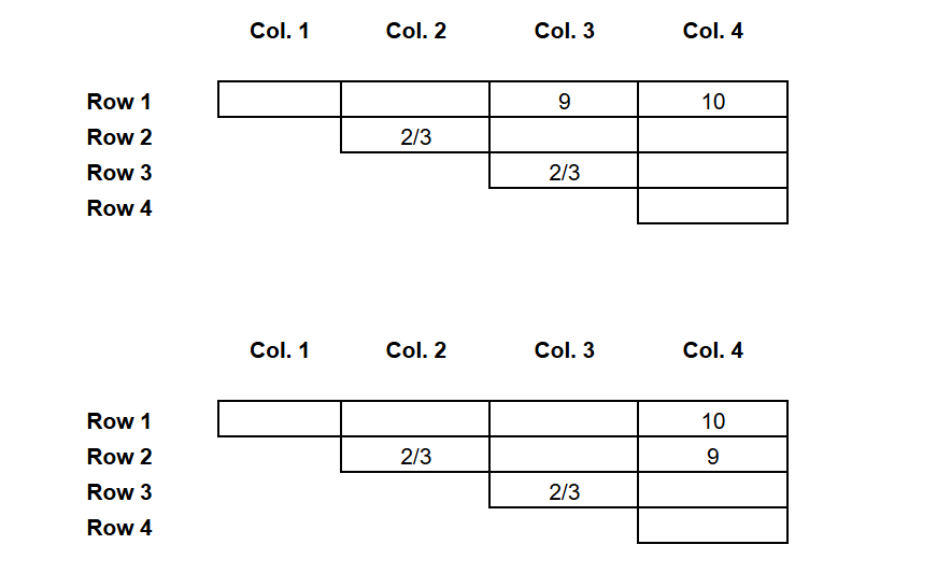
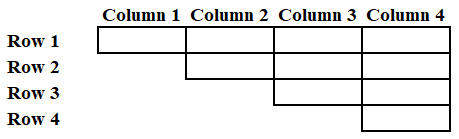
The numbers 1, 2, 3, 4, 5, 6, 7, 8, 9, and 10 are placed in ten slots of the following grid based on the conditions below.

1. Numbers in any row appear in an increasing order from left to right. 2. Numbers in any column appear in a decreasing order from top to bottom. 3. 1 is placed either in the same row or in the same column as 10. 4. Neither 2 nor 3 is placed in the same row or in the same column as 10. 5. Neither 7 nor 8 is placed in the same row or in the same column as 9. 6. 4 and 6 are placed in the same row.

Question 25

What is the row number which has the least sum of numbers placed in that row?

Up to 2 decimal places. No negative marking for TITA.

Answer & explanation

Correct answer: 4

We are given that the numbers keep increasing from left to right (clue 1), and the number keeps decreasing from top to bottom (clue 2)

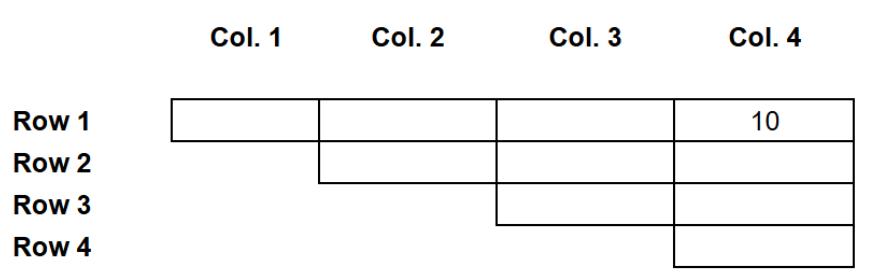
The key takeaway from this is that 10 must be placed in Row 1, column 4, as placing it anywhere else would mean that the number above it, or right to it, must be greater than 10, which is not an option.

Clue 3 says that one is either in the same row or the same column as 10. The same logic that we used for 10 applies for 1; it must be either in Row 1, column 1, or Row 4, column 4; we don't know which one yet.

We are given that 2 and 3 are not in the same column or row as 10, meaning that they must occupy two spots from (Row 2, Col. 2), (Row 2, Col. 3), and (Row 3, Col. 3)

2 and 3 must be present in Row 2, column 2 or Row 3, column 3, as there is no number smaller than it to be in the cell left to it.

Clue 6 says that 4 and 6 are in the same row; this can be rows 1, 2, or 3.

Clue 5 is a good starting point. Once we found the position of 10, the only positions possible for 9 are R1C3 or R2C4

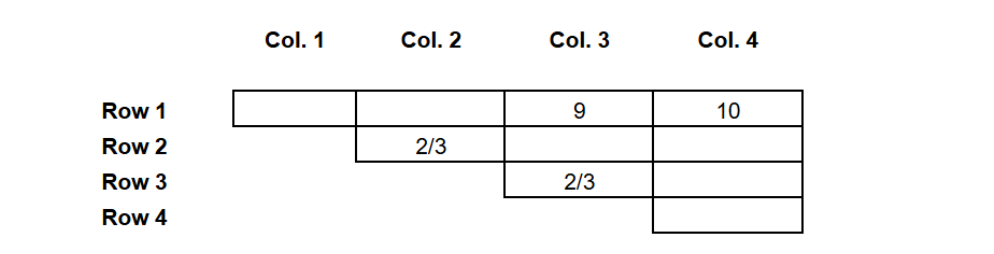
If 9 is placed in R2C4, 7 and 8 must be placed in row 1. Clue 6 says that 4 and 6 are in the same row, but with 7 and 8 in row 1, no rows are left with two spaces. Hence, 9 can not be in R2C4, and the arrangement must be:

7 and 8 must be in column 4, occupying R3C4 and R2C4, respectively.

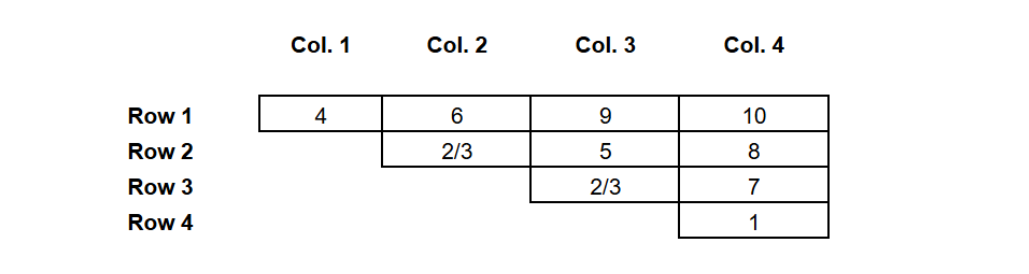
Hence, 4, 6 must be in row 1:

The lowest sum is of the 4th row.

Therefore, is the correct answer.

Question 26

Which of the following statements MUST be true? I. 10 is placed in a slot in Row 1. II. 1 is placed in a slot in Row 4.

Answer & explanation

Correct answer: A

We are given that the numbers keep increasing from left to right (clue 1), and the number keeps decreasing from top to bottom (clue 2)

The key takeaway from this is that 10 must be placed in Row 1, column 4, as placing it anywhere else would mean that the number above it, or right to it, must be greater than 10, which is not an option.

Clue 3 says that one is either in the same row or the same column as 10. The same logic that we used for 10 applies for 1; it must be either in Row 1, column 1, or Row 4, column 4; we don't know which one yet.

We are given that 2 and 3 are not in the same column or row as 10, meaning that they must occupy two spots from (Row 2, Col. 2), (Row 2, Col. 3), and (Row 3, Col. 3)

2 and 3 must be present in Row 2, column 2 or Row 3, column 3, as there is no number smaller than it to be in the cell left to it.

Clue 6 says that 4 and 6 are in the same row; this can be rows 1, 2, or 3.

Clue 5 is a good starting point. Once we found the position of 10, the only positions possible for 9 are R1C3 or R2C4

If 9 is placed in R2C4, 7 and 8 must be placed in row 1. Clue 6 says that 4 and 6 are in the same row, but with 7 and 8 in row 1, no rows are left with two spaces. Hence, 9 can not be in R2C4, and the arrangement must be:

7 and 8 must be in column 4, occupying R3C4 and R2C4, respectively.

Hence, 4, 6 must be in row 1:

We can see that the positions 10 and 1 are fixed and agree with the given statements. Both the statements are true. Therefore, Option A is the correct answer.

Question 27

Which of the following statements MUST be true? I. 2 is placed in a slot in Column 2. II. 3 is placed in a slot in Column 3.

Answer & explanation

Correct answer: C

We are given that the numbers keep increasing from left to right (clue 1), and the number keeps decreasing from top to bottom (clue 2)

The key takeaway from this is that 10 must be placed in Row 1, column 4, as placing it anywhere else would mean that the number above it, or right to it, must be greater than 10, which is not an option.

Clue 3 says that one is either in the same row or the same column as 10. The same logic that we used for 10 applies for 1; it must be either in Row 1, column 1, or Row 4, column 4; we don't know which one yet.

We are given that 2 and 3 are not in the same column or row as 10, meaning that they must occupy two spots from (Row 2, Col. 2), (Row 2, Col. 3), and (Row 3, Col. 3)

2 and 3 must be present in Row 2, column 2 or Row 3, column 3, as there is no number smaller than it to be in the cell left to it.

Clue 6 says that 4 and 6 are in the same row; this can be rows 1, 2, or 3.

Clue 5 is a good starting point. Once we found the position of 10, the only positions possible for 9 are R1C3 or R2C4

If 9 is placed in R2C4, 7 and 8 must be placed in row 1. Clue 6 says that 4 and 6 are in the same row, but with 7 and 8 in row 1, no rows are left with two spaces. Hence, 9 can not be in R2C4, and the arrangement must be:

7 and 8 must be in column 4, occupying R3C4 and R2C4, respectively.

Hence, 4, 6 must be in row 1:

Positions 2 and 3 can be switched. Either of them can be in column 2 or 3

Neither of the statements is necessarily true. Therefore, Option C is the correct answer.

Question 28

For how many slots in the grid, placement of numbers CANNOT be determined with certainty?

Up to 2 decimal places. No negative marking for TITA.

Answer & explanation

Correct answer: 2

We are given that the numbers keep increasing from left to right (clue 1), and the number keeps decreasing from top to bottom (clue 2)

The key takeaway from this is that 10 must be placed in Row 1, column 4, as placing it anywhere else would mean that the number above it, or right to it, must be greater than 10, which is not an option.

Clue 3 says that one is either in the same row or the same column as 10. The same logic that we used for 10 applies for 1; it must be either in Row 1, column 1, or Row 4, column 4; we don't know which one yet.

We are given that 2 and 3 are not in the same column or row as 10, meaning that they must occupy two spots from (Row 2, Col. 2), (Row 2, Col. 3), and (Row 3, Col. 3)

2 and 3 must be present in Row 2, column 2 or Row 3, column 3, as there is no number smaller than it to be in the cell left to it.

Clue 6 says that 4 and 6 are in the same row; this can be rows 1, 2, or 3.

Clue 5 is a good starting point. Once we found the position of 10, the only positions possible for 9 are R1C3 or R2C4

If 9 is placed in R2C4, 7 and 8 must be placed in row 1. Clue 6 says that 4 and 6 are in the same row, but with 7 and 8 in row 1, no rows are left with two spaces. Hence, 9 can not be in R2C4, and the arrangement must be:

7 and 8 must be in column 4, occupying R3C4 and R2C4, respectively.

Hence, 4, 6 must be in row 1:

Placements of all the numbers except 2 and 3 can be determined.

Therefore, 2 is the correct answer.

Question 29

What is the sum of the numbers placed in Column 4?

Up to 2 decimal places. No negative marking for TITA.

Answer & explanation

Correct answer: 26

We are given that the numbers keep increasing from left to right (clue 1), and the number keeps decreasing from top to bottom (clue 2)

The key takeaway from this is that 10 must be placed in Row 1, column 4, as placing it anywhere else would mean that the number above it, or right to it, must be greater than 10, which is not an option.

Clue 3 says that one is either in the same row or the same column as 10. The same logic that we used for 10 applies for 1; it must be either in Row 1, column 1, or Row 4, column 4; we don't know which one yet.

We are given that 2 and 3 are not in the same column or row as 10, meaning that they must occupy two spots from (Row 2, Col. 2), (Row 2, Col. 3), and (Row 3, Col. 3)

2 and 3 must be present in Row 2, column 2 or Row 3, column 3, as there is no number smaller than it to be in the cell left to it.

Clue 6 says that 4 and 6 are in the same row; this can be rows 1, 2, or 3.

Clue 5 is a good starting point. Once we found the position of 10, the only positions possible for 9 are R1C3 or R2C4

If 9 is placed in R2C4, 7 and 8 must be placed in row 1. Clue 6 says that 4 and 6 are in the same row, but with 7 and 8 in row 1, no rows are left with two spaces. Hence, 9 can not be in R2C4, and the arrangement must be:

7 and 8 must be in column 4, occupying R3C4 and R2C4, respectively.

Hence, 4, 6 must be in row 1:

The sum of numbers in the 4th column is 10+8+7+1 = 26

Therefore, 26 is the correct answer.

Passage for questions 3033

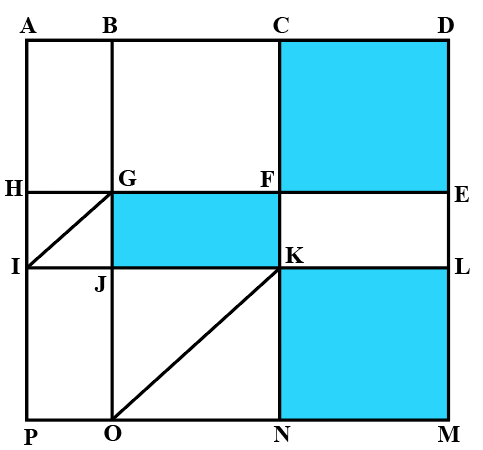
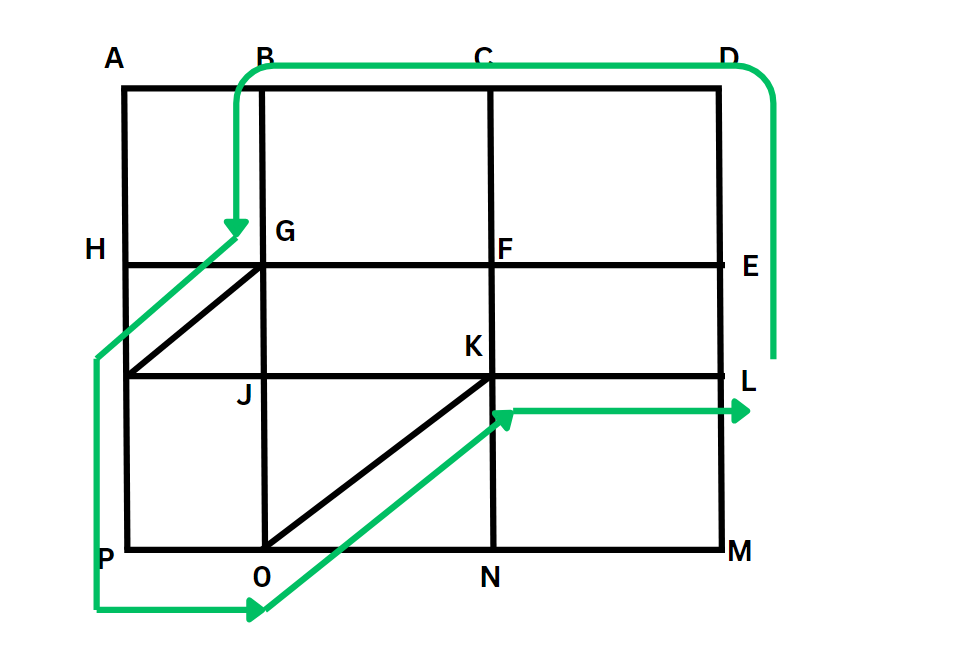
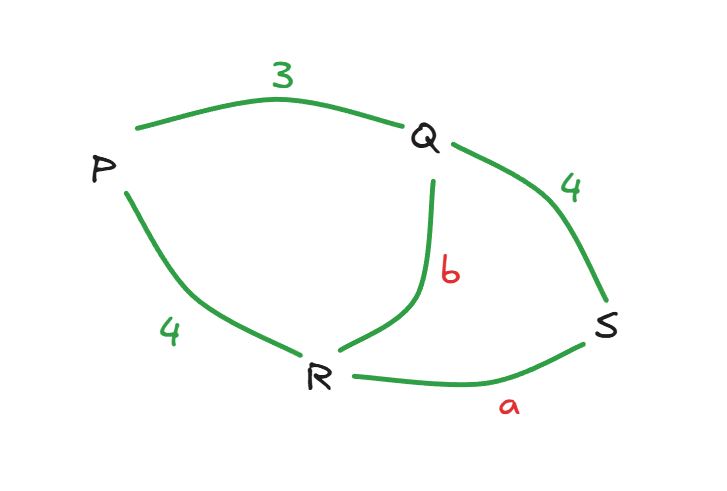
The above is a schematic diagram of walkways (indicated by all the straight-lines) and lakes (3 of them, each in the shape of rectangles - shaded in the diagram) of a gated area. Different points on the walkway are indicated by letters (A through P) with distances being OP = 150 m, ON = MN = 300 m, ML = 400 m, EL = 200 m, DE = 400 m.

The following additional information about the facilities in the area is known. 1. The only entry/exit point is at C. 2. There are many residences within the gated area; all of them are located on the path AH and ML with four of them being at A, H, M, and L. 3. The post office is located at P and the bank is located at B.

Question 30

One resident whose house is located at L, needs to visit the post office as well as the bank. What is the minimum distance (in m) he has to walk starting from his residence and returning to his residence after visiting both the post office and the bank?

Answer & explanation

Correct answer: B

The first thing to realise here is the lengths of the paths.

KN should be equal to LM, giving the length of KO using Pythagoras theorem as 500m

Similarly, the length of HJ=OP=150m and length of GJ=EL=200m, giving the length of HG as 250 m

The shortest path from L to B and then to P (or the other way around would involve) using these hypotenuses as much as possible instead of the two adjacent sides. The shortest can be visualised as shown below or multitude of others variations, as there are multiple ways that would make one travel the shortest distance)

The below figure is the simplest one for visualisation.

Other possible paths are L-E-F-C-.. and following the same path.

The shortest distance in each of these instance would be LE+ED+DC+CB+BG+GI+IP+PO+OK+KL

Which would be 200+400+300+300+400+250+400+150+500+300 = 3200

Therefore, Option B is the correct answer.

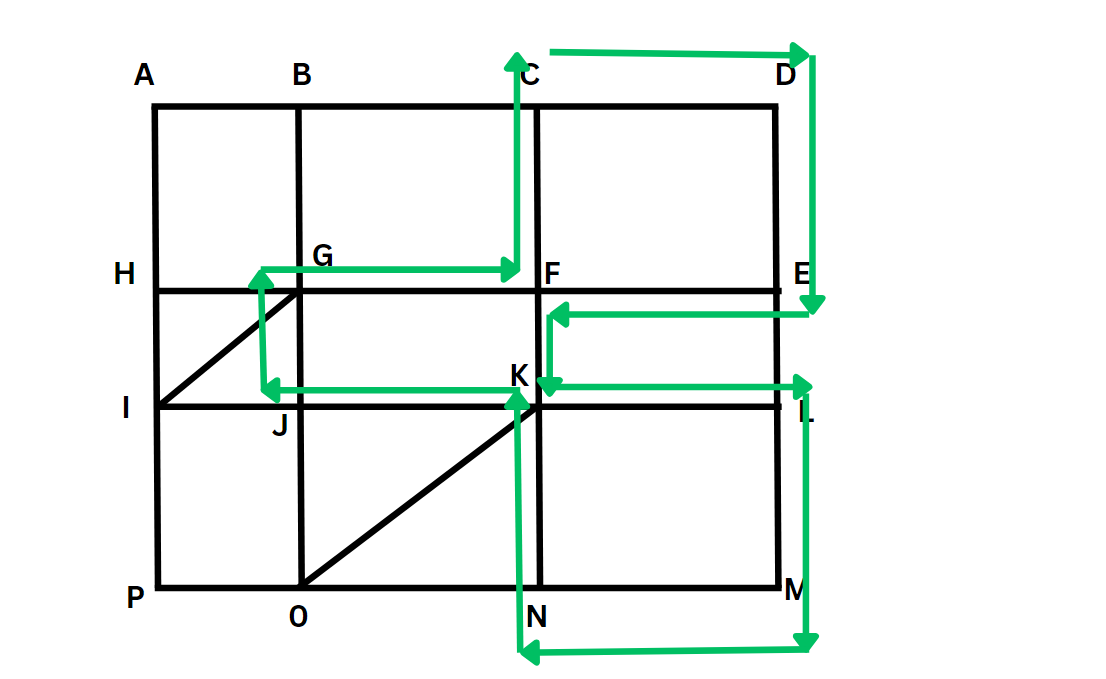
Question 31

One person enters the gated area and decides to walk as much as possible before leaving the area without walking along any path more than once and always walking next to one of the lakes. Note that he may cross a point multiple times. How much distance (in m) will he walk within the gated area?

Answer & explanation

Correct answer: C

Since we can only walk along the side of lakes, that drastically reduces the paths we can take. The diagram below shows the path with the maximum distance travelled.

The path is CD-DE-EF-FK-KL-LM-MN-NK-KJ-JG-GF-FC

(the reverse of this path is also valid)

We can either manually add the lengths or use shorter methods to note that in the path we travel walkways of length 400 m 4 times (DE, LM, KN, EF), walkways of length 300m 6 times (CD, EF, KL, MN, KJ, GF) and walkways of length 200 m 2 times (FK, JG) Giving the total length to be 1600+1800+400 = 3800

Therefore, Option C is the correct answer.

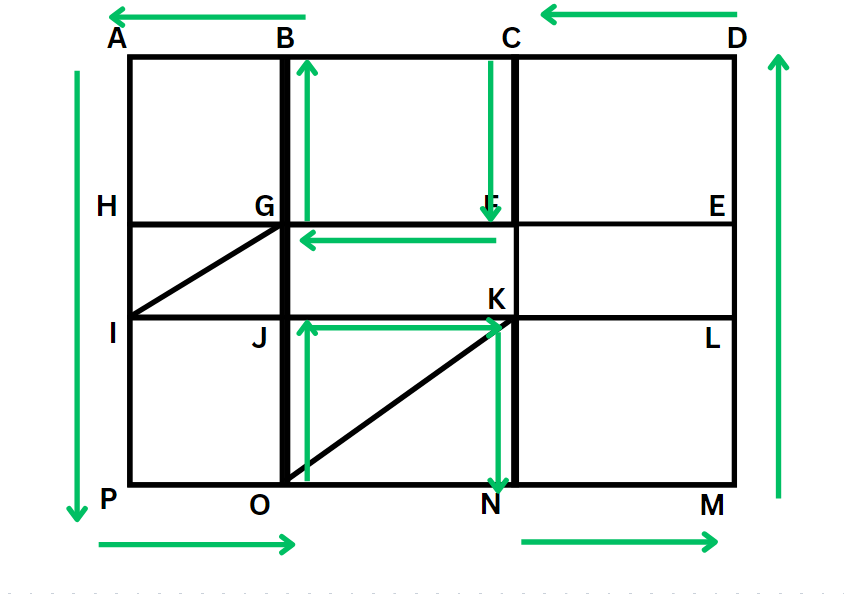
Question 32

One resident takes a walk within the gated area starting from A and returning to A without going through any point (other than A) more than once. What is the maximum distance (in m) she can walk in this way?

Up to 2 decimal places. No negative marking for TITA.

Answer & explanation

Correct answer: 5100

Counter to the first question, we should minimize the use of those hypotenuse walkways as they reduce the distance we travel.

The longest possible route would include then travelling through the edges of the rectangles and sqaures, and not touch any point more than once. Best case scenario would be us touching each point exactly once.

This can be visualized as:

Where we do not use any of the hypotenuse and cross through each gate exactly once.

The total distance would be:

AH+HI+ IP = 400+200+400 = 1000

DE+EL+LM = 400+200+400 = 1000

PO+JK+NM = 150+300+300 = 750

DC+FG+BA = 150+300+300 = 750

JO+KN = 400+400 = 800

CF+GB = 400+400 = 800

Adding up to: 5100m

Therefore, 5100 is the correct answer.

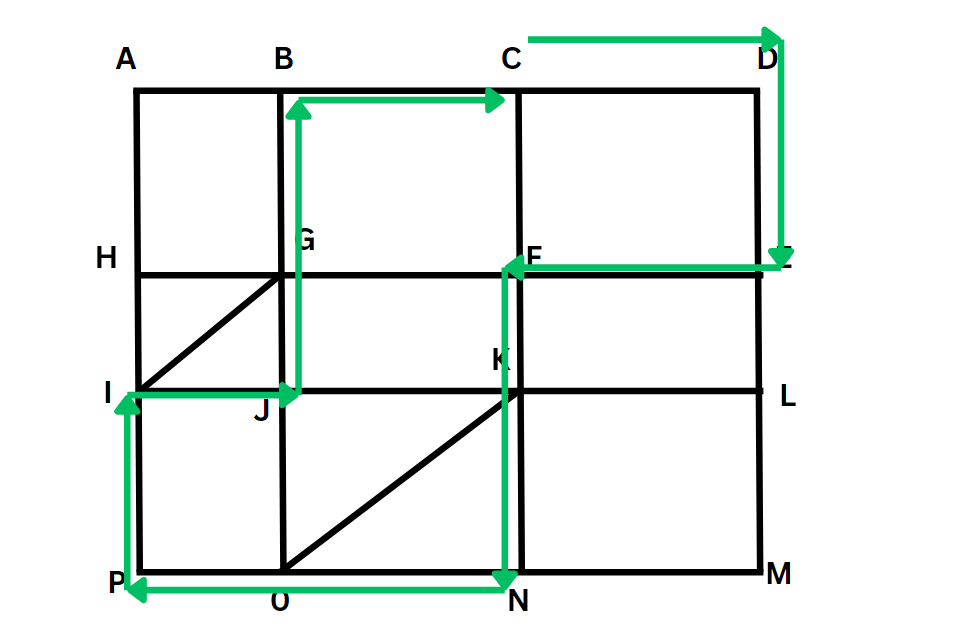
Question 33

Visitors coming for morning walks are allowed to enter as long as they do not pass by any of the residences and do not cross any point (except C) more than once. What is the maximum distance (in m) that such a visitor can walk within the gated area?

Up to 2 decimal places. No negative marking for TITA.

Answer & explanation

Correct answer: 3500

Similar to the previous question, we should try to avoid the hypotenuse

The total path distance would be 300(CD) + 400(DE) + 300(EF) + 200(FK) + 400(KN) + 300(NO) + 150(OP) + 400(PI) + 150(IJ) + 200(JG) + 400(GB) + 300(BC)

Adding up to 3,500 meters

Therefore, 3500 is the correct answer.

Passage for questions 3437

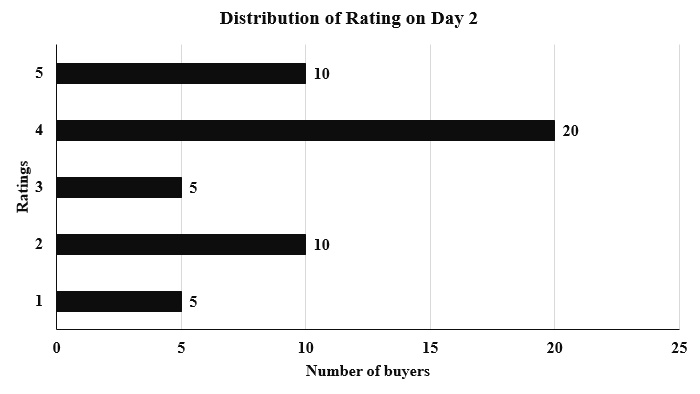
An online e-commerce firm receives daily integer product ratings from 1 through 5 given by buyers. The daily average is the average of the ratings given on that day. The cumulative average is the average of all ratings given on or before that day. The rating system began on Day 1, and the cumulative averages were 3 and 3.1 at the end of Day 1 and Day 2, respectively. The distribution of ratings on Day 2 is given in the figure below.

The following information is known about ratings on Day 3. 1. 100 buyers gave product ratings on Day 3. 2. The modes of the product ratings were 4 and 5. 3. The numbers of buyers giving each product rating are non-zero multiples of 10. 4. The same number of buyers gave product ratings of 1 and 2, and that number is half the number of buyers who gave a rating of 3.

Question 34

How many buyers gave ratings on Day 1?

Up to 2 decimal places. No negative marking for TITA.

Answer & explanation

Correct answer: 150

From the given chart, we can find the average rating on day 2: $$\frac{\left(5\times\ 1\right)+\left(10\times\ 2\right)+\left(5\times\ 3\right)+\left(20\times\ 4\right)+\left(10\times\ 5\right)}{5+10+5+20+10}=\frac{170}{50}=3.4$$ We are given the cumulative average of day 1 and day 2 as 3.1, and the average at the end of day 1 is 3. Let's take the number of ratings received on day 1 as $$x$$; using this overall average and the average on day 2, we get the equation: $$\frac{3x+\left(50\times\ 3.4\right)}{x+50}=3.1$$ $$3x+170=3.1x+155$$ $$15\ =\ 0.1x$$ $$x=150$$ Therefore, the number of ratings received on day 1 is 150.

Question 35

What is the daily average rating of Day 3?

Answer & explanation

Correct answer: A

We are given that on day 3, a total of 100 ratings came in The modes were 4 and 5, meaning that an equal number of 4 and 5 ratings came in; let it be 10b (since we are given that all ratings were non-zero multiples of 10) Let's take the number of 1 and 2 ratings as 10a each, giving the number of 3 ratings as 20a Adding all of these up: 10a+10a+20a+10b+10b = 100 40a+20b = 100 2a+b = 5 The only integer combination for a and b, without them being zero, is a being 1 and b being 3 or a=2 and b=1 But taking b as 1 would make 3 as the mode rating, so we can not consider the latter case. We are giving 10 - 1 ratings, 10 - 2 ratings, 20 - 3 ratings, 30 - 4 ratings, and 30 - 5 ratings. The average would be $$\frac{\left(10\times\ 1\right)+\left(10\times\ 2\right)+\left(20\times\ 3\right)+\left(30\times\ 4\right)+\left(30\times\ 5\right)}{100}=\frac{360}{100}=3.6$$ Therefore, Option A is the correct answer.

Question 36

What is the median of all ratings given on Day 3?

Up to 2 decimal places. No negative marking for TITA.

Answer & explanation

Correct answer: 4

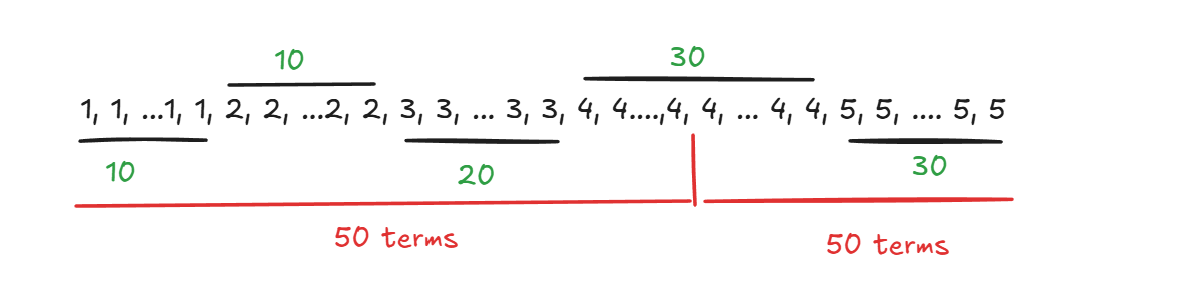
As deduced in the previous question, there were 10 1 ratings, 10 2 ratings, 20 3 ratings, 30 4 ratings, and 30 5 ratings.

The median would be the 50th and 51st ratings' average when arranged in ascending/descending order. Both of which would be 4

Therefore, 4 is the correct answer

Question 37

Which of the following is true about the cumulative average ratings of Day 2 and Day 3?

Answer & explanation

Correct answer: C

The cumulative average rating at the end of day 3 would be $$\frac{\left(3.1\times\ 200\right)+\left(3.6\times\ 100\right)}{200+100}$$ [the cumulative average rating on day 2= 3.1 Number of ratings received by day 2= 200] $$\frac{360+620}{300}=\frac{980}{300}=3.266$$ The increase in the cumulative average from day 2 to day 3 can be calculated as $$\frac{3.266-3.1}{3.1}\times\ 100\approx\ 5.34$$ Which aligns with the statement given in option C. Therefore, Option C is the correct answer.

Passage for questions 3841

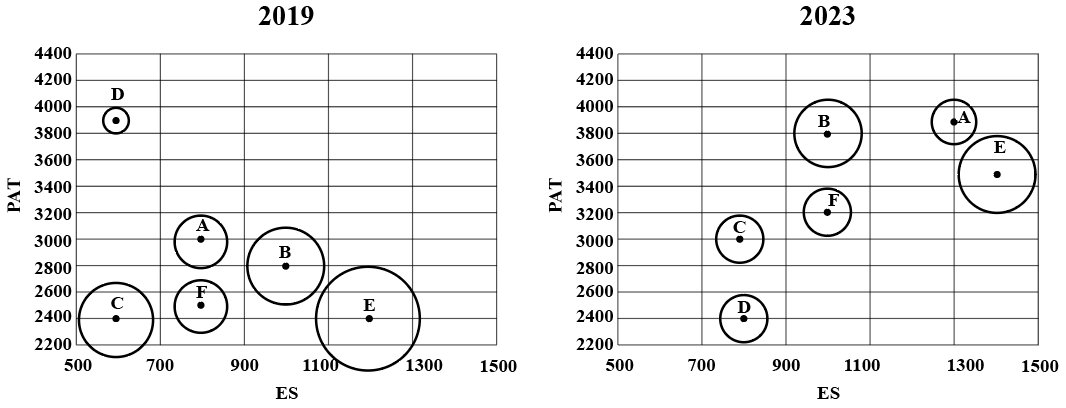
The two plots below give the following information about six firms A, B, C, D, E, and F for 2019 and 2023.

PAT: The firm’s profits after taxes in Rs. crores, ES: The firm’s employee strength, that is the number of employees in the firm, and PRD: The percentage of the firm’s PAT that they spend on Research and Development (R&D).

In the plots, the horizontal and vertical coordinates of point representing each firm gives their ES and PAT values respectively. The PRD values of each firm are proportional to the areas around the points representing each firm. The areas are comparable between the two plots, i.e., equal areas in the two plots represent the same PRD values for the two years.

Question 38

Assume that the annual rate of growth in PAT over the previous year (ARG) remained constant over the years for each of the six firms. Which among the firms A, B, C, and E had the highest ARG?

Answer & explanation

Correct answer: C

Since we are given that the annual growth rate should be taken as constant, we can simply compare the ratio changes in the firm's PAT in 2019 and 2023 and compare them. Firm A: 3000 to 3900; an increase of 900, giving the growth rate to be $$\frac{900}{3000}=\frac{3}{10}=0.3$$ Firm C: 2400 to 3000; an increase of 600, giving the growth rate to be $$\frac{600}{2400}=\frac{1}{4}=0.25$$ Firm E: 2400 to 3500; an increase of 1100, giving the growth rate to be $$\frac{1100}{2400}=\frac{11}{24}\approx\ 0.45$$ Firm B: 2800 to 3800; an increase of 1000, giving the growth to be $$\frac{1000}{2800}=\frac{5}{14}\approx\ 0.35$$ We can see that of the given ratios, the growth rate is highest for firm E (closest to 0.5). Therefore, the highest ARG, among the given options, will be for firm E. Therefore, Option C is the correct answer.

Question 39

The ratio of the amount of money spent by Firm C on R&D in 2019 to that in 2023 is closest to

Answer & explanation

Correct answer: D

This can be a little difficult to solve since the bubbles are not closed within a fixed boundary, but in such instances, we should approximate the most visible cases. Like the bubble of C in 2019 is almost 3 units vertically long in diameter, while that in 2023 is 2 units long. The ratio of the amount spend on R&D on 2019 to 2024 would be given by: $$\frac{2400\pi\left(1.5\right)^2\ }{3000\pi\ \left(1\right)^2}=\frac{8}{10}\times\ \frac{9}{4}=9:5$$ Which is option D.

Question 40

Which among the firms A, C, E, and F had the maximum PAT per employee in 2023?

Answer & explanation

Correct answer: D

The Pat per employee for the firm in 2023 will be: Firm E:$$\frac{3500}{1400}=\frac{35}{14}=\frac{5}{2}$$ Firm A: $$\frac{3900}{1300}=3$$ Firm F: $$\frac{3200}{1000}=3.2$$ Firm C: $$\frac{3000}{800}=\frac{15}{4}=3.75$$ The value if maximum for firm C, therefore, Option D is the correct answer.

Question 41

Which among the firms C, D, E, and F had the least amount of R&D spending per employee in 2023?

Answer & explanation

Correct answer: B

We calculated the PAT per employee for F, C and E in the last question, using that information and calculating the PAT per employee for firm D to be $$\frac{2400}{800}=3$$ For firms F, C and D, we can see that the area is the same hence the only factor to consider is PAT per employee F is 3.2, C is 3.75, and D is 3 This leaves D as the minimum. Comparing E and D (taking the proportionality constant as k) E has PAT per employee as 2.5 with a radius of 1.5 units, the PRD value per employee would be $$\frac{5}{2}k\pi\ \left(\frac{3}{2}\right)^2=k\pi\ \times\ \frac{5\times\ 9}{8}$$ D has PAT per employee as 3, with a radius of 1 unit.the PRD value per employee would be $$3k\pi\ \left(1\right)^2=3k\pi\ $$ We can see that the value would be greater for E, therefore firm D will have the lowest R&D spending per employee in 2023 Therefore, Option B is the correct answer.

Passage for questions 4246

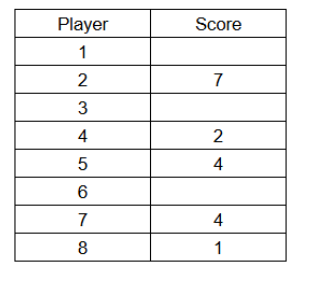
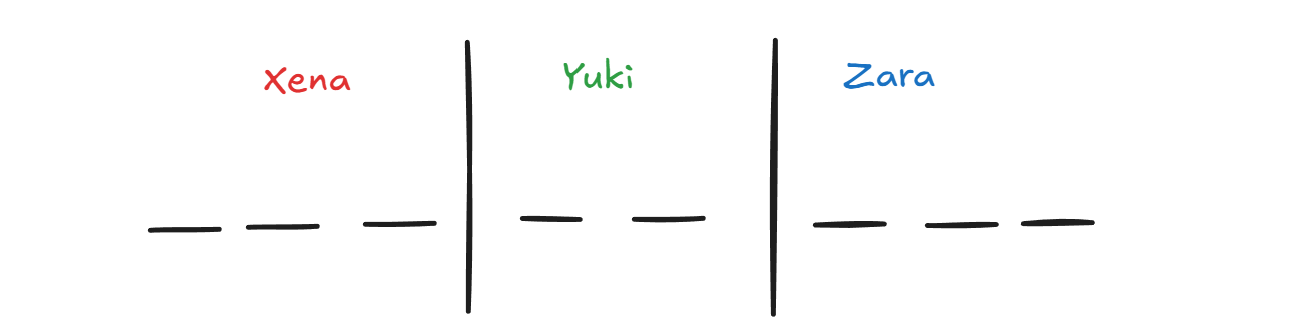
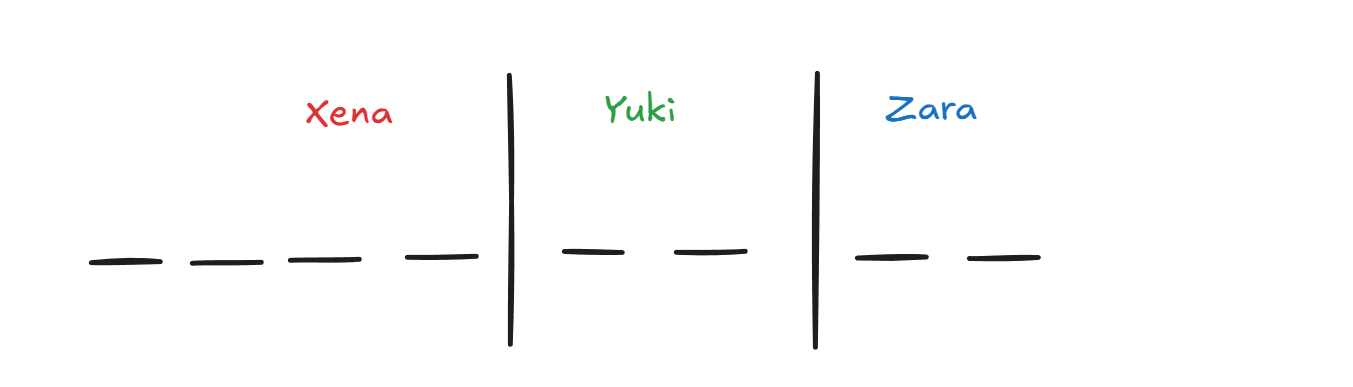
Eight gymnastics players numbered 1 through 8 underwent a training camp where they were coached by three coaches - Xena, Yuki, and Zara. Each coach trained at least two players. Yuki trained only even numbered players, while Zara trained only odd numbered players. After the camp, the coaches evaluated the players and gave integer ratings to the respective players trained by them on a scale of 1 to 7, with 1 being the lowest rating and 7 the highest. The following additional information is known. 1. Xena trained more players than Yuki. 2. Player-1 and Player-4 were trained by the same coach, while the coaches who trained Player-2, Player-3 and Player-5 were all different. 3. Player-5 and Player-7 were trained by the same coach and got the same rating. All other players got a unique rating. 4. The average of the ratings of all the players was 4. 5. Player-2 got the highest rating. 6. The average of the ratings of the players trained by Yuki was twice that of the players trained by Xena and two more than that of the players trained by Zara. 7. Player-4's rating was double of Player-8's and less than Player-5's.

Question 42

What best can be concluded about the number of players coached by Zara?

Answer & explanation

Correct answer: B

We are told that each coach had at least two players. Clue 1 says that Xena trained more people than Yuki. It must be the case that Yuki trained only two people. If Yuki had trained three, then Xena would have trained at least four players, leaving only one for Zara.

Hence, Yuki trained two people.

Coming to the scores given to the players themselves:

We are given that only 5 and 7 received a sam rating; everyone else received a distinct rating. We are also given their average to be 4 (clue 4), giving the sum of all the scores they got to be 32 The sum of all numbers from 1 to 7 would be $$\frac{8}{2}\times\ 7=28$$, hence the repeated score must be 32-28 = 4

Thus, the score of 5 and 7 was 4

Clue 5 says that player 2 got the highest score, which is 7

Clue 7 says that player 4 got a score double that of player 8 but less than player 5; the only possibility is player 4 getting 2 and player 8 getting 1.

Now, considering clues 2, 3 and 6:

We are given the same coach trained in 5 and 7. And 2, 3, and 5 were trained by different coaches, with 1 and 4 being trained by the same coach. Cheer 6 informs us about the average number of players the coaches train.

We know that Yuki trained only two players. Let's take the average score of Yuki's players to be x

The average of Xena's players would be x/2, and that of Zara's players would be x-2

The total score of Yuki's players would be 2x. The total score of Xena's players would be 3x/2 or 2x. The total score of Zara's players would be 3x-6 or 2x-4

We have two cases to consider:

Let's say Xena and Zara had three players each. The total score of Yuki's players would be 2x. The total score of Xena's players would be 3x/2. The total score of Zara's players would be 3x-6.

The sum of all these scores would be $$\frac{13x}{2}-6$$ which should be equal to 32 This would give us the value of x as $$\frac{13x}{2}=38$$ Which would give a non-integral value of 2s, that is, the sum of Yuki's player's score.

Hence, this must not be the case.

The other possibility:

The total score of Yuki's players would be 2x. The total score of Xena's players would be 2x. The total score of Zara's players would be 2x-4.

The sum of all these scores would be 6x-4, which should be equal to 32 This would give the value of x as 6

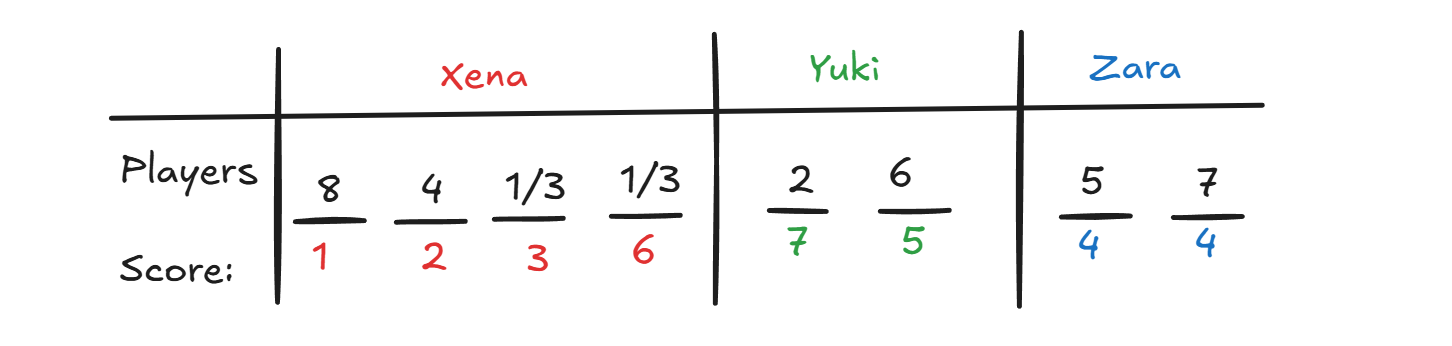
Hence, the sum of all of Yuki's players would be 12 The sum of all of Xena's players would be 12 The sum of all of Zara's players would be 8

Yuki has only two players whose scores add up to 12; the only combination possible is scores 7+5, where seven were scored by player 2. Hence, player two must be under Yuki.

Zara got a total of 8 scores, with 7 and 5 gone. The combinations that could get this score are 2+6 and 4+4 The score of 2 is obtained by player 4, which must come with player 1 It is possible that 1 could have gotten a score 6 But then we run into a contradiction: players 3 and 5 would end up under the same coach.

Hence, Zara must have gotten 8 through 4+4 with players 5 and 7.

All the remaining scores must be with Xena, adding up to 12, which is the case.

4 and 1 must be present together, and 3 must be present in Xena as well, giving us the arrangement.

We can see that Zara had two players.

Therefore, Option B is the correct answer.

Question 43

What was the rating of Player-7?

Up to 2 decimal places. No negative marking for TITA.

Answer & explanation

Correct answer: 4

We are told that each coach had at least two players. Clue 1 says that Xena trained more people than Yuki. It must be the case that Yuki trained only two people. If Yuki had trained three, then Xena would have trained at least four players, leaving only one for Zara.

Hence, Yuki trained two people.

Coming to the scores given to the players themselves:

We are given that only 5 and 7 received a sam rating; everyone else received a distinct rating. We are also given their average to be 4 (clue 4), giving the sum of all the scores they got to be 32 The sum of all numbers from 1 to 7 would be $$\frac{8}{2}\times\ 7=28$$, hence the repeated score must be 32-28 = 4

Thus, the score of 5 and 7 was 4

Clue 5 says that player 2 got the highest score, which is 7

Clue 7 says that player 4 got a score double that of player 8 but less than player 5; the only possibility is player 4 getting 2 and player 8 getting 1.

Now, considering clues 2, 3 and 6:

We are given the same coach trained in 5 and 7. And 2, 3, and 5 were trained by different coaches, with 1 and 4 being trained by the same coach. Cheer 6 informs us about the average number of players the coaches train.

We know that Yuki trained only two players. Let's take the average score of Yuki's players to be x

The average of Xena's players would be x/2, and that of Zara's players would be x-2

The total score of Yuki's players would be 2x. The total score of Xena's players would be 3x/2 or 2x. The total score of Zara's players would be 3x-6 or 2x-4

We have two cases to consider:

Let's say Xena and Zara had three players each. The total score of Yuki's players would be 2x. The total score of Xena's players would be 3x/2. The total score of Zara's players would be 3x-6.

The sum of all these scores would be $$\frac{13x}{2}-6$$ which should be equal to 32 This would give us the value of x as $$\frac{13x}{2}=38$$ Which would give a non-integral value of 2s, that is, the sum of Yuki's player's score.

Hence, this must not be the case.

The other possibility:

The total score of Yuki's players would be 2x. The total score of Xena's players would be 2x. The total score of Zara's players would be 2x-4.

The sum of all these scores would be 6x-4, which should be equal to 32 This would give the value of x as 6

Hence, the sum of all of Yuki's players would be 12 The sum of all of Xena's players would be 12 The sum of all of Zara's players would be 8

Yuki has only two players whose scores add up to 12; the only combination possible is scores 7+5, where seven were scored by player 2. Hence, player two must be under Yuki.

Zara got a total of 8 scores, with 7 and 5 gone. The combinations that could get this score are 2+6 and 4+4 The score of 2 is obtained by player 4, which must come with player 1 It is possible that 1 could have gotten a score 6 But then we run into a contradiction: players 3 and 5 would end up under the same coach.

Hence, Zara must have gotten 8 through 4+4 with players 5 and 7.

All the remaining scores must be with Xena, adding up to 12, which is the case.

4 and 1 must be present together, and 3 must be present in Xena as well, giving us the arrangement.

Score of player 7 was 4

Therefore, 4 is the correct answer.

Question 44

What was the rating of Player-6?

Up to 2 decimal places. No negative marking for TITA.

Answer & explanation

Correct answer: 5

We are told that each coach had at least two players. Clue 1 says that Xena trained more people than Yuki. It must be the case that Yuki trained only two people. If Yuki had trained three, then Xena would have trained at least four players, leaving only one for Zara.

Hence, Yuki trained two people.

Coming to the scores given to the players themselves:

We are given that only 5 and 7 received a sam rating; everyone else received a distinct rating. We are also given their average to be 4 (clue 4), giving the sum of all the scores they got to be 32 The sum of all numbers from 1 to 7 would be $$\frac{8}{2}\times\ 7=28$$, hence the repeated score must be 32-28 = 4

Thus, the score of 5 and 7 was 4

Clue 5 says that player 2 got the highest score, which is 7

Clue 7 says that player 4 got a score double that of player 8 but less than player 5; the only possibility is player 4 getting 2 and player 8 getting 1.

Now, considering clues 2, 3 and 6:

We are given the same coach trained in 5 and 7. And 2, 3, and 5 were trained by different coaches, with 1 and 4 being trained by the same coach. Cheer 6 informs us about the average number of players the coaches train.

We know that Yuki trained only two players. Let's take the average score of Yuki's players to be x

The average of Xena's players would be x/2, and that of Zara's players would be x-2

The total score of Yuki's players would be 2x. The total score of Xena's players would be 3x/2 or 2x. The total score of Zara's players would be 3x-6 or 2x-4

We have two cases to consider:

Let's say Xena and Zara had three players each. The total score of Yuki's players would be 2x. The total score of Xena's players would be 3x/2. The total score of Zara's players would be 3x-6.

The sum of all these scores would be $$\frac{13x}{2}-6$$ which should be equal to 32 This would give us the value of x as $$\frac{13x}{2}=38$$ Which would give a non-integral value of 2s, that is, the sum of Yuki's player's score.

Hence, this must not be the case.

The other possibility:

The total score of Yuki's players would be 2x. The total score of Xena's players would be 2x. The total score of Zara's players would be 2x-4.

The sum of all these scores would be 6x-4, which should be equal to 32 This would give the value of x as 6

Hence, the sum of all of Yuki's players would be 12 The sum of all of Xena's players would be 12 The sum of all of Zara's players would be 8

Yuki has only two players whose scores add up to 12; the only combination possible is scores 7+5, where seven were scored by player 2. Hence, player two must be under Yuki.

Zara got a total of 8 scores, with 7 and 5 gone. The combinations that could get this score are 2+6 and 4+4 The score of 2 is obtained by player 4, which must come with player 1 It is possible that 1 could have gotten a score 6 But then we run into a contradiction: players 3 and 5 would end up under the same coach.

Hence, Zara must have gotten 8 through 4+4 with players 5 and 7.

All the remaining scores must be with Xena, adding up to 12, which is the case.

4 and 1 must be present together, and 3 must be present in Xena as well, giving us the arrangement.

The rating of player 6 was 5

Therefore, 5 is the correct answer.

Question 45

For how many players the ratings can be determined with certainty?

Up to 2 decimal places. No negative marking for TITA.

Answer & explanation

Correct answer: 6

We are told that each coach had at least two players. Clue 1 says that Xena trained more people than Yuki. It must be the case that Yuki trained only two people. If Yuki had trained three, then Xena would have trained at least four players, leaving only one for Zara.

Hence, Yuki trained two people.

Coming to the scores given to the players themselves:

We are given that only 5 and 7 received a sam rating; everyone else received a distinct rating. We are also given their average to be 4 (clue 4), giving the sum of all the scores they got to be 32 The sum of all numbers from 1 to 7 would be $$\frac{8}{2}\times\ 7=28$$, hence the repeated score must be 32-28 = 4

Thus, the score of 5 and 7 was 4

Clue 5 says that player 2 got the highest score, which is 7

Clue 7 says that player 4 got a score double that of player 8 but less than player 5; the only possibility is player 4 getting 2 and player 8 getting 1.

Now, considering clues 2, 3 and 6:

We are given the same coach trained in 5 and 7. And 2, 3, and 5 were trained by different coaches, with 1 and 4 being trained by the same coach. Cheer 6 informs us about the average number of players the coaches train.

We know that Yuki trained only two players. Let's take the average score of Yuki's players to be x

The average of Xena's players would be x/2, and that of Zara's players would be x-2

The total score of Yuki's players would be 2x. The total score of Xena's players would be 3x/2 or 2x. The total score of Zara's players would be 3x-6 or 2x-4

We have two cases to consider:

Let's say Xena and Zara had three players each. The total score of Yuki's players would be 2x. The total score of Xena's players would be 3x/2. The total score of Zara's players would be 3x-6.

The sum of all these scores would be $$\frac{13x}{2}-6$$ which should be equal to 32 This would give us the value of x as $$\frac{13x}{2}=38$$ Which would give a non-integral value of 2s, that is, the sum of Yuki's player's score.

Hence, this must not be the case.

The other possibility:

The total score of Yuki's players would be 2x. The total score of Xena's players would be 2x. The total score of Zara's players would be 2x-4.

The sum of all these scores would be 6x-4, which should be equal to 32 This would give the value of x as 6

Hence, the sum of all of Yuki's players would be 12 The sum of all of Xena's players would be 12 The sum of all of Zara's players would be 8

Yuki has only two players whose scores add up to 12; the only combination possible is scores 7+5, where seven were scored by player 2. Hence, player two must be under Yuki.

Zara got a total of 8 scores, with 7 and 5 gone. The combinations that could get this score are 2+6 and 4+4 The score of 2 is obtained by player 4, which must come with player 1 It is possible that 1 could have gotten a score 6 But then we run into a contradiction: players 3 and 5 would end up under the same coach.

Hence, Zara must have gotten 8 through 4+4 with players 5 and 7.

All the remaining scores must be with Xena, adding up to 12, which is the case.

4 and 1 must be present together, and 3 must be present in Xena as well, giving us the arrangement.

We can determine the ratings of all the players except 1 and 3

Therefore, 6 is the correct answer.

Question 46

Who all were the players trained by Xena?

Answer & explanation

Correct answer: B

We are told that each coach had at least two players. Clue 1 says that Xena trained more people than Yuki. It must be the case that Yuki trained only two people. If Yuki had trained three, then Xena would have trained at least four players, leaving only one for Zara.

Hence, Yuki trained two people.

Coming to the scores given to the players themselves:

We are given that only 5 and 7 received a sam rating; everyone else received a distinct rating. We are also given their average to be 4 (clue 4), giving the sum of all the scores they got to be 32 The sum of all numbers from 1 to 7 would be $$\frac{8}{2}\times\ 7=28$$, hence the repeated score must be 32-28 = 4

Thus, the score of 5 and 7 was 4

Clue 5 says that player 2 got the highest score, which is 7

Clue 7 says that player 4 got a score double that of player 8 but less than player 5; the only possibility is player 4 getting 2 and player 8 getting 1.

Now, considering clues 2, 3 and 6:

We are given the same coach trained in 5 and 7. And 2, 3, and 5 were trained by different coaches, with 1 and 4 being trained by the same coach. Cheer 6 informs us about the average number of players the coaches train.

We know that Yuki trained only two players. Let's take the average score of Yuki's players to be x

The average of Xena's players would be x/2, and that of Zara's players would be x-2

The total score of Yuki's players would be 2x. The total score of Xena's players would be 3x/2 or 2x. The total score of Zara's players would be 3x-6 or 2x-4

We have two cases to consider:

Let's say Xena and Zara had three players each. The total score of Yuki's players would be 2x. The total score of Xena's players would be 3x/2. The total score of Zara's players would be 3x-6.

The sum of all these scores would be $$\frac{13x}{2}-6$$ which should be equal to 32 This would give us the value of x as $$\frac{13x}{2}=38$$ Which would give a non-integral value of 2s, that is, the sum of Yuki's player's score.

Hence, this must not be the case.

The other possibility:

The total score of Yuki's players would be 2x. The total score of Xena's players would be 2x. The total score of Zara's players would be 2x-4.

The sum of all these scores would be 6x-4, which should be equal to 32 This would give the value of x as 6

Hence, the sum of all of Yuki's players would be 12 The sum of all of Xena's players would be 12 The sum of all of Zara's players would be 8

Yuki has only two players whose scores add up to 12; the only combination possible is scores 7+5, where seven were scored by player 2. Hence, player two must be under Yuki.

Zara got a total of 8 scores, with 7 and 5 gone. The combinations that could get this score are 2+6 and 4+4 The score of 2 is obtained by player 4, which must come with player 1 It is possible that 1 could have gotten a score 6 But then we run into a contradiction: players 3 and 5 would end up under the same coach.

Hence, Zara must have gotten 8 through 4+4 with players 5 and 7.

All the remaining scores must be with Xena, adding up to 12, which is the case.

4 and 1 must be present together, and 3 must be present in Xena as well, giving us the arrangement.

Xena coached players numbered 1, 3, 4 and 8

Therefore, Option B is the correct answer.

QA22 questions

Question 47

Bina incurs 19% loss when she sells a product at Rs. 4860 to Shyam, who in turn sells this product to Hari. If Bina would have sold this product to Shyam at the purchase price of Hari, she would have obtained 17% profit. Then, the profit, in rupees, made by Shyam is

Up to 2 decimal places. No negative marking for TITA.

Answer & explanation

Correct answer: 2160

Let the cost price of the item be C We are given that Bina sells this at 19% loss or at (1 - 0.19)C = 0.81C at 4860 This gives us the value of C at Rs. 6000 If Bina had sold this at 17% profit, the selling price would have been $$1.17\times\ 6000\ =\ 7020$$ So Shyam bought the product at 4860 and sold it to Hari at 7020 Giving the profit made by Shyam to be $$7020-4860\ =\ 2160$$ Therefore, 2160 is the correct answer.

Question 48

The coordinates of the three vertices of a triangle are: (1, 2), (7, 2), and (1, 10). Then the radius of the incircle of the triangle is

Up to 2 decimal places. No negative marking for TITA.

Answer & explanation

Correct answer: 2

Upon drawing a rough sketch of the coordinates given, we realise that this is a right-angled triangle.

The three side lengths are 6, 8 and 10 units

The inradius of a circle can be calculated using the formula: $$rs=Area$$, where s is the semi-perimeter of the triangle

The Area would be $$\frac{1}{2}\times\ 6\times\ 8=24$$ and the semi-perimeter would be $$\frac{10+6+8}{2}=12$$

Giving the inradius to be $$\frac{24}{12}=2$$ units

Therefore, 2 is the correct answer.

Question 49

A fruit seller has a stock of mangoes, bananas and apples with at least one fruit of each type. At the beginning of a day, the number of mangoes make up 40% of his stock. That day, he sells half of the mangoes, 96 bananas and 40% of the apples. At the end of the day, he ends up selling 50% of the fruits. The smallest possible total number of fruits in the stock at the beginning of the day is

Up to 2 decimal places. No negative marking for TITA.

Answer & explanation

Correct answer: 340

(Note: This was a repeated question that appeared in both CAT 2023 and CAT 2024) Let us assume the initial stock of all the fruits is S. Let us take we have 'b' and 'a' mangoes initially. Stock of Mangoes = 40% of S = 2S/5 The total number of fruits sold are Mangoes Sold + Apples Sold + Bananas Sold = 2S/10 + 96 + 4a/10 = S/2 (Given) => S/5 + 96 + 2a/5 = S/2 => S = $$\dfrac{\left(4a+960\right)}{3}$$ => $$\dfrac{4a}{3}+320$$ 'a' has to be a multiple of 3 for the above term to be an integer. But 'a' has to be a multiple of 5 for 4a/10 to be an integer. => The smallest value of 'a' satisfying both conditions is 15. => $$\dfrac{4a}{3}+320=\dfrac{4\left(15\right)}{3}+320$$ = 340 Therefore, 340 is the correct answer.

Question 50

If a, b and c are positive real numbers such that $$a > 10 \geq b \geq c$$ and $$\cfrac{\log_8 (a + b)}{\log_2c} + \cfrac{\log_{27} (a - b)}{\log_3c} = \cfrac{2}{3}$$, then the greatest possible integer value of a is

Up to 2 decimal places. No negative marking for TITA.

Answer & explanation

Correct answer: 14

The first term of the expression can be rewritten as $$\frac{\frac{1}{3}\log_2\left(a+b\right)}{\log_2c}$$ Using the property $$\frac{m}{n}\log_ab=\log_ab^{\frac{m}{n}}$$ this can be rewritten as $$\frac{\log_2\left(a+b\right)^{\frac{1}{3}}}{\log_2c}$$ And finally using the property $$\frac{\log_ba}{\log_bc}=\log_ca$$, we can rewrite the expression as $$\log_c\left(a+b\right)^{\frac{1}{3}}$$ Doing identical operations in the second term, we get the entire left-hand side to be: $$\log_c\left(a+b\right)^{\frac{1}{3}}+\log_c\left(a-b\right)^{\frac{1}{3}}$$ Using property $$\log_ca+\log_cb=\log_c\left(ab\right)$$ we get $$\log_c\left[\left(a+b\right)^{\frac{1}{3}}\left(a-b\right)^{\frac{1}{3}}\right]$$ $$\log_c\left[\left(a+b\right)\left(a-b\right)\right]^{\frac{1}{3}}$$ $$\log_c\left[\left(a^2-b^2\right)\right]^{\frac{1}{3}}$$ This expression is given to be equal to 2/3 Using the definition of log: $$\log_cN=a\ $$ which is $$c^a=N$$ we get:$$c^{\frac{2}{3}}=\left(a^2-b^2\right)^{\frac{1}{3}}$$ Cubing both sides: $$c^2=a^2-b^2$$ Finally giving $$a^2=b^2+c^2$$ We have upper limits on b and c as 10, and we want to maximize the value of a squared. This can be thought of as a right-angled triangle, and the value of a will be maximum when both b and c are equal to 10, giving $$a^2=200$$, but this would not give an integer value of a We need to adjust $$a^2$$ to the biggest square less than 200, which is 196 Giving the value of $$a$$ as 14. Therefore, 14 is the correct answer.

Question 51

A function f maps the set of natural numbers to whole numbers, such that f(xy) = f(x)f(y) + f(x) + f(y) for all x, y and f(p) = 1 for every prime number p. Then, the value of f(160000) is

Answer & explanation

Correct answer: A

Looking at the additional information about the prime numbers should make one realise that they are the key to solving the question. f(16000) can be written as $$f\left(2^8\times\ 5^4\right)$$ Now, we can try to find these individual values: For any prime p: f(p)=1 $$f\left(p^2\right)=f\left(p\right)f\left(p\right)+f\left(p\right)+f\left(p\right)=1+1+1=3$$ $$f\left(p^3\right)=f\left(p^2\right)f\left(p\right)+f\left(p^2\right)+f\left(p\right)=3+3+1=7$$ This way, we can find the function output for any prime number raised to a power. We can see that each new exponent is twice the previous output +1, solving this way till prime raised to power 8 $$f\left(p^4\right)=7+7+1=15$$ $$f\left(p^5\right)=15+15+1=31$$ $$f\left(p^6\right)=31+31+1=63$$ $$f\left(p^7\right)=63+63+1=127$$ $$f\left(p^8\right)=127+127+1=255$$ Using these values in the original expression of $$f\left(2^8\times\ 5^4\right)=f\left(2^8\right)f\left(5^4\right)+f\left(2^8\right)+f\left(5^4\right)$$ we get $$f\left(2^8\times\ 5^4\right)=\left(255\times\ 15\right)+255+15=4095$$ Therefore, Option A is the correct answer.

Question 52

The roots $$\alpha, \beta$$ of the equation $$3x^2 + \lambda x - 1 = 0$$, satisfy $$\cfrac{1}{\alpha^2} + \cfrac{1}{\beta^2} = 15$$. The value of $$(\alpha^3 + \beta^3)^2$$, is

Answer & explanation

Correct answer: B

From the sum and product of roots, we get: $$\alpha\ +\beta\ =-\dfrac{\lambda}{3}$$ and $$\alpha\ \beta\ =-\dfrac{1}{3}$$ Simplifying the expression given in the question, we get: $$\dfrac{\alpha^2+\beta^2\ }{\alpha^2\beta^2\ }=15$$ and substituting the denominator's value as 1/9, we get:$$\alpha^2+\beta^2\ =\dfrac{15}{9}$$ We want the expression $$\alpha^3+\beta^3\ $$, so multiplying both sides by $$\alpha+\beta$$, we get: $$\alpha^3+\beta^3+\alpha\beta\left(a+\beta\ \right)=\dfrac{15}{9}\left(\alpha\ +\beta\ \right)$$ $$\alpha^3+\beta^3+\dfrac{\lambda}{9}\ =\dfrac{15}{9}\left(-\dfrac{\lambda}{3}\ \right)$$ $$\alpha^3+\beta^3+\dfrac{\lambda}{9}\ =-\dfrac{5\lambda}{9}-\dfrac{\lambda}{9}=-\dfrac{2\lambda\ }{3}\ \ $$ We would still need to find the value of $$\lambda$$ This we can do from the initial relation we had: $$\alpha^2+\beta^2\ =\dfrac{15}{9}$$ $$\alpha^2+\beta^2\ =\left(\alpha+\beta\right)^2-2\alpha\ \beta\ \ \ =\dfrac{15}{9}$$ $$\dfrac{\lambda^2}{9}+\frac{2}{3}\ \ \ =\dfrac{15}{9}$$ $$\dfrac{\lambda^2}{9}\ =\dfrac{15-6}{9}=\dfrac{9}{9}=1$$ This would finally give us $$\lambda^2=9$$ Using this in our required expression, we get: $$\left(\alpha^3+\beta^3\right)^2=\left(-\dfrac{2\lambda}{3}\ \ \right)^2=\dfrac{4\times\ 9}{9}=4$$ Therefore, Option B is the correct answer.

Question 53

When Rajesh's age was same as the present age of Garima, the ratio of their ages was 3 : 2. When Garima's age becomes the same as the present age of Rajesh, the ratio of the ages of Rajesh and Garima will become

Answer & explanation

Correct answer: C

Let's take Rajesh and Garima's ages to be R and G, respectively From the given ratio, we can see that Rajesh is older than Garima, so let's take R=G+x When Rajesh was of age G, which was x years ago, Garima was of G-x years old Giving the ratio as $$\frac{G}{G-x}=\frac{3}{2}$$ This gives us G as 3x, which in turn gives R as 4x We are asked the ratio when Gramia becomes 4x years old. By that time, Rajesh will be 5x years old. Giinv their ratio as $$\frac{5x}{4x}=5:4$$ Therefore, Option C is the correct answer.

Question 54

Three circles of equal radii touch (but not cross) each other externally. Two other circles, X and Y, are drawn such that both touch (but not cross) each of the three previous circles. If the radius of X is more than that of Y, the ratio of the radii of X and Y is

Answer & explanation

Correct answer: A

Let's take the radius of the original circles to be R and that of the circle in between the three circles to be r.

Joining the centres of the three circles, we will get an equilateral triangle or length 2R. The distance between the circle's centre and the original circle's centre would be R+r.

Using this right angle triangle, we can get the relation: $$\frac{R}{R+r}=\frac{\sqrt{\ 3}}{2}$$ We can take $$R=\sqrt{\ 3}a$$ and R+r as 2a, this would give us r as $$R=\left(2-\sqrt{\ 3}\right)a$$

The outer circle will have a radius of 2R+r We need to find the ratio of $$\frac{2R+r}{r}$$

This will be equal to $$\frac{\left(2\sqrt{\ 3}+2-\sqrt{\ 3}\right)a}{\left(2-\sqrt{\ 3}\right)a}=\frac{2+\sqrt{\ 3}}{2-\sqrt{\ 3}}=4+3+4\sqrt{\ 3}=7+4\sqrt{\ 3}:1$$

Therefore, Option A is the correct answer.

Question 55

ABCD is a trapezium in which AB is parallel to CD. The sides AD and BC when extended, intersect at point E. If AB = 2 cm, CD = 1 cm, and perimeter of ABCD is 6 cm, then the perimeter, in cm, of $$\triangle AEB$$ is

Answer & explanation

Correct answer: A

The simplest way to visualise this would be with symmetry.

We can take AD to be x and CB to be 3-x; since the perimeter of ABCD is 6, and AB and CD are given as 2 and 1 cm, respectively, that leaves AD+BC as three only.

We can see that triangles AEB and DEC are similar, with the lengths of AB being double of CD, essentially making D the mid-point of AE and C the mid-point of EB.

Through this, we get the length of DE and CE to be x and 3-x. Give us the AE and BE lengths as 2x and 6-2x, respectively.

Giving the perimeter of AEB as 2x+6-2x+2 = 8 cm

Therefore, Option A is the correct answer.

Question 56

A company has 40 employees whose names are listed in a certain order. In the year 2022, the average bonus of the first 30 employees was Rs. 40000, of the last 30 employees was Rs. 60000, and of the first 10 and last 10 employees together was Rs. 50000. Next year, the average bonus of the first 10 employees increased by 100%, of the last 10 employees increased by 200% and of the remaining employees was unchanged. Then, the average bonus, in rupees, of all the 40 employees together in the year 2023 was

Answer & explanation

Correct answer: A

We can divide the list into 4 elements: the first 10 as a, the next 10 as b, the next 10 as c, and the last 10 as d From the relations we are given, we can form the equations: $$\frac{a+b+c}{3}=40,000$$ $$\frac{b+c+d}{3}=60,000$$ and $$\frac{a+d}{2}=50,000$$ Adding the first two equations, we get $$a+2\left(b+c\right)+d=300,000$$ We can substitute the value of a+d as 100,000 to get b+c as 100,000 Using this value in the first and second equation would give a and d as 20,000 and 80,000, respectively. We are told that the average of the first 10 employees increases by 100%, that is, it changes from 20,000 to 40,000 The average of the last 10 increases by 200%; that is, it changes from 80,000 to 240,000 The total of all the four elements would be 40,000+100,000+240.000 = 380,000 Giving the average to be $$\frac{380,000}{4}=95,000$$ Therefore, Option A is the correct answer.

Question 57

Amal and Vimal together can complete a task in 150 days, while Vimal and Sunil together can complete the same task in 100 days. Amal starts working on the task and works for 75 days, then Vimal takes over and works for 135 days. Finally, Sunil takes over and completes the remaining task in 45 days. If Amal had started the task alone and worked on all days, Vimal had worked on every second day, and Sunil had worked on every third day, then the number of days required to complete the task would have been

Up to 2 decimal places. No negative marking for TITA.

Answer & explanation

Correct answer: 139

We can take the work done by Amal, Vimal and Sunil to be A, V and S, respectively. Let's take the total work they did to be T. We are given the equations: 150A + 150V = T ...(1) 100V + 100S = T ...(2) 75A + 135V + 45S = T ...(3) Adding (1) and (2), we get: 150A + 250V + 100S = 2T ...(4) And multiplying (3) with 2 we get: 150A + 270V + 100S = 2T ...(5) Subtracting (5) from (4), we get 10S = 20V or simply S = 2V Using this in (2), we get the total work T to be 300V, and using that result in (1), we get A=V Therefore, the work done by A, V and S equals V, V, and 2V units per day. Now, in the question, we are given work cycles. To simplify the calculations, we should consider a time duration that is the LCM of the period taken by the three agents, which in this case would be 6 In 6 days, Amal will work for 6 days, doing 6V units of work. Vimal will work for 3 days, doing 3V units of work. Sunil will work for 2 days, doing 4V units of work. So, in one 6-day cycle, 13V units of work will be done. Dividing the total work (300V) by 13V we can see that in 23 cycles 299V units of work will be done. These 23 cycles will be $$23\times\ 6\ =\ 138$$ days The remaining 1V units of work will be done the next day. Therefore, a total of 139 days will be required.

Question 58

All the values of x satisfying the inequality $$\cfrac{1}{x + 5} \leq \cfrac{1}{2x - 3}$$ are

Answer & explanation

Correct answer: A

There are two critical points for the inequality to consider: x=-5 and x=3/2

Region I: x is greater than 3/2 In this scenario, both the terms would be positive; cross-multiplying, we get the relation $$2x-3\le x+5$$ Giving the boundary $$x\le8$$, hence giving us the valid range as $$\frac{3}{2}<x\le8$$

Region II: $$-5<x<\frac{3}{2}$$ In this case, the right-hand side will be a negative value, and hence, the sign would change when multiplying, giving the inequality $$2x-3\ge x+5$$ Which will give x>8, which is out of bounds for this region

Another way is to put a value in the region to check for the validity of the inequality; by putting x=0, we could see that the inequality does not hold in this region

Region III: x less than -5 In this scenario, both the terms are negative, essentially giving us the same boundary as region 1; we take the lower bounds, giving us that x has to be less than 5

Therefore, for the given inequality to hold true x<-5 or $$\frac{3}{2}<x\le8$$

Hence, Option A is the correct answer.

Question 59

Anil invests Rs 22000 for 6 years in a scheme with 4% interest per annum, compounded half-yearly. Separately, Sunil invests a certain amount in the same scheme for 5 years, and then reinvests the entire amount he receives at the end of 5 years, for one year at 10% simple interest. If the amounts received by both at the end of 6 years are equal, then the initial investment, in rupees, made by Sunil is

Answer & explanation

Correct answer: D

Let's take the amount invested by Sunil to be X. The amount received by Anil at the end of 6 years would be $$22000\left(1+\frac{4}{2\times\ 100}\right)^{6\times\ 2}=22000\left(1.02\right)^{12}$$ The amount received by Sunil at the end of 5 years would be $$X\left(1.02\right)^{10}$$ In the 6th year, Sunil invests this at a simple interest of 10%, giving him an interest of $$X\left(1.02\right)^{10}\times\ 0.1$$ Giving the total amount with him at the end of 6 years to be $$X\left(1.02\right)^{10}\times\ \left(1+0.1\right)$$ Equating the final amount with Sunil and Anil, we get: $$X\left(1.02\right)^{10}\times\ \left(1.1\right)=22000\left(1.02\right)^{12}$$ $$X=\frac{22000\left(1.02\right)^2}{1.1}=20808$$ Therefore, Option D is the correct answer.

Question 60

A bus starts at 9 am and follows a fixed route every day. One day, it traveled at a constant speed of 60 km per hour and reached its destination 3.5 hours later than its scheduled arrival time. Next day, it traveled two-thirds of its route in one-third of its total scheduled travel time, and the remaining part of the route at 40 km per hour to reach just on time. The scheduled arrival time of the bus is

Answer & explanation

Correct answer: A

Let's take the scheduled time taken by the bus to be t From the first statement (bus travelling at 60 kmph), we can get the total distance travelled by bus to 60(t+3.5) The second scenario gives us that the bus covered two-thirds of the distance in one-third of the time, meaning that the remaining one-third distance was covered in two-thirds of the time, giving us the relation $$\frac{1}{3}st$$ covered in $$\frac{2}{3}t$$ giving the speed to be $$\frac{s}{2}$$ which is given as 40 km/h, thereby giving the usual speed of the bus to be 80 km/hr Now the first relation we get 60(t+3.5)=80t Giving us t=10.5 hours Thus, the bus usually takes 10.5 hours on its journey. Staring at 9:00, it will complete the journey at 7:30 pm Therefore, Option A is the correct answer.

Question 61

If $$m$$ and $$n$$ are natural numbers such that $$n > 1$$, and $$m^n = 2^{25} \times 3^{40}$$, then $$m - n$$ equals

Answer & explanation

Correct answer: D

We must bring the right-hand side in the form so that everything has the same power. 25 has factors 1, 5 and 25 The only common factor 40 and 25 have is 5 (other than 1 of course, which does not work) So the right-hand side can be rewritten as $$\left(2^5\right)^5\times\ \left(3^8\right)^5$$ $$\left(32\times\ 81\times\ 81\right)^5$$ $$\left(209952\right)^5$$ Giving the value of m - n as 209952 - 5 = 209947 Therefore, Option D is the correct answer.

Question 62

When $$3^{333}$$ is divided by 11, the remainder is

Answer & explanation

Correct answer: A

There are multiple ways of solving these sorts of questions. One method is to look for powers of the term in the numerator that leave a remainder of 1 or -1 when divided by the denominator. Noting down the powers of 3, 3, 9, 27, 81, 243 243 is one such number, 242 is multiple of 11 (11 times 22), hence 243 will leave a remainder of 1 when divided by 11. 243 is 3 raised to power 5; we can rewrite the given term as $$\dfrac{3^{330}\times\ 3^3}{11}$$ The overall remainder will be $$\left[\dfrac{3^{330}}{11}\right]_R\times\ \left[\dfrac{3^3}{11}\right]_R$$ $$\left[\dfrac{3^{5\times\ 66}}{11}\right]_R\times\ \left[\dfrac{3^3}{11}\right]_R$$ $$\left[\dfrac{243^{66}}{11}\right]_R\times\ \left[\dfrac{3^3}{11}\right]_R$$ $$1^{66}\times\ \left[\dfrac{27}{11}\right]_R$$ $$1\times\ 5$$ $$5$$ Therefore, Option A is the correct answer.

Question 63

If x and y are real numbers such that $$4x^2 + 4y^2 - 4xy - 6y + 3 = 0$$, then the value of $$(4x + 5y)$$ is

Up to 2 decimal places. No negative marking for TITA.

Answer & explanation

Correct answer: 7

In such questions, we should be trying to complete the squares. We see a $$xy$$ term; we need to accommodate that in a square that has both x and y terms. Since there is only one other term with x, we also need to have it entirely in the square. $$\left(2x-y\right)^{^2}=4x^2+y^2-4xy$$ Using this in the given equation, we are left with $$\left(2x-y\right)^{^2}+3y^2+3-6y$$ This can be written as $$\left(2x-y\right)^{^2}+3\left(y^2+1-2y\right)$$ $$\left(2x-y\right)^{^2}+3\left(y-1\right)^2=0$$ Since both the squares add up to 0, this is only possible when the squares themselves are 0 This would give us y=1 from the second term, and using that, we get x= 1/2 from the first term. Therefore the value of 4x+5y will be 2+5 = 7 Hence, 7 is the correct answer.

Question 64

If $$(x + 6\sqrt{2})^{\cfrac{1}{2}} - (x - 6\sqrt{2})^{\cfrac{1}{2}} = 2\sqrt{2}$$, then x equals

Up to 2 decimal places. No negative marking for TITA.

Answer & explanation

Correct answer: 11

Squaring on both sides, we get: $$x+6\sqrt{\ 2}+x-6\sqrt{\ 2}-2\left(x^2-72\right)^{\frac{1}{2}}=8$$ $$x-\left(x^2-72\right)^{\frac{1}{2}}=4$$ Bringing x to the other side, we get: $$-\left(x^2-72\right)^{\frac{1}{2}}=4-x$$ Squaring on both sides again, we get: $$x^2-72=16+x^2-8x$$ $$8x=88$$ $$x=11$$ Therefore, 11 is the correct answer.

Question 65

P, Q, R and S are four towns. One can travel between P and Q along 3 direct paths, between Q and S along 4 direct paths, and between P and R along 4 direct paths. There is no direct path between P and S, while there are few direct paths between Q and R, and between R and S. One can travel from P to S either via Q, or via R, or via Q followed by R, respectively, in exactly 62 possible ways. One can also travel from Q to R either directly, or via P, or via S, in exactly 27 possible ways. Then, the number of direct paths between Q and R is

Up to 2 decimal places. No negative marking for TITA.

Answer & explanation

Correct answer: 7

Let's take the number of paths between Q and R to be b and the number of paths between R and S to be a

We are given the paths from P to S through R (which would be 4a), the paths from P to S through Q (which would be 12) and the paths from P to Q to R to S, which would be 3ab) is equal to 62 Giving the relation 4a+12+3ab = 62 Or 4a+3ab = 50

The paths from Q to R directly (which would be b), through P( which would be 12) and through S (which would be 4a) are 27 Giving the relation b+12+4a = 27 Or 4a+b = 15

Subtracting this equation from the first one we got, we get 3ab-b=35, or b(3a-1)=35 b can be 1, 3, 5 or 7 Substituting these values in the second equation, we see that it can not be 1 or 5, leaving only 3 or 7 as the possible values.

Substituting b as 3 in the first equation would give 13a=50, which is not true. Substituting bas 7 in the first equation would give 25a= 50, which would give a=2

We are asked the number of paths from Q to R, which is b=7

Therefore, 7 is the correct answer.

Question 66

If x and y satisfy the equations $$\mid x \mid + x + y = 15$$ and $$x + \mid y \mid - y = 20$$, then $$(x - y)$$ equals

Answer & explanation

Correct answer: B

We can consider the quadrants of a graph: First quadrant: Both x and y are positive This would change the equation to 2x+y=15 and x=20, giving a negative value of y; hence, this is not the case. Second quadrant: x is negative, but y is positive This would change the equations to y=15 and x=20, giving a positive value of x, which hence can not be the case. Third quadrant: Both x and y are negative This would change the equation to y=15 and x-2y=20; this gives a positive value of y and hence can not be the case. Fourth quadrant: x is positive, but y is negative This would change the equations to 2x+y=15 and x-2y=20; this gives the value of x as 10 and y as -5, which would lie in the fourth quadrant. The value of x-y would be 10-(-5)=15 Therefore, Option B is the correct answer.

Question 67

A vessel contained a certain amount of a solution of acid and water. When 2 litres of water was added to it, the new solution had 50% acid concentration. When 15 litres of acid was further added to this new solution, the final solution had 80% acid concentration. The ratio of water and acid in the original solution was

Answer & explanation

Correct answer: B

Let's start from the step when there was 50% concentration. Let's take there to ee 2T solution: T acid and T water. Adding 15 litres of acid increases the acid concentration to 80%, giving the equation $$\frac{T+15}{2T+15}=\frac{4}{5}$$ Solving this would give us T=5 This means that there were 5 litres of acid and 5 litres of water after mixing 2 litres of water. Therefore, there would be 5 litres of acid and 3 litres of water before adding the water. We are asked the ratio of water to acid, which would be 3:5 Therefore, Option B is the correct answer.

Question 68

The sum of the infinite series $$\cfrac{1}{5}\left(\cfrac{1}{5} - \cfrac{1}{7}\right) + \left(\cfrac{1}{5}\right)^2 \left(\left(\cfrac{1}{5}\right)^2 - \left(\cfrac{1}{7}\right)^2\right) + \left(\cfrac{1}{5}\right)^3 \left(\left(\cfrac{1}{5}\right)^3 - \left(\cfrac{1}{7}\right)^3\right) + ......$$ is equal to

Answer & explanation

Correct answer: B

Opening the brackets, we get the series as: $$\left(\dfrac{1}{5}\right)^2-\left(\dfrac{1}{5}\times\ \dfrac{1}{7}\right)+\left(\dfrac{1}{5}\right)^4-\left(\dfrac{1}{5}\times\ \dfrac{1}{7}\right)^2+\left(\dfrac{1}{5}\right)^6-\left(\dfrac{1}{5}\times\ \dfrac{1}{7}\right)^6+...$$ These are two infinite GPs when rearranged: $$\left(\dfrac{1}{5}\right)^2+\left(\dfrac{1}{5}\right)^4+\left(\dfrac{1}{5}\right)^6+...-\left(\dfrac{1}{5}\times\ \dfrac{1}{7}\right)-\left(\dfrac{1}{5}\times\ \dfrac{1}{7}\right)^6-\left(\dfrac{1}{5}\times\ \dfrac{1}{7}\right)^2-...$$ The sum of the first series would be $$\dfrac{\dfrac{1}{25}}{1-\dfrac{1}{25}}=\dfrac{1}{24}$$ The sum of the second series would be $$\frac{\dfrac{1}{35}}{1-\dfrac{1}{35}}=\dfrac{1}{34}$$ The answer to the given series would then be $$\dfrac{1}{24}-\dfrac{1}{34}=\dfrac{10}{816}=\dfrac{5}{408}$$ Therefore, Option B is the correct answer.